
中国畜牧兽医 ›› 2026, Vol. 53 ›› Issue (2): 682-691.doi: 10.16431/j.cnki.1671-7236.2026.02.016
王慧欣1,2( ), 高庆涛1,3, 黎家恒1, 张顺芬1, 钟儒清1(), 王阳2(), 陈亮1, 张宏福1
收稿日期:2025-05-08
出版日期:2026-02-20
发布日期:2026-01-27
通讯作者:
钟儒清,王阳
E-mail:wanghuixint9@163.com;zhongruqing@caas.cn;yangwang@qau.edu.cn
作者简介:王慧欣,E-mail:wanghuixint9@163.com
基金资助:
WANG Huixin1,2(), GAO Qingtao1,3, LI Jiaheng1, ZHANG Shunfen1, ZHONG Ruqing1(), WANG Yang2(), CHEN Liang1, ZHANG Hongfu1
Received:2025-05-08
Online:2026-02-20
Published:2026-01-27
Contact:
ZHONG Ruqing, WANG Yang
E-mail:wanghuixint9@163.com;zhongruqing@caas.cn;yangwang@qau.edu.cn
摘要:
目的 研究植物乳杆菌硒对蛋鸡卵巢、输卵管组织结构及抗氧化功能和炎症指标的影响,以期为蛋鸡生殖健康提供新的硒源参考。 方法 试验选取96只22周龄健康海兰褐蛋鸡,随机分为2个处理组(每组16个重复,每个重复3只鸡):对照组(CON)蛋鸡饲喂常规玉米-豆粕型基础饲粮,饲粮中硒实测含量为0.38 mg/kg;植物乳杆菌硒组(SEL)在基础饲粮基础上添加500 mg/kg植物乳杆菌硒,饲粮中硒实测含量为1.58 mg/kg。试验共188 d。试验结束后每组随机挑选8只蛋鸡屠宰,采集输卵管和卵巢组织样本,分析植物乳杆菌硒对蛋鸡生产性能的影响;通过HE染色观察卵巢和输卵管的组织结构,并进一步检测植物乳杆菌硒对蛋鸡卵巢激素水平的影响;通过实时荧光定量PCR检测卵巢和输卵管组织中抗氧化与炎症相关基因的相对表达量。 结果 ①两组蛋鸡日采食量、产蛋率、平均日产蛋重、料蛋比等主要生产性能指标均无显著差异(P>0.05)。②与CON组相比,SEL组蛋鸡卵巢组织形态更为完整,大黄卵泡数量显著增加(P<0.05),且卵巢组织中促卵泡激素(FSH)、雌二醇(E2)水平均显著升高(P<0.05)。③与CON组相比,SEL蛋鸡输卵管膨大部的组织结构和形态更完整,输卵管膨大部组织中抗氧化相关基因GPX1、GPX4、CAT、TXNRD2、TXNRD3和SOD1,以及炎症因子相关基因IL-6和TNFAIP3表达量均显著升高(P<0.05)。 结论 饲粮中添加植物乳杆菌硒可有效改善产蛋鸡卵巢及输卵管组织的形态结构,提升输卵管组织的抗氧化功能。本试验结果表明植物乳杆菌硒对提升蛋鸡输卵管健康、提高蛋鸡综合生产效益具有重要应用价值。
中图分类号:
王慧欣, 高庆涛, 黎家恒, 张顺芬, 钟儒清, 王阳, 陈亮, 张宏福. 植物乳杆菌硒对蛋鸡卵巢及输卵管组织形态、抗氧化功能和炎症指标的影响[J]. 中国畜牧兽医, 2026, 53(2): 682-691.
WANG Huixin, GAO Qingtao, LI Jiaheng, ZHANG Shunfen, ZHONG Ruqing, WANG Yang, CHEN Liang, ZHANG Hongfu. Effects of Lactobacillus plantarum Selenium on Tissue Morphology, Antioxidant Function and Inflammatory Indices in Ovary and Oviduct of Laying Hens[J]. China Animal Husbandry & Veterinary Medicine, 2026, 53(2): 682-691.
表1
基础饲粮组成及营养水平(风干基础) (%)"
原料 Ingredient | 含量 Contents | 营养成分 Nutrient components② | 含量 Contents |
|---|---|---|---|
| 玉米 Corn | 64.40 | 总能 GE/(MJ/kg) | 14.36 |
| 豆粕 Soybean meal | 21.00 | 干物质 DM | 90.81 |
| 膨化大豆 Extruded soybean | 4.00 | 粗蛋白质 CP | 14.17 |
| 石粉 Limestone | 8.29 | 粗脂肪 EE | 2.43 |
| 磷酸氢钙 Dicalcium phosphate | 1.00 | 粗灰分 Ash | 11.95 |
| 1%预混料 1% premix① | 1.00 | 中性洗涤纤维 NDF | 7.01 |
| 98%赖氨酸 98% lysine | 0.10 | 酸性洗涤纤维 ADF | 3.13 |
| DL-蛋氨酸 DL-methionine | 0.16 | 钙 Ca | 3.63 |
| L-苏氨酸 L-threonine | 0.05 | 总磷 TP | 0.48 |
| 总计 Total | 100.00 |
表2
实时荧光定量PCR引物信息"
基因 Genes | 引物序列 Primer sequences (5′→3′) | 登录号 Accession No. | 产物长度 Product length/bp | |
|---|---|---|---|---|
| ACTB | F:CTCTATCCTGGCCTCCCT | R:GGGTGTGGGTGTTGGTAA | NM_205518.1 | 127 |
| IL-10 | F:GATGCTGCGCTTCTACACA | R:TGCTTGATGGCTTTGCTC | NM_001004414.2 | 168 |
| IL-1β | F:TACCGTCCCGTTGCTTTT | R:AATACCTCCACCCCGACA | NM_204524.1 | 92 |
| IL-6 | F:GATAGCGAAAAGCAGAACG | R:CTTCAGATTGGCGAGGAG | NM_204628.1 | 141 |
| SOD1 | F:TTTCTCTTACCGGACCACA | R:CATTTCCCACTGCCATCT | NM_205064.1 | 194 |
| CAT | F:TGCCTGTTACTTTCCCTCTT | R:TCCAATCCAACTGCTAGTGA | NM_001031215.2 | 142 |
| TXNRD1 | F:TGCCCCATTCCTACGAC | R:CTCCAAGACCCCACGAA | NM_001030762.2 | 150 |
| TXNRD2 | F:AGGGCTTCTCTCCTCTGTC | R:CCTCTTCACTGGCTGTCC | NM_001122691.1 | 136 |
| TXNRD3 | F:GAACGAACCAATGTGCCT | R:GGAGTTTCCCTGCCTGA | NM_001122777.1 | 94 |
| TNFAIP3 | F:CCCTGACTGACCAAGCC | R:CTCCTGACCTCCATGCAC | XM_015284186.1 | 73 |
| GPX1 | F:GAGGTGAACGGGAAGGG | R:TGATGTACTGCGGGTTGG | NM_001277853.1 | 106 |
| GPX3 | F:CGAAAGTACGCGGGGAA | R:AATTGGTTGGAGGGGAAGC | NM_001163232.2 | 143 |
| GPX4 | F:TCGGCCACCTCCATCTAC | R:CGCGGTCTTTCCTCATTT | XM_015299984.1 | 123 |
表3
蛋鸡生产性能检测结果"
项目 Items | 组别 Groups | P值 P-value | |
|---|---|---|---|
| CON | SEL | ||
平均日采食量 ADFI/g | 126.26±5.10 | 128.62±6.72 | 0.377 |
| 产蛋率 LR/% | 93.71±3.84 | 91.98±4.33 | 0.797 |
平均日产蛋重 ADE/g | 58.11±6.35 | 59.76±6.32 | 0.729 |
| 料蛋比 Feed-egg ratio | 2.20±0.31 | 2.17±0.20 | 0.670 |
| 软壳蛋率 SR/% | 0.68±1.35 | 0.43±0.84 | 0.430 |
| 破壳蛋率 BER/% | 2.70±5.38 | 1.62±1.86 | 0.228 |
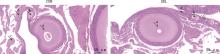
图1
蛋鸡卵巢组织结构观察(HE染色)a,成熟卵泡;b,次级卵泡;c,初级卵泡;d,颗粒细胞"

表4
蛋鸡卵巢卵泡计数结果 (枚)"
项目 Items | 组别 Groups | P值 P-value | |
|---|---|---|---|
| CON | SEL | ||
| 排卵前卵泡 POF | 5.75±0.71 | 5.86±0.69 | 0.772 |
| 小白卵泡 SWF | 8.25±2.96 | 13.71±4.57 | 0.016 |
| 大白卵泡 LWF | 12.38±4.78 | 8.86±2.54 | 0.106 |
| 小黄卵泡 SYF | 5.75±2.66 | 7.00±2.58 | 0.374 |
| 大黄卵泡 LYF | 4.63±3.11 | 5.14±2.85 | 0.744 |
| 卵泡总数 Total number of follicles | 36.75±8.94 | 40.57±10.50 | 0.460 |
表5
蛋鸡卵巢激素水平检测"
激素 Hormone | 组别 Groups | P值 P-value | |
|---|---|---|---|
| CON | SEL | ||
| 促黄体生成素 LH/(mIU/mL) | 4.22±1.66 | 3.36±2.59 | 0.463 |
| 孕激素 PROG/(ng/mL) | 2.69±0.03 | 2.72±0.02 | 0.058 |
| 促卵泡激素 FSH/(mIU/mL) | 1.53±0.01 | 1.60±0.05 | 0.001 |
| 雌二醇 E2/(ng/L) | 1.84±0.01 | 1.85±0.01 | 0.019 |
| 抗缪勒管激素 AMH/(ng/L) | 0.03±0.01 | 0.03±0.01 | 0.664 |
表6
蛋鸡卵巢组织中抗氧化及炎症相关基因相对表达量"
基因 Genes | 组别 Groups | P值 | |
|---|---|---|---|
| CON | SEL | P-value | |
| GPX1 | 1.06±0.42 | 0.85±0.36 | 0.368 |
| GPX3 | 1.10±0.48 | 0.91±0.53 | 0.531 |
| GPX4 | 1.08±0.41 | 1.05±0.34 | 0.915 |
| CAT | 1.01±0.19 | 1.12±0.34 | 0.533 |
| SOD1 | 1.00±0.10 | 1.18±0.32 | 0.239 |
| TXNRD1 | 1.03±0.29 | 0.84±0.50 | 0.433 |
| TXNRD2 | 1.19±0.66 | 1.83±0.91 | 0.196 |
| TXNRD3 | 1.16±0.69 | 1.97±1.17 | 0.173 |
| IL-1β | 0.74±0.33 | 0.47±0.30 | 0.196 |
| IL-6 | 0.78±0.37 | 0.57±0.54 | 0.493 |
| IL-10 | 1.07±0.39 | 0.84±0.25 | 0.263 |
| TNFAIP3 | 1.02±0.22 | 0.75±0.27 | 0.084 |
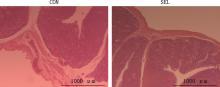
图2
蛋鸡输卵管组织形态观察(HE染色)"
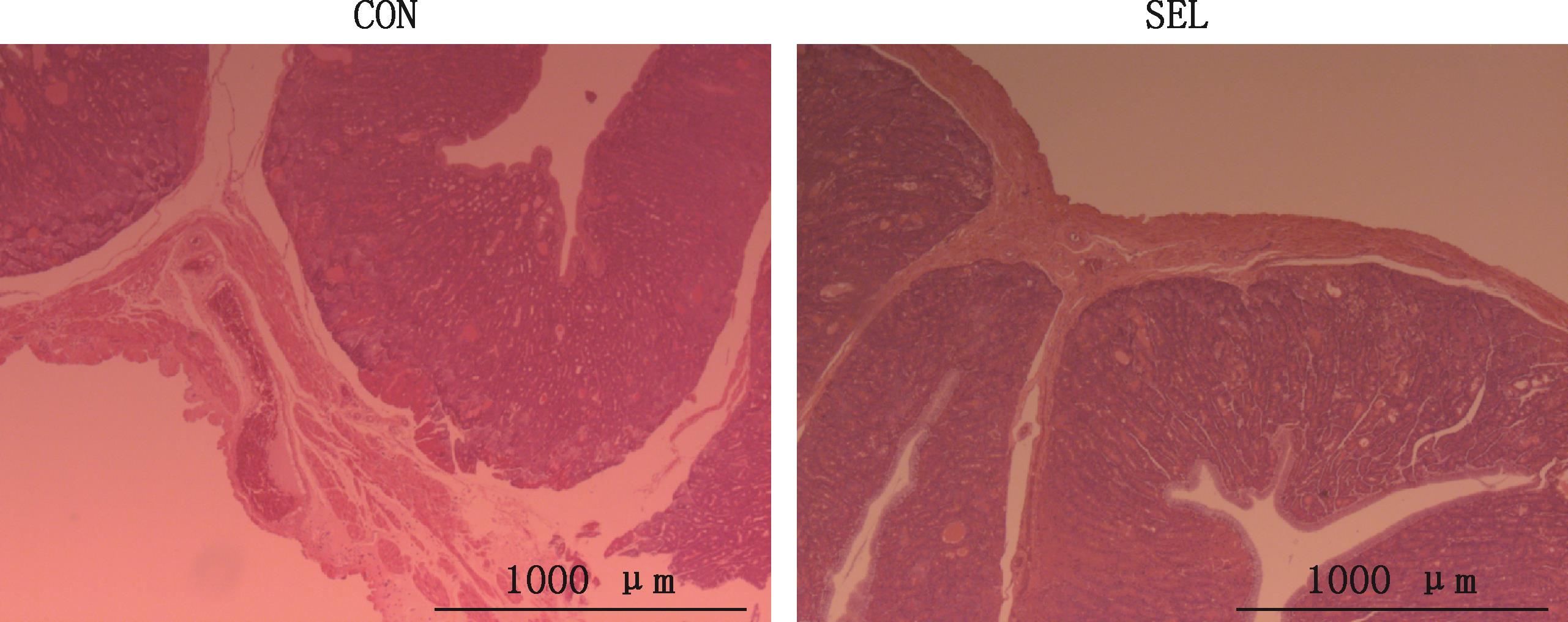
表7
蛋鸡输卵管组织中抗氧化及炎症相关基因表达量"
基因 Genes | 组别 Groups | P值 | |
|---|---|---|---|
| CON | SEL | P-value | |
| GPX1 | 1.07±0.41 | 2.22±0.73 | 0.007 |
| GPX3 | 1.25±0.82 | 1.82±0.71 | 0.394 |
| GPX4 | 1.13±0.57 | 2.44±0.49 | 0.009 |
| CAT | 1.29±0.99 | 2.57±0.62 | 0.023 |
| SOD1 | 1.13±0.58 | 2.25±0.39 | 0.003 |
| TXNRD1 | 1.02±0.20 | 1.35±0.48 | 0.240 |
| TXNRD2 | 1.34±0.98 | 2.81±0.61 | 0.011 |
| TXNRD3 | 1.29±0.92 | 2.92±1.08 | 0.018 |
| IL-1β | 1.08±0.45 | 1.49±0.43 | 0.132 |
| IL-6 | 1.09±0.47 | 1.68±0.34 | 0.032 |
| IL-10 | 1.15±0.61 | 2.12±1.32 | 0.134 |
| TNFAIP3 | 1.17±0.69 | 2.49±0.62 | 0.006 |
| [1] | HOU Q, LI G, PAN X, et al. Long-term supplementation of genistein improves immune homeostasis in the aged gut and extends the laying cycle of aged laying hens[J]. Poultry Science,2024,103(6):103670. |
| [2] | FRANCESCHI C, CAPRI M, MONTI D, et al. Inflammaging and anti-inflammaging: A systemic perspective on aging and longevity emerged from studies in humans[J]. Mechanisms of Ageing and Development,2007,128(1):92-105. |
| [3] | WU Y, ZHOU S, ZHAO A, et al. Protective effect of rutin on ferroptosis-induced oxidative stress in aging laying hens through Nrf2/HO-1 signaling[J]. Cell Biology International,2023,47(3):598-611. |
| [4] | PARK S U, WALSH L, BERKOWITZ K M, et al. Mechanisms of ovarian aging[J]. Reproduction,2021,162(2):R19-R33. |
| [5] | MARTEL J, OJCIUS D M, KO Y F, et al. Hormetic effects of phytochemicals on health and longevity[J]. Trends in Endocrinology & Metabolism,2019,30(6):335-346. |
| [6] | MARZEC A, DAMAZIAK K, KOWALSKA H, et al. Effect of hens age and storage time on functional and physiochemical properties of eggs[J]. Journal of Applied Poultry Research,2019,28(2):290-300. |
| [7] | GLOUX A, LE ROY N, MÊME N, et al. Increased expression of fibroblast growth factor 23 is the signature of a deteriorated Ca/P balance in ageing laying hens[J]. Scientific Reports,2020,10(1):21124. |
| [8] | ZHANG J C, CHEN P, ZHANG C, et al. Yeast culture promotes the production of aged laying hens by improving intestinal digestive enzyme activities and the intestinal health status[J].Poultry Science,2020,99(4):2026-2032. |
| [9] | HAN Q, GUO Y, ZHANG B, et al. Effects of dietary zinc on performance, zinc transporters expression, and immune response of aged laying hens[J]. Biological Trace Element Research,2020,196(1):231-242. |
| [10] | ABDOLLAHI A, KARIMI A, SADEGHI A, et al. The effects of the fiber source and xylanase supplementation on production, egg quality, digestibility, and intestinal morphology in the aged laying hen[J]. Poultry Science,2020,100(3):100936. |
| [11] | WANG J, WANG W W, QI G H, et al. Effects of dietary Bacillus subtilis supplementation and calcium levels on performance and eggshell quality of laying hens in the late phase of production[J]. Poultry Science,2020,100(3):100970. |
| [12] | LÓPEZ OTÍN C, GALLUZZI L, FREIJE J M P, et al. Metabolic control of longevity[J]. Cell,2016,166(4):802-821. |
| [13] | RAYMAN M P. Food-chain selenium and human health: Emphasis on intake[J]. British Journal of Nutrition,2008,100(2):254-268. |
| [14] | QAZI I, CAO Y, YANG H, et al. Impact of dietary selenium on modulation of expression of several non-selenoprotein genes related to key ovarian functions, female fertility, and proteostasis: A transcriptome-based analysis of the aging mice ovaries[J]. Biological Trace Element Research,2021,199(2):633-648. |
| [15] | JOHNSON C C, FORDYCE F M, RAYMAN M. Symposium on ‘Geographical and geological influences on nutrition’ factors controlling the distribution of selenium in the environment and their impact on health and nutrition: Conference on ‘Over- and undernutrition: Challenges and approaches’[J]. Proceedings of the Nutrition Society,2010,69(1):119-132. |
| [16] | AVENDAÑO R, CHAVES N, FUENTES P, et al. Production of selenium nanoparticles in Pseudomonas putida KT2440[J]. Scientific Reports,2016,6(1):37155. |
| [17] | ALZATE A, PÉREZ CONDE M C, GUTIÉRREZ A M, et al. Selenium-enriched fermented milk: A suitable dairy product to improve selenium intake in humans[J]. International Dairy Journal,2010,20(11):761-769. |
| [18] | HANDA E, PUSPITASARI I M, ABDULAH R, et al. Recent advances in clinical studies of selenium supplementation in radiotherapy[J]. Journal of Trace Elements in Medicine and Biology,2020,62:126653. |
| [19] | LI Y, MU T, LI R, et al. Effects of different selenium sources and levels on the physiological state, selenoprotein expression, and production and preservation of selenium-enriched eggs in laying hens[J]. Poultry Science,2024,103(2):103347. |
| [20] | SHANG X, YU P, YIN Y, et al. Effect of selenium-rich Bacillus subtilis against mercury-induced intestinal damage repair and oxidative stress in common carp[J]. Comparative Biochemistry and Physiology Part C: Toxicology & Pharmacology,2021,239:108851. |
| [21] | LIN Y, REN Y, ZHANG Y, et al. Protective role of nano-selenium-enriched Bifidobacterium longum in delaying the onset of streptozotocin-induced diabetes[J]. Royal Society Open Science,2018,5(12):181156. |
| [22] | YAZDI M H, MAHDAVI M, KHERADMAND E, et al. The preventive oral supplementation of a selenium nanoparticle-enriched probiotic increases the immune response and lifespan of 4T1 breast cancer bearing mice[J]. Arzneimittelforschung,2012,62(11):525-531. |
| [23] | WANG B, ZHAO N, LI J, et al. Selenium-enriched Lactobacillus plantarum improves the antioxidant activity and flavor properties of fermented Pleurotus eryngii [J]. Food Chemistry,2021,345:128770. |
| [24] | SONG Y, ZHANG J, LI Y, et al. Potential protective effect of selenium-enriched Lactobacillus plantarum on cadmium-induced liver injury in mice[J]. Journal of Microbiology and Biotechnology,2024,34(6):1328-1339. |
| [25] | ZHANG L, ZHOU J, OBIANWUNA U, et al. Optimizing selenium-enriched yeast supplementation in laying hens: Enhancing egg quality, selenium concentration in eggs, antioxidant defense, and liver health[J]. Poultry Science,2024,104(1):104584. |
| [26] | 周帅帅, 刘家言, 赵鹏宇,等.槲皮万寿菊素对产蛋后期蛋鸡生产性能、蛋品质、抗氧化和脂质沉积的影响[J]. 中国饲料,2023,21:27-35. |
| ZHOU S S, LIU J Y, ZHAO P Y, et al. Effects of quercetagetin on production performance, egg quality, antioxidation and lipid deposition in laying hens during the late laying stage[J]. China Feed,2023,21:27-35.(in Chinese) | |
| [27] | WANG H, CONG X, QIN K, et al. Se-enriched cardamine violifolia improves laying performance and regulates ovarian antioxidative function in aging laying hens[J]. Antioxidants,2023,12(2):450. |
| [28] | PAN C, HUANG K, ZHAO Y, et al. Effect of selenium source and level in hen’s diet on tissue selenium deposition and egg selenium concentrations[J]. Journal of Agricultural and Food Chemistry,2007,55(3):1027-1032. |
| [29] | QU W, YANG J, SUN Z, et al. Effect of selenium nanoparticles on antioxidative level, egg production and quality and blood parameter of laying hens exposed to deoxynivalenol[J]. Journal of Animal Research & Nutrition,2017,2(1).Doi:10.2176/2572-5459.100021 . |
| [30] | CRUZ G, FERNANDOIS D, PAREDES A H. Ovarian function and reproductive senescence in the rat: Role of ovarian sympathetic innervation[J]. Reproduction,2017,153(2):R59-R68. |
| [31] | COSTELLO M F, SHRESTHA B, EDEN J, et al. Metformin versus oral contraceptive pill in polycystic ovary syndrome: A cochrane review[J]. Human Reproduction,2007,22(5):1200-1209. |
| [32] | AYERS K L, SINCLAIR A H, SMITH C A. The molecular genetics of ovarian differentiation in the avian model[J]. Sexual Development,2012,7(1-3):80-94. |
| [33] | SAFIYEH F D, MOJGAN M, PARVIZ S, et al. The effect of selenium and vitamin E supplementation on anti-Mullerian hormone and antral follicle count in infertile women with occult premature ovarian insufficiency:A randomized controlled clinical trial[J]. Complementary Therapies in Medicine,2021,56:102533. |
| [34] | XU S, DONG Y, CHEN S, et al. 2-hydroxy-4-methylselenobutanoic acid promotes follicle development by antioxidant pathway[J]. Frontiers in Nutrition,2022,9:2296-861X. |
| [35] | HAO E Y, WANG D H, CHANG L Y, et al. Melatonin regulates chicken granulosa cell proliferation and apoptosis by activating the mTOR signaling pathway via its receptors[J]. Poultry Science,2020,99(11):6147-6162. |
| [36] | SILVA ISLAS C A, MALDONADO P D. Canonical and non-canonical mechanisms of Nrf2 activation[J]. Pharmacological Research,2018,134:92-99. |
| [37] | TOKMAK A, YILDIRIM G, SARIKAYA E, et al. Increased oxidative stress markers may be a promising indicator of risk for primary ovarian insufficiency: A cross-sectional case control study[J]. Revista Brasileira de Ginecologia e Obstetrićia: Revista da Federação Brasileira das Sociedades de Ginecologia e Obstetrícia,2015,37(9):411-416. |
| [38] | YANG H, QAZI I H, PAN B, et al. Dietary selenium supplementation ameliorates female reproductive efficiency in aging mice[J]. Antioxidants,2019,8(12):634. |
| [39] | BEILSTEIN M A, WHANGER P D. Glutathione peroxidase activity and chemical forms of selenium in tissues of rats given selenite or selenomethionine[J]. Journal of Inorganic Biochemistry,1988,33(1):31-46. |
| [40] | BRENNAN K M, CROWDUS C A, CANTOR A H, et al. Effects of organic and inorganic dietary selenium supplementation on gene expression profiles in oviduct tissue from broiler-breeder hens[J]. Animal Reproduction Science,2011,125(1):180-188. |
| [41] | JIANG X, DONG J, WANG B, et al. Effects of organic selenium supplement on glutathione peroxidase activities: A Meta-analysis of randomized controlled trials[J]. Aquaculture,2012,41(1):120-123. |
| [42] | MENG T, LIU Y L, XIE C Y, et al. Effects of different selenium sources on laying performance, egg selenium concentration, and antioxidant capacity in laying hens[J]. Biological Trace Element Research,2019,189(2):548-555. |
| [43] | KHAN A, KHAN I, KHAN S, et al. Selenium-enriched probiotics improve hepatic protection by regulating pro-inflammatory cytokines and antioxidant capacity in broilers under heat stress conditions[J]. Journal of Advanced Veterinary and Animal Research,2019,6(3):355-361. |
| [44] | 刘兴廷. 衰老蛋鸡卵巢氧化应激缓解措施及其机理的研究[D].杭州:浙江大学,2018. |
| LIU X T. Attenuation of the oxidative stress in the ovaries of the aging laying chicken[D].Hangzhou;Zhejiang Universitity,2018.(in Chinese) | |
| [45] | LIU Q, LI W, ZHANG J, et al. Lipoamide alleviates oxidized fish oil-induced host inflammatory response and oxidative damage in the oviduct of laying hens[J]. Frontiers in Veterinary Science,2022,9:875769. |
| [46] | DIVYASHREE S, YAJURVEDI H N. Chronic stress effects and their reversibility on the Fallopian tubes and uterus in rats[J]. Reproduction, Fertility and Development,2018,30(2):380-390. |
| [47] | VARGAS MENDOZA N, MORALES GONZÁLEZ Á, MORALES MARTÍNEZ M, et al. Flavolignans from silymarin as Nrf2 bioactivators and their therapeutic applications[J]. Biomedicines,2020,8(5):122. |
| [48] | YANG W S, SRIRAMARATNAM R, WELSCH M E, et al. Regulation of ferroptotic cancer cell death by GPX4[J]. Cell,2014,156(1):317-331. |
| [49] | ZHANG W, LIU Y, LIAO Y, et al.GPX4, ferroptosis, and diseases[J]. Biomedicine & Pharmacotherapy,2024,174:116512. |
| [50] | MUHAMMAD A I, MOHAMED D A, CHWEN L T, et al. Effect of sodium selenite, selenium yeast, and bacterial enriched protein on chicken egg yolk color, antioxidant profiles, and oxidative stability[J]. Foods,2021,10(4):871. |
| [51] | YANG Z, XIAN H, HU J, et al. USP18 negatively regulates NF-κB signaling by targeting TAK1 and NEMO for deubiquitination through distinct mechanisms[J]. Scientific Reports,2015,5(1):12738. |
| [1] | 郝志磊, 张红瑞, 马云. 不同来源油脂对蛋鸡产蛋性能、蛋品质及蛋黄脂肪酸组成的影响[J]. 中国畜牧兽医, 2026, 53(2): 703-710. |
| [2] | 邹英昊, 王勇, 孙丽华, 陈星, 王杰, 刘国华, 王坤, 郑爱娟, 郑树贵. 不同水平脂肪粉对海兰褐蛋鸡产蛋性能和蛋品质的影响[J]. 中国畜牧兽医, 2026, 53(1): 233-244. |
| [3] | 齐思超, 于浩霖, 张灵芝, 华裕平, 陈蕾晓, 王华南, 李剑. 蛋鸡肠黏膜损伤后抵御再次损伤的可能机制[J]. 中国畜牧兽医, 2026, 53(1): 427-438. |
| [4] | 刘慧莹, 高丽冰, 李晓敏, 李伟, 王秋菊, 王晶. 胆汁酸和复合精油对延养期蛋鸡产蛋性能和脂质代谢的影响[J]. 中国畜牧兽医, 2025, 52(9): 4105-4113. |
| [5] | 宋文静, 陈将, 熊平文, 宋琼莉, 艾高祥, 韦启鹏, 邹志恒, 陈小连. 山香圆叶提取物对脂多糖刺激肉鸡生长性能、免疫、抗氧化功能和肠道健康的影响[J]. 中国畜牧兽医, 2025, 52(9): 4123-4135. |
| [6] | 王宇艳, 李梦琳, 曹庆云, 周巧仪, 张兴月, 肖娅琪, 黄诗蕊, 张之盈, 胡铁生, 石达友. 发酵茶叶对强制换羽后蛋鸡产蛋性能的影响[J]. 中国畜牧兽医, 2025, 52(8): 3574-3583. |
| [7] | 巴弘历, 马宁. 枯草芽孢杆菌调控蛋鸡肠道健康的作用机制及应用研究进展[J]. 中国畜牧兽医, 2025, 52(8): 3976-3986. |
| [8] | 吕玲燕, 孙如玉, 林昌华, 张胜斌, 覃秀珍, 柏秀芳, 吴永绍, 陈钊, 刘磊, 张冰, 蒋家霞, 张家庆. 后备母猪发情期和乏情期下丘脑-垂体-卵巢性腺轴miRNA-mRNA表达谱比较分析[J]. 中国畜牧兽医, 2025, 52(7): 2965-2980. |
| [9] | 李伟, 黄巧艳, 王鑫昆, 谷若怀, 孙慧萍, 朱乐萧, 邢凤. 多浪羊LIN28A基因启动子区克隆、序列分析及蛋白表达研究[J]. 中国畜牧兽医, 2025, 52(7): 2992-3003. |
| [10] | 李嘉宁, 蒋志惠, 邢月腾, 马圣明. 饲粮中添加桉叶素对蛋鸡和鸡蛋抗氧化能力的影响[J]. 中国畜牧兽医, 2025, 52(7): 3016-3030. |
| [11] | 王贝贝, 郝二英, 张海华, 张海军, 邱凯, 武书庚. 饲粮中添加有机锰铁铜锌复合制剂对蛋鸡生产性能、血液生化指标、卵巢功能和胫骨质量的影响[J]. 中国畜牧兽医, 2025, 52(5): 2012-2022. |
| [12] | 兰忠岐, 李鹏, 沈爽, 蒋金凤, 秦鸿灯, 向钰婷, 王家乡. 饲粮中添加表皮生长因子对蛋鸡卵巢形态学、激素含量及凋亡因子表达的影响[J]. 中国畜牧兽医, 2025, 52(5): 2035-2044. |
| [13] | 赵娜, 王立中, 朱莲英, 蔡玉梅, 李爽, 李成会. 栗苞水提物对小鼠生长性能、脏器系数、抗氧化功能及组织结构的影响[J]. 中国畜牧兽医, 2025, 52(5): 2056-2065. |
| [14] | 王紫华, 游伟, 成海建, 胡鑫, 胡志勇, 宋恩亮, 姜富贵. 辣椒油树脂对育肥牛血清生化、免疫和抗氧化指标的影响[J]. 中国畜牧兽医, 2025, 52(2): 698-706. |
| [15] | 刘世雄, 李啸, 李薛强, 徐子萱, 李松建, 杜蕊, 薛晨, 刘大程. 复合菌培养物对蒙寒杂交肉羊生长性能、免疫功能及疫苗抗体效价的影响[J]. 中国畜牧兽医, 2025, 52(2): 718-729. |
| 阅读次数 | ||||||
|
全文 |
|
|||||
|
摘要 |
|
|||||
