
China Animal Husbandry & Veterinary Medicine ›› 2026, Vol. 53 ›› Issue (1): 190-200.doi: 10.16431/j.cnki.1671-7236.2026.01.017
• Nutrition and Feed • Previous Articles Next Articles
LIANG Haohui1,2( ), QIN Yao1,3, XIONG Pan1,2, CAO Junming2, CAI Jia1, HU Junru2, CHEN Xiaoying2, WANG Guoxia2()
Revised:2025-07-16
Online:2026-01-05
Published:2025-12-26
Contact:
WANG Guoxia
E-mail:2642663924@qq.com;wanggx78@126.com
CLC Number:
LIANG Haohui, QIN Yao, XIONG Pan, CAO Junming, CAI Jia, HU Junru, CHEN Xiaoying, WANG Guoxia. Study on Vitamin B6 Requirements of Juvenile Largemouth Bass (Micropterus salmoides)[J]. China Animal Husbandry & Veterinary Medicine, 2026, 53(1): 190-200.
Table 1
Composition and nutrient levels of the basal diet (DM basis)"
| 项目 Items | 含量 Contents |
|---|---|
| 组成 Ingredients | |
| 酶解鸡肉粉 Fermented chicken meal | 10.00 |
| 鱼粉 Peru fish meal | 32.00 |
| 南极磷虾粉 Antarctic krill meal | 10.00 |
| 玉米蛋白粉 Corn gluten meal | 10.00 |
| 发酵豆粕 Fermented soybean meal | 10.00 |
| 面粉 Wheat flour | 5.79 |
| 三藻胶 Alginates | 3.00 |
| 鱼油∶大豆卵磷脂(7∶8) Fish oil∶Soybean phospholipids (7∶8) | 15.00 |
| 蛋氨酸 Met | 0.96 |
| 预混料 Premix① | 3.25 |
| 合计 Total | 100.00 |
| 营养成分 Nutrient components② | |
| 总能 TE/(MJ/kg) | 20.69 |
| 粗蛋白质 CP | 49.84 |
| 粗脂肪 EE | 14.90 |
| 粗灰分 Ash | 11.08 |
Table 2
Growth performance and whole-body composition of juvenile largemouth bass (% wet weight)"
项目 Items | 组别 Groups | |||||
|---|---|---|---|---|---|---|
| P0 | P1 | P2 | P3 | P4 | P5 | |
初始体重 IBW/mg | 92.50±0.28 | 92.50±0.28 | 92.50±0.28 | 92.50±0.28 | 92.50±0.28 | 92.50±0.28 |
| 终末体重 FBW/g | 1.68±0.12ab | 1.83±0.08b | 1.54±0.09ab | 1.51±0.16ab | 1.47±0.00a | 1.48±0.02a |
| 增重率 WGR/% | 1 763.34±133.53ab | 1 929.95±90.16b | 1 605.86±99.32ab | 1 578.11±182.37ab | 1 537.35±3.50a | 1 540.22±22.13a |
特定生长率 SGR/(%/d) | 9.72±0.25ab | 10.03±0.14b | 9.44±0.19ab | 9.33±0.40ab | 9.32±0.01a | 9.32±0.05a |
| 饲料系数 FCR | 1.30±0.20 | 1.04±0.22 | 1.05±0.13 | 1.05±0.13 | 1.12±0.22 | 1.07±0.13 |
存活率 SR/% | 72.00±7.56 | 76.75±9.29 | 81.00±7.35 | 83.75±5.01 | 80.00±9.00 | 79.50±4.79 |
脏体比 VSI/% | 9.85±0.32 | 9.42±0.21 | 9.22±0.40 | 10.09±0.49 | 9.07±0.31 | 9.91±0.20 |
肥满度 CF/(g/cm3) | 1.87±0.03 | 1.88±0.03 | 1.90±0.04 | 1.90±0.03 | 1.83±0.03 | 1.89±0.03 |
| 水分Moisture/% | 78.87±0.31 | 78.44±0.61 | 79.46±0.58 | 78.74±0.58 | 79.01±0.38 | 78.15±0.10 |
| 粗蛋白质 CP/% | 13.05±0.20ab | 12.49±0.30ab | 12.13±0.66a | 12.55±0.17ab | 13.39±0.22b | 13.01±0.17ab |
| 粗脂肪 EE/% | 5.59±0.16b | 5.65±0.22b | 4.95±0.25ab | 5.40±0.20b | 4.48±0.32a | 5.07±0.14ab |
| 粗灰分 Ash% | 2.80±0.09 | 2.74±0.09 | 2.63±0.07 | 2.67±0.07 | 2.84±0.05 | 2.85±0.05 |
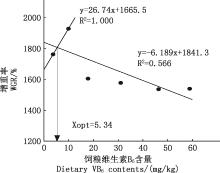
Fig.1
Broken-line regression model of weight gain rate in juvenile largemouth bass"
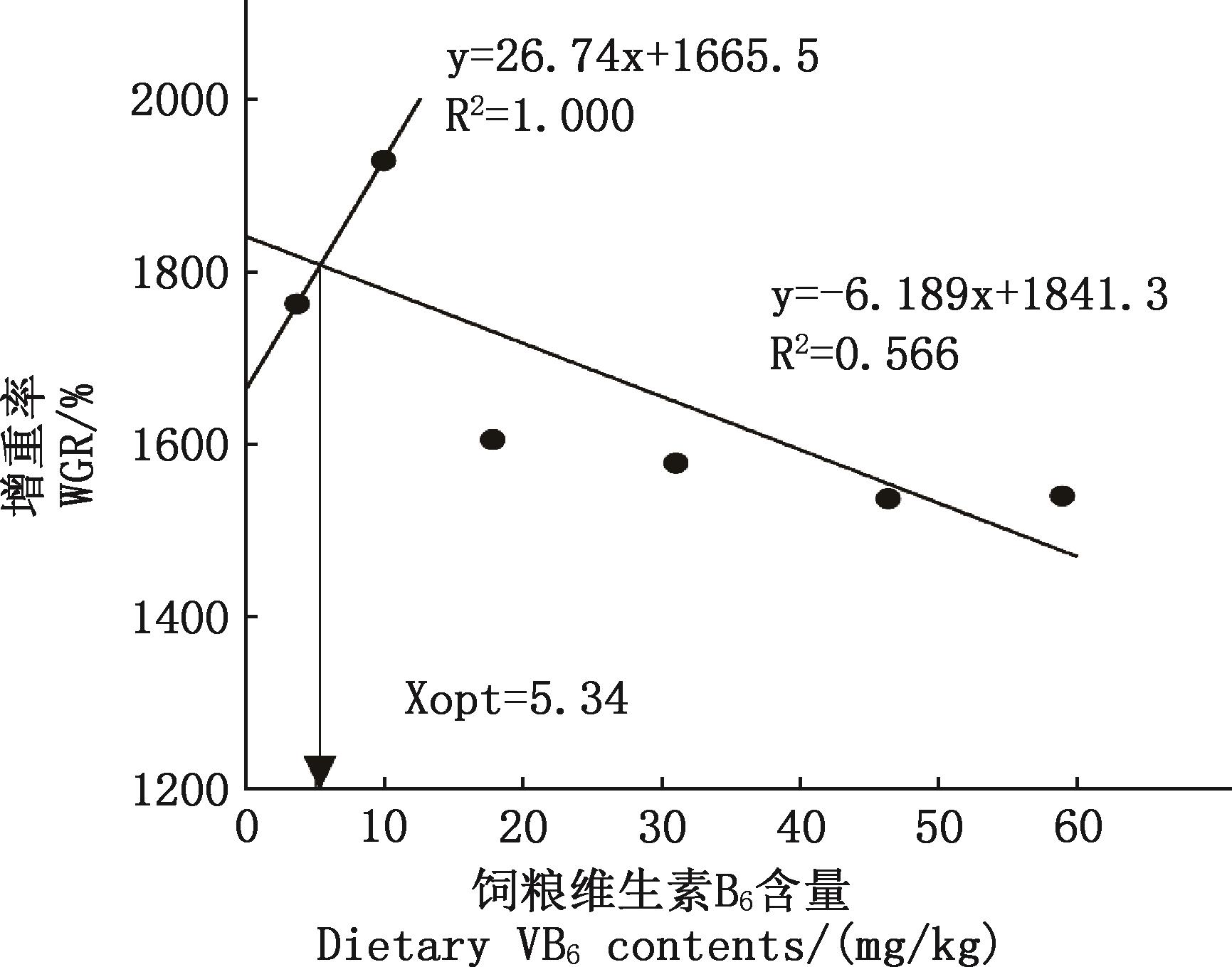
Table 3
Visceral biochemical indicators of juvenile largemouth bass"
项目 Items | 组别 Groups | |||||
|---|---|---|---|---|---|---|
| P0 | P1 | P2 | P3 | P4 | P5 | |
| 葡萄糖 GLU/(mmol/g prot) | 15.94±4.64 | 23.58±3.86 | 15.48±1.36 | 19.54±4.17 | 17.36±5.0 | 16.84±3.53 |
| 甘油三酯 TG/(mmol/g prot) | 0.02±0.00 | 0.03±0.00 | 0.03±0.00 | 0.03±0.00 | 0.03±0.00 | 0.02±0.0 |
| 谷丙转氨酶 ALT/(U/g prot) | 6.26±0.77 | 4.06±0.41 | 4.89±0.79 | 5.17±0.45 | 5.03±0.94 | 4.81±0.21 |
| 谷草转氨酶 AST/(U/g prot) | 2.34±0.11a | 4.66±1.15ab | 4.84±1.04ab | 5.07±0.3ab | 6.19±1.64bc | 8.67±1.04c |
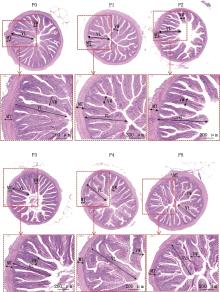
Fig.2
Microstructure of the intestinal tract in juvenile largemouth bassVL, Villus length;VW, Villus width;MT, Muscular thickness"

Table 4
Determination results of intestinal morphology indicators of juvenile largemouth bass"
项目 Items | 组别 Groups | |||||
|---|---|---|---|---|---|---|
| P0 | P1 | P2 | P3 | P4 | P5 | |
| 绒毛宽度 Villus width | 61.60±3.76 | 58.57±9.26 | 58.75±5.40 | 63.41±3.77 | 71.55±2.43 | 70.43±6.21 |
| 绒毛长度 Villus length | 316.77±53.88 | 278.26±12.81 | 265.40±13.44 | 264.77±32.51 | 253.14±47.32 | 294.36±17.06 |
| 肌层厚度 Muscular thickness | 64.66±5.41b | 55.27±2.69ab | 46.50±6.66a | 41.66±4.16a | 48.73±6.26ab | 45.82±3.66a |
Table 5
Digestive enzyme activities in juvenile largemouth bass"
项目 Items | 组别 Groups | |||||
|---|---|---|---|---|---|---|
| P0 | P1 | P2 | P3 | P4 | P5 | |
胰蛋白酶 Protease/ (U/mg prot) | 4 615.15±625.94c | 4 349.98±217.62bc | 3 643.25±642.74abc | 2 945.1±710.64abc | 2 323.38±326.7a | 2 761.96±326.6ab |
脂肪酶 Lipase/ (U/g prot) | 271.90±13.05a | 450.97±21.64b | 223.21±57.64a | 194.62±34.06a | 238.66±46.68a | 230.81±52.29a |
α-淀粉酶 α-amylase/ (U/mg prot) | 0.16±0.03b | 0.12±0.01ab | 0.11±0.01ab | 0.12±0.02ab | 0.08±0.01a | 0.09±0.01a |
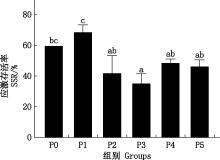
Fig.3
Post-air-exposure stress survival rate of juvenile largemouth bassValues with different letter superscripts mean significant difference (P<0.05);While with the same letter superscripts mean no significant difference (P>0.05)"
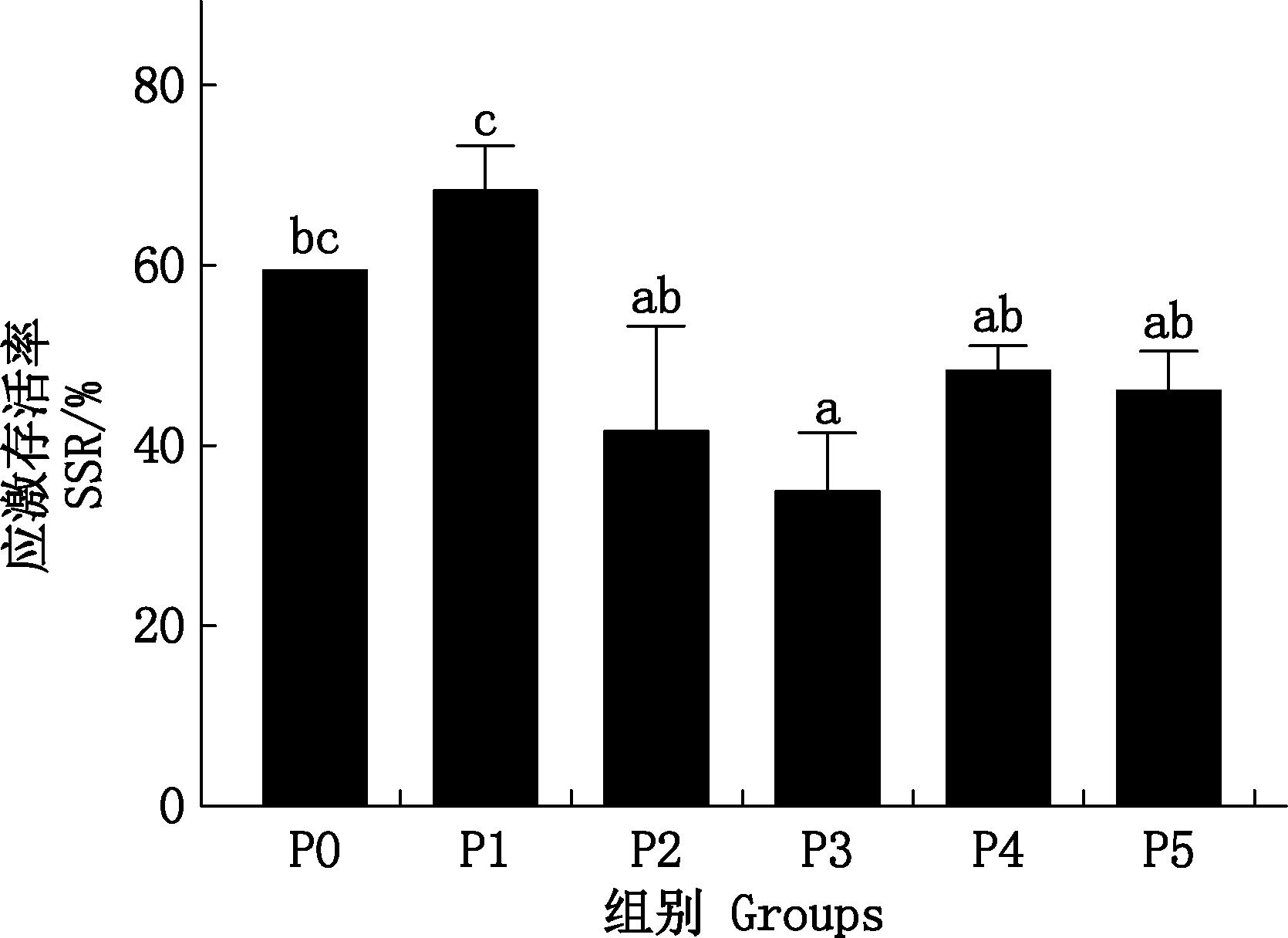
Table 6
Determination results of antioxidant indicators in juvenile largemouth bass pre- and post-air-exposure stress"
项目 Items | 组别 Groups | |||||
|---|---|---|---|---|---|---|
| P0 | P1 | P2 | P3 | P4 | P5 | |
| 胁迫前 Pre-air-exposure | ||||||
总超氧化物歧 化酶 T-SOD/ (U/mg prot) | 105.12±29.29b | 81.12±14.37ab | 74.75±10.96ab | 68.04±8.54ab | 41.53±16.72a | 65.44±4.40ab |
过氧化氢酶 CAT/ (U/mg prot) | 0.53±0.09b | 0.43±0.02ab | 0.38±0.02ab | 0.45±0.07ab | 0.30±0.04a | 0.40±0.02ab |
丙二醛 MDA/ (nmol/mg prot) | 8.20±1.09 | 8.89±1.63 | 6.34±0.39 | 7.07±0.72 | 6.42±0.75 | 6.79±0.55 |
碱性磷酸酶 AKP/ (U/mg prot) | 52.81±8.05 | 49.09±2.28 | 44.31±5.09 | 48.10±4.99 | 37.89±5.59 | 51.20±5.89 |
| 胁迫后 Post-air-exposure | ||||||
总超氧化物歧 化酶 T-SOD / (U/mg prot) | 199.73±16.23b* | 205.18±20.50b* | 153.02±1.02a* | 154.68±6.37a* | 157.24±3.65a* | 150.07±17.47a* |
过氧化氢酶 CAT/ (U/mg prot) | 1.20±0.08b* | 1.01±0.08ab* | 0.76±0.06a* | 0.77±0.19a | 0.77±0.17a | 0.65±0.13a |
丙二醛 MDA/ (nmol/mg prot) | 26.58±1.56b* | 22.58±3.96ab* | 18.95±0.59ab* | 16.84±1.93a* | 18.77±0.28ab* | 19.21±3.27ab* |
碱性磷酸酶 AKP/ (U/mg prot) | 20.49±1.57* | 22.95±5.20* | 17.15±3.08* | 31.63±11.39 | 26.21±0.66 | 18.20±3.14* |
| [1] | 朱婷婷, 金敏, 孙蓬, 等. 饲料脂肪水平对大口黑鲈形体指标、组织脂肪酸组成、血清生化指标及肝脏抗氧化性能的影响[J]. 动物营养学报, 2018, 30(1): 126-137. |
| ZHU T T, JIN M, SUN P, et al. Effects of dietary lipid level on morphology indexes, tissue fatty acid composition, serum biochemical indexes and liver antioxidant indexes of largemouth bass (Micropterus salmoides)[J].Chinese Journal of Animal Nutrition, 2018, 30(1): 126-137.(in Chinese) | |
| [2] | 石琼, 范明君, 张勇. 中国经济鱼类志[M]. 武汉: 华中科技大学出版社, 2015. |
| SHI Q, FAN M J, ZHANG Y. Economically Important Fish in China[M]. Wuhan: Huazhong University of Science and Technology Press, 2015.(in Chinese) | |
| [3] | COUTANT C C, DEANGELIS D L. Comparative temperature-dependent growth rates of largemouth and smallmouth bass fry[J]. Transactions of the American Fisheries Society, 1983, 112(3): 416-423. |
| [4] | 吴凡, 任春, 文华, 等. 吉富罗非鱼对饲料中维生素B6的需要量[J]. 动物营养学报, 2018, 30(5): 1781-1788. |
| WU F, REN C, WEN H, et al. Dietary vitamin B6 requirement of genetically improved farmed tilapia (Oreochromis niloticus)[J]. Chinese Journal of Animal Nutrition, 2018, 30(5): 1781-1788.(in Chinese) | |
| [5] | ZEHRA S, KHAN M A. Dietary pyridoxine requirement of fingerling Channa punctatus (Bloch) based on growth performance, liver pyridoxine concentration, and carcass composition[J]. Journal of Applied Aquaculture, 2018, 30(3): 238-255. |
| [6] | HUANG Q, LIN H, WANG R, et al. Effect of dietary vitamin B6 supplementation on growth and intestinal microflora of juvenile golden pompano (Trachinotus ovatus)[J]. Aquaculture Research, 2019, 50(9): 2359-2370. |
| [7] | 周莹. 许氏平鲉幼鱼对维生素B1和维生素B6需求的研究[D]. 上海:上海海洋大学, 2020. |
| ZHOU Y. Dietary vitamin B1 and vitamin B6 requirements of juvenile rockfish (Sebastes schlegeli)[D]. Shanghai:Shanghai Ocean University, 2020.(in Chinese) | |
| [8] | LI P, HOU D, ZHAO H, et al. Dietary pyridoxine effect on growth performance, physiological metabolic parameters, intestinal enzymatic activities and antioxidant status of juvenile yellow catfish (Pelteobagrus fulvidraco)[J]. Aquaculture Reports, 2022, 24: 101153. |
| [9] | 张春晓. 大黄鱼、鲈鱼主要B族维生素和矿物质—磷的营养生理研究[D]. 青岛:中国海洋大学, 2006. |
| ZHANG C X.Studies on nutritional physiology of major B vitamins and mineral-phosphorus for Large Yellow croaker, Pseudosciaena crocea R. and Japanese seabass,Lateolabrax japonicus[D]. Qingdao:Ocean University of China, 2006.(in Chinese) | |
| [10] | 王莹, 李向飞, 张微微, 等. 团头鲂幼鱼吡哆醇适宜需求量的研究[J]. 水生生物学报, 2013, 37(4): 632-639. |
| WANG Y, LI X F, ZHANG W W, et al. Optimal dietary pyridoxine requirement of juvenile blunt snout bream, Megalobrama amblycephala [J]. Acta Hydrobiologica Sinica, 2013, 37(4): 632-639.(in Chinese) | |
| [11] | ADRON J W, KNOX D, COWEY C B, et al. Studies on the nutrition of marine flatfish. The pyridoxine requirement of turbot (Scophthalmus maximus)[J]. British Journal of Nutrition, 1978, 40(2): 261-268. |
| [12] | HUANG J W, TIAN L X, DU Z Y, et al. Pyridoxine deficiency of grouper, Epinephelus coioides: Physiological and biochemical alteration[J]. Fish Physiology and Biochemistry, 2005, 31: 331-337. |
| [13] | ZHENG X, FENG L, JIANG W, et al. Dietary pyridoxine deficiency reduced growth performance and impaired intestinal immune function associated with TOR and NF-κB signalling of young grass carp (Ctenopharyngodon idella)[J]. Fish & Shellfish Immunology, 2017, 70: 682-700. |
| [14] | 黄世蕉, 沈竑. 维生素B6对草鱼脂肪代谢的影响[J]. 水生生物学报, 1992,4: 313-321. |
| HUANG S J, SHEN H. The effect of vitamine B6 on the lipid metabolism of grass carp (Ctenopharyngodon idella)[J]. Acta Hydrobiologica Sinica, 1992, 4: 313-321.(in Chinese) | |
| [15] | 王锦林, 朱晓鸣, 雷武, 等. 异育银鲫幼鱼对饲料中维生素B6需求量的研究[J]. 水生生物学报, 2011, 35(1): 98-104. |
| WANG J L, ZHU X M, LEI W, et al. Dietary vitamin B6 requirement of juvenile gibel carp, Carassius auratus gibelio [J]. Acta Hydrobiologica Sinica, 2011, 35(1): 98-104.(in Chinese) | |
| [16] | HOSOKAWA H, TERAOKA R, SAITO Y, et al. Dietary pyridoxine requirement of fingerling yellow tail[J]. Aquaculture Science, 1992, 40(2): 215-220. |
| [17] | KHAN Y M, KHAN M A. Optimization of dietary pyridoxine improved growth performance, hematological indices, antioxidant capacity, intestinal enzyme activity, non-specific immune response, and liver pyridoxine concentration of fingerling major carp Catla catla (Hamilton)[J]. Aquaculture, 2021, 541: 736815. |
| [18] | BAKER R, DAVIES S J. The effect of pyridoxine supplementation on dietary protein utilization in gilthead seabream fry[J]. Animal Science, 1995, 60(1): 157-162. |
| [19] | ZEHRA S, KHAN M A. Dietary thiamin and pyridoxine requirements of fingerling Indian major carp, Cirrhinus mrigala (Hamilton)[J]. Aquaculture Research, 2017, 48(9): 4945-4957. |
| [20] | SHIAU S, HSIEH H. Vitamin B6 requirements of tilapia Oreochromis niloticus×O. aureus fed two dietary protein concentrations[J]. Fisheries Science, 1997, 63(6): 1002-1007. |
| [21] | MOHAMED J S. Dietary pyridoxine requirement of the Indian catfish, Heteropneustes fossilis [J]. Aquaculture, 2001, 194(3-4): 327-335. |
| [22] | 何伟. 吡哆醇对幼建鲤消化吸收能力和免疫能力的影响[D]. 雅安:四川农业大学, 2008. |
| HE W. Effects of dietary pyridoxine on digestive and immune ability of juvenile jian carp (Cyprinus carpio Var.Jian)[D]. Ya’an: Sichuan Agricultural University, 2008.(in Chinese) | |
| [23] | 荣华, 谢雨晴, 赵涛, 等. 四种不同食性鱼类肠道微生物群落组成及多样性比较分析[J]. 渔业科学进展, 2024, 45(4):75-85. |
| RONG H, XIE Y Q, ZHAO T, et al. Comparative analysis of the composition and diversity of the intestinal microflora of four fishes with different feeding habits[J]. Progress in Fishery Sciences, 2024, 45(4):75-85.(in Chinese) | |
| [24] | 邢浩春, 李同庆, 杜利强, 等. 维生素B6对史氏鲟幼鱼胰蛋白酶活性的影响[J]. 水生态学杂志, 2011, 32(4): 121-124. |
| XING H C, LI T Q, DU L Q, et al.Effect of dietary vitamin B6 on trypsin activity for juvenile Acipenser schrencki [J]. Journal of Hydroecology, 2011, 32(4): 121-124.(in Chinese) | |
| [25] | BOAVENTURA T P, SOUZA C F, FERREIRA A L, et al. The use of Ocimum gratissimum L. essential oil during the transport of Lophiosilurus alexandri: Water quality, hematology, blood biochemistry and oxidative stress[J]. Aquaculture, 2021, 531: 735964. |
| [26] | 王红权. 基于GCRV抗性提高的草鱼免疫特性分析[D]. 长沙:湖南农业大学, 2014. |
| WANG H Q.Immune characteristics of grass carp (Ctenopharyngodon idellus) to improve the resistance of GCRV[D]. Changsha: Hunan Agricultural University, 2014.(in Chinese) | |
| [27] | CAO L, HUANG W, LIU J, et al. Accumulation and oxidative stress biomarkers in Japanese flounder larvae and juveniles under chronic cadmium exposure[J]. Comparative Biochemistry and Physiology Part C: Toxicology & Pharmacology, 2010, 151(3): 386-392. |
| [28] | 翟晓虎, 杨海锋, 陈慧英, 等. 丙二醛的毒性作用及检测技术研究进展[J]. 上海农业学报, 2018, 34(1): 144-148. |
| ZHAI X H, YANG H F, CHEN H Y, et al. Research progress in the toxicity and determination technology of malondialdehyde[J]. Acta Agriculturae Shanghai, 2018, 34(1): 144-148.(in Chinese) | |
| [29] | 姚仕彬, 叶元土, 蔡春芳, 等. 丙二醛对离体草鱼肠道黏膜细胞的损伤作用[J]. 水生生物学报, 2015, 39(1): 133-141. |
| YAO S B, YE Y T, CAI C F, et al. Damage of mda on intestinal epithelial cells in vitro of grass carp (Ctenopharyngodon idella)[J]. Acta Hydrobiologica Sinica, 2015, 39(1): 133-141.(in Chinese) | |
| [30] | 王红权, 李瑞, 金柏涛, 等. 饲料中添加核苷酸对草鱼生长性能、体成分及血清生化指标的影响[J]. 动物营养学报, 2019, 31(6): 2745-2751. |
| WANG H Q, LI R, JIN B T, et al. Effects of dietary nucleotides on growth performance, body composition and serum biochemical parameters of grass carp (Ctenopharyngodon idella)[J]. Chinese Journal of Animal Nutrition, 2019, 31(6): 2745-2751.(in Chinese) | |
| [31] | 程民杰, 黄亚东, 徐文敏, 等. 离水操作胁迫对红鳍东方鲀血清生化指标的影响[J]. 水产科学, 2015, 34(4): 227-231. |
| CHENG M J, HUANG Y D, XU W M, et al. Effects of handling stress out of water on serum parameters in tiger puffer Takifugu rubripes [J]. Fisheries Science,2015, 34(4): 227-231.(in Chinese) | |
| [32] | WAN J, GE X, LIU B, et al. Effect of dietary vitamin C on non-specific immunity and mRNA expression of three heat shock proteins (HSPs) in juvenile Megalobrama amblycephala under pH stress[J]. Aquaculture, 2014, 434: 325-333. |
| [33] | 孙敬诚, 李潇, 鲁康乐, 等. 饲料维生素C对急性降温后花鲈免疫、抗氧化及抗应激的影响[J]. 渔业科学进展, 2021, 42(4): 126-133. |
| SUN J C, LI X, LU K L, et al. Effects of dietary vitamin C on the immune, antioxidant capacity, and stress tolerance of spotted seabass (Lateolabrax maculatus) after acute cooling[J]. Progress in Fishery Sciences, 2021, 42(4): 126-133.(in Chinese) | |
| [34] | KUMAR N, AMBASANKAR K, KRISHNANI K K, et al. Dietary pyridoxine promotes growth and cellular metabolic plasticity of Chanos chanos fingerlings exposed to endosulfan induced stress[J]. Aquaculture Research, 2017, 48(5): 2074-2087. |
| [35] | 黄晓玲. 凡纳滨对虾幼虾对硫胺素、泛酸、维生素B6和肌醇需要量的研究[D]. 宁波:宁波大学, 2014. |
| HUANG X L. Study on the requirements of thaimin, pantothenic acid, vitamin B6 and inositol for juvenile pacific white shrimp, Litopenaeus vannamei [D]. Ningbo: Ningbo University, 2014.(in Chinese) |
| [1] | WANG Chenjun, YU Hongji, ZHAO Jing, WANG Yunzhao, YIN Xintong, WANG Di, WU Yingjie, LIU Ning, QIN Yinghe. Effects of Dietary Quercetagetin on Reproductive Performance of Female Rabbits and Growth of Offspring [J]. China Animal Husbandry & Veterinary Medicine, 2026, 53(2): 639-647. |
| [2] | ZHANG Zhiying, HU Xiaodi, PENG Su, ZHANG Xingyue, SHE Peining, HUANG Xiaojie, SHI Dayou. Effects of LPS on the Growth Performance, Serum Biochemistry and Intestinal Health of Mahuang Chickens [J]. China Animal Husbandry & Veterinary Medicine, 2026, 53(2): 659-670. |
| [3] | LI Yumeng, WU Yongbao, WU Sen, XU Tong, WANG Ning, LU Zhentao, REN Wenwen, WANG Qimeng, CAO Junting, YANG Yiwen, XING Guangnan, TANG Jing, HOU Shuisheng, WEN Zhiguo. Difference Analysis of Growth Performance, Carcass Performance and Plasma Biochemical Indicators of Meat Ducks with Different Feed Efficiency [J]. China Animal Husbandry & Veterinary Medicine, 2026, 53(2): 692-702. |
| [4] | YI Lin, ZHOU Changming, KANG Shouting, ZHAO Fuwei, ZHAO Xianlin, WAN Shuangxiu, JIANG Lili, WANG Shiyu, FAN Zhaobin, ZHANG Jianbin. Effects of Pomegranate Peel Powder on Growth Performance, Antioxidant Capacity and Intestinal Microorganisms of Broilers [J]. China Animal Husbandry & Veterinary Medicine, 2026, 53(2): 723-734. |
| [5] | BAI Qin, LUO Xiaolin, SHANG Kaiyuan, GUAN Jiuqiang, HUA Haiquan, XU Chunxi, AN Tianwu, ZHAO Hongwen, GOU Yuting, ZHANG Xiangfei. Effect of Seasonal Differential Feeding of Full Year on Growth Performance, Serum Biochemistry Indicators and Feeding Benefits of Yaks [J]. China Animal Husbandry & Veterinary Medicine, 2026, 53(2): 735-748. |
| [6] | LUO Qi, LONG Dingbiao, WANG Jing, XIAO Rong, WANG Qi. Effects of Rare Earth-chitosan Chelate on Growth Performance, Digestibility of Nutrients, Serum Indices and Fecal Microbiota of Growing-finishing Pigs [J]. China Animal Husbandry & Veterinary Medicine, 2026, 53(2): 787-797. |
| [7] | JI Zhenzhen, CHENG Pu, XI Lei, LIU Tongshuai, WANG Yongfen. Effects of Eucalyptus globulus Essential Oil on Growth Performance, Serum Biochemical Indicators, Antioxidant Capacity and Intestinal Health of Broilers Under Heat Stress [J]. China Animal Husbandry & Veterinary Medicine, 2026, 53(1): 136-150. |
| [8] | WANG Xiaohan, WU Huiguang, REN Lijing, ZHAO Jiangnan, LIN Miao, ZHAO Jingwen. Effects of Glycerol Monolaurate on Growth Performance, Rumen Fermentation Parameters, Serum Biochemical Indices, and Gas Emissions in Dairy Cows [J]. China Animal Husbandry & Veterinary Medicine, 2026, 53(1): 179-189. |
| [9] | ZHANG Chaoping, LAI Meifei, ZHANG Shunyu, LI Zixu, GAO Yuyang, WU Yingjie, LIU Ning, QIN Yinghe. Effects of Dietary Astaxanthin on Reproductive Performance, Antioxidant Capacity of Female Rabbits and Growth of Suckling Rabbits [J]. China Animal Husbandry & Veterinary Medicine, 2026, 53(1): 224-232. |
| [10] | QIU Xiaotong, FU Bing, FAN Lanfen, ZHOU Donglai, LI Qingrong, XING Dongxu. Application of Mulberry Resources in Aquatic Animals [J]. China Animal Husbandry & Veterinary Medicine, 2026, 53(1): 49-60. |
| [11] | CHEN Wanhong, YANG Wenpeng, HUANG Shaohua, ZHU Peiji, JIA Daihan, ZHAO Minmeng, ZHANG Jun, LI Jun, GONG Daoqing. Effects of Different Energy and Protein Levels Diets on the Growth Performance of Offspring of Snowy Mountain Chicken Breeder Hens [J]. China Animal Husbandry & Veterinary Medicine, 2025, 52(9): 4057-4068. |
| [12] | FAN Qiuli, GOU Zhongyong, WANG Yitong, CUI Yan, LUO Qili, YE Jinling, LIN Xiajing, WANG Yibing, JIANG Shouqun. Effects of Fermented Mixed Meal on Growth Performance,Plasma Biochemical Indices and Meat Quality of Medium-growing Yellow-feathered Chickens [J]. China Animal Husbandry & Veterinary Medicine, 2025, 52(9): 4069-4081. |
| [13] | DANG Danqi, KONG Xiaohui, TIAN Haoliang, LIAN Hongxia, GAO Tengyun, ZHANG Liangyu, ZHANG Liyang, FU Tong. Effects of Peanut Vine Compound Extruded Feed on Growth Performance, Rumen Fermentation and Microbial Composition of Fattening Hu Sheep [J]. China Animal Husbandry & Veterinary Medicine, 2025, 52(9): 4082-4093. |
| [14] | CUI Yan, JIANG Shouqun, FAN Qiuli, LIN Xiajing, DING Fayuan, GAO Kaiguo, GOU Zhongyong. Effects of Whole Wheat-based Diet on Growth Performance and Meat Quality of Yellow-feathered Chickens [J]. China Animal Husbandry & Veterinary Medicine, 2025, 52(9): 4136-4145. |
| [15] | CHEN Bo, WANG Difei, YANG Xuexi, LIU Rui, CHEN Lin, LIU Yue, ZHANG Jize, GAO Yang. Effects of Dietary Supplementation with Squalene on Growth Performance,Meat Quality,and Antioxidant Function in Growing-finishing Pigs [J]. China Animal Husbandry & Veterinary Medicine, 2025, 52(9): 4146-4154. |
| Viewed | ||||||
|
Full text |
|
|||||
|
Abstract |
|
|||||
