
China Animal Husbandry & Veterinary Medicine ›› 2026, Vol. 53 ›› Issue (2): 723-734.doi: 10.16431/j.cnki.1671-7236.2026.02.020
• Nutrition and Feed • Previous Articles Next Articles
YI Lin1,2( ), ZHOU Changming2(), KANG Shouting2, ZHAO Fuwei2, ZHAO Xianlin2, WAN Shuangxiu2, JIANG Lili2, WANG Shiyu2, FAN Zhaobin2(), ZHANG Jianbin1()
Received:2025-07-15
Online:2026-02-20
Published:2026-01-27
Contact:
FAN Zhaobin, ZHANG Jianbin
E-mail:yilinhn2023@163.com;306716753@qq.com;fanzhaobin79@163.com;zjbzwz@126.com
CLC Number:
YI Lin, ZHOU Changming, KANG Shouting, ZHAO Fuwei, ZHAO Xianlin, WAN Shuangxiu, JIANG Lili, WANG Shiyu, FAN Zhaobin, ZHANG Jianbin. Effects of Pomegranate Peel Powder on Growth Performance, Antioxidant Capacity and Intestinal Microorganisms of Broilers[J]. China Animal Husbandry & Veterinary Medicine, 2026, 53(2): 723-734.
Table 1
Nutrient content of raw materials of PPP (air-dry basis)"
| 成分 Ingredients | 含量 Contents |
|---|---|
| 黄酮 Flavone/(mg/g) | 53.74 |
| 多酚 Polyphenol/(mg/g) | 141.57 |
| 鞣质 Tannin/(mg/g) | 163.52 |
| 干物质 DM/% | 93.92 |
| 粗蛋白质 CP/% | 3.65 |
| 粗脂肪 EE/% | 0.72 |
| 粗灰分 Ash/% | 4.42 |
| 粗纤维 CF/% | 17.53 |
| 钙 Ca/% | 1.94 |
| 磷 P/% | 0.11 |
Table 2
Composition and nutritional levels of the basal diets (air-dry basis)"
项目 Items | 0~21 d | 22~42 d | ||||||
|---|---|---|---|---|---|---|---|---|
| 对照组 CON group | 1组 Group 1 | 2组 Group 2 | 3组 Group 3 | 对照组 CON group | 1组 Group 1 | 2组 Group 2 | 3组 Group 3 | |
| 原料 Ingredients | ||||||||
| 玉米 Corn | 61.00 | 61.00 | 61.00 | 61.00 | 63.00 | 63.00 | 63.00 | 63.00 |
| 次粉 Wheat middling | 4.00 | 3.50 | 3.00 | 2.00 | 5.10 | 4.60 | 4.10 | 3.60 |
| 豆粕 Soybean meal | 26.00 | 26.00 | 26.00 | 26.00 | 20.00 | 20.00 | 20.00 | 20.00 |
| 酒糟蛋白饲料 DDGS | 3.00 | 2.75 | 2.50 | 2.00 | 5.00 | 4.75 | 4.50 | 3.50 |
| 石榴皮粉 PPP | 0.00 | 0.75 | 1.50 | 3.00 | 0.00 | 0.75 | 1.50 | 3.00 |
| 磷酸氢钙 Dicalcium phosphate | 1.30 | 1.30 | 1.30 | 1.30 | 1.40 | 1.40 | 1.40 | 1.40 |
| 细石粉 Limestone flour | 1.40 | 1.40 | 1.40 | 1.40 | 1.50 | 1.50 | 1.50 | 1.50 |
| 大豆油 Soybean oil | 2.00 | 2.00 | 2.00 | 2.00 | 2.85 | 2.85 | 2.85 | 2.85 |
| 食盐 Salt | 0.30 | 0.30 | 0.30 | 0.30 | 0.30 | 0.30 | 0.30 | 0.30 |
| L-赖氨酸 L-lysine | 0.40 | 0.40 | 0.40 | 0.40 | 0.35 | 0.35 | 0.35 | 0.35 |
| DL-蛋氨酸 DL-methionine | 0.20 | 0.20 | 0.20 | 0.20 | 0.14 | 0.14 | 0.14 | 0.14 |
| L-苏氨酸 L-threonine | 0.10 | 0.10 | 0.10 | 0.10 | 0.06 | 0.06 | 0.06 | 0.06 |
| 胆碱 Choline chloride | 0.10 | 0.10 | 0.10 | 0.10 | 0.10 | 0.10 | 0.10 | 0.10 |
| 预混料Premix① | 0.20 | 0.20 | 0.20 | 0.20 | 0.20 | 0.20 | 0.20 | 0.20 |
| 合计Total | 100.00 | 100.00 | 100.00 | 100.00 | 100.00 | 100.00 | 100.00 | 100.00 |
| 营养成分Nutrient components② | ||||||||
| 代谢能 ME/(MJ/kg) | 12.66 | 12.62 | 12.62 | 12.62 | 13.02 | 13.02 | 13.02 | 13.02 |
| 粗蛋白质 Crude protein | 19.60 | 19.50 | 19.46 | 19.45 | 19.50 | 18.50 | 18.48 | 18.45 |
| 钙 Calcium | 0.91 | 0.91 | 0.91 | 0.91 | 0.95 | 0.95 | 0.95 | 0.95 |
| 磷 Phosphorus | 0.59 | 0.59 | 0.59 | 0.59 | 0.58 | 0.58 | 0.58 | 0.58 |
| 赖氨酸 Lysine | 1.12 | 1.12 | 1.12 | 1.12 | 1.00 | 1.00 | 1.00 | 1.00 |
| 蛋氨酸 Methionine | 0.53 | 0.53 | 0.53 | 0.53 | 0.45 | 0.45 | 0.45 | 0.45 |
| 苏氨酸 Threonine | 0.82 | 0.82 | 0.82 | 0.82 | 0.73 | 0.73 | 0.73 | 0.73 |
Table 3
The effect of adding PPP to the feed on the growth performance of broilers"
项目 Items | 组别 Groups | P值 P-value | |||
|---|---|---|---|---|---|
对照组 CON group | 1组 Group 1 | 2组 Group 2 | 3组 Group 3 | ||
| 初始体重 IBW/g | 46.85±0.18 | 45.65±0.70 | 47.18±1.10 | 46.68±1.55 | 0.743 |
| 终末体重 FBW/g | 2 772.7±6.23ab | 2 954.89±120.70a | 2 440.11±81.72bc | 2 430.33±57.51c | 0.004 |
| 平均日采食量 ADFI/g | 105.41±0.14a | 105.63±0.55a | 99.75±0.40c | 102.91±0.30b | <0.001 |
| 平均日增重 ADG/g | 64.93±2.63ab | 69.24±2.05a | 56.97±2.01b | 56.75±0.57b | 0.005 |
| 料重比 F/G | 1.63±0.06ab | 1.52±0.04b | 1.76±0.07ab | 1.81±0.02a | 0.017 |
Table 4
The effect of adding PPP to the feed on the serum biochemical and antioxidant indicators of broilers"
项目 Items | 组别 Groups | P值 P-value | |||
|---|---|---|---|---|---|
对照组 CON group | 1组 Group 1 | 2组 Group 2 | 3组 Group 3 | ||
天门冬氨酸氨基转移酶 AST/(U/L) | 9.77±0.50a | 7.23±0.40b | 7.77±0.56ab | 8.46±0.72ab | 0.014 |
丙氨酸氨基转移酶 ALT/(U/L) | 1.70±0.05 | 1.62±0.19 | 1.63±0.07 | 1.75±0.02 | 0.814 |
| 肌酐 CRE/(μmol/L) | 11.05±0.57 | 10.70±0.80 | 10.82±0.84 | 11.09±1.07 | 0.986 |
| 总蛋白 TP/(g/L) | 19.54±0.36b | 20.34±0.57ab | 21.00±0.48ab | 21.90±0.43a | 0.006 |
| 白蛋白 ALB/(g/L) | 12.91±0.28 | 13.89±0.53 | 14.07±0.77 | 14.33±0.61 | 0.333 |
谷胱甘肽过氧化物酶 GSH-Px/(μmol/L) | 791.40±31.79b | 877.12±16.97ab | 826.97±21.27ab | 911.87±20.26a | 0.004 |
总抗氧化能力 T-AOC/(mmol/mL) | 0.53±0.01d | 0.71±0.01a | 0.61±0.01c | 0.66±0.01b | <0.001 |
| 丙二醛 MDA/(μmol/mL) | 7.56±0.55 | 6.14±0.50 | 6.57±0.20 | 6.82±0.31 | 0.122 |
超氧化物歧化酶 SOD/(U/mL) | 104.95±1.85b | 115.11±1.48a | 109.57±1.71ab | 111.66±1.65a | 0.001 |
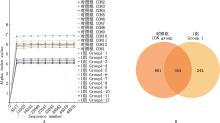
Fig.1
Sequencing quality assessment and Venn diagram analysis of the intestinal microbiota of broilersA, Rarefaction curves;B, Venn diagram of intestinal flora"
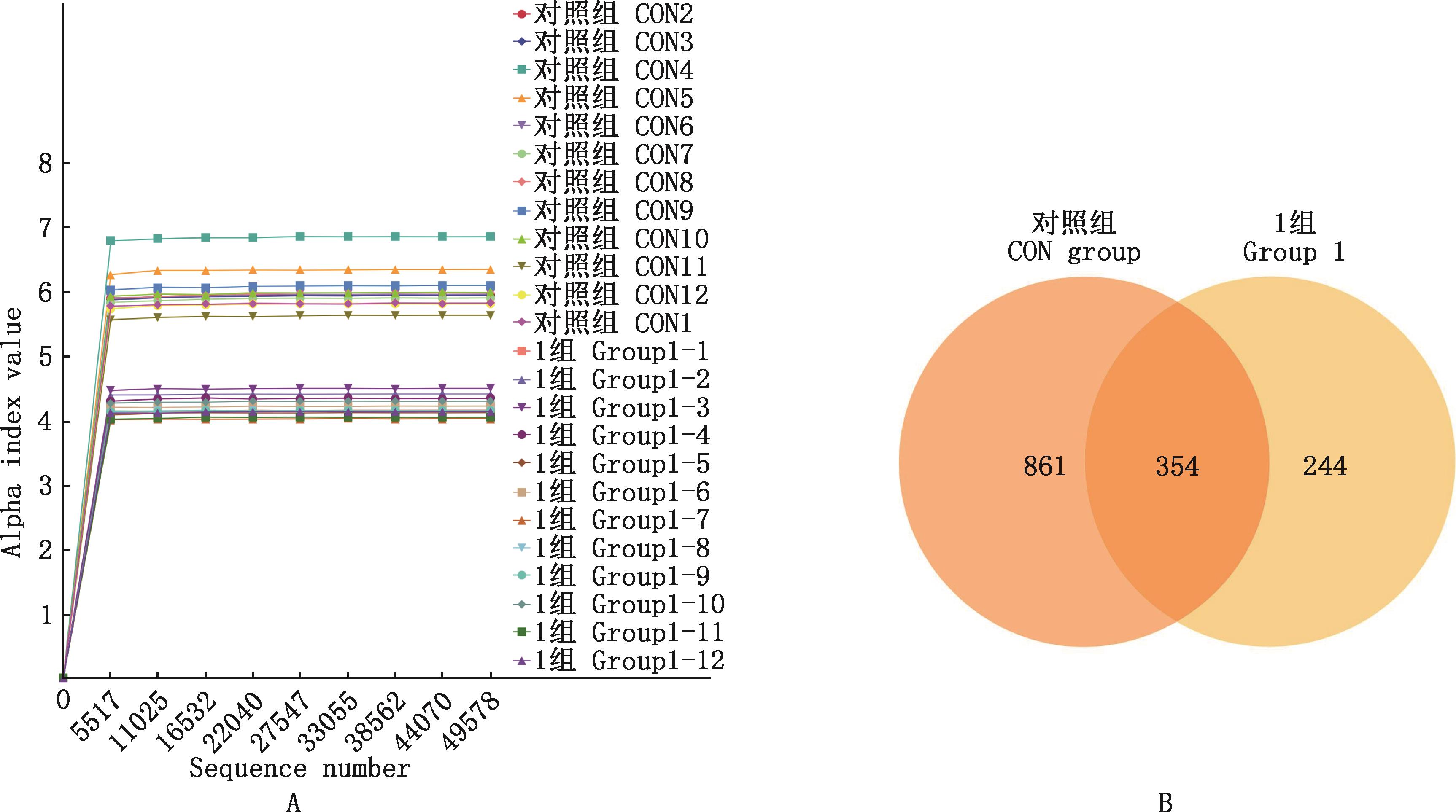
Table 5
The effect of adding PPP to the feed on the intestinal morphology of broilers"
项目 Items | 组别 Groups | P值 P-value | |||
|---|---|---|---|---|---|
对照组 CON group | 1组 Group 1 | 2组 Group 2 | 3组 Group 3 | ||
| 空肠 Jejunum | |||||
| 绒毛高度 VH | 987.73±7.65c | 1 338.91±19.19a | 1 120.07±16.39b | 1 049.63±19.25c | <0.001 |
| 隐窝深度 CD | 156.07±2.01a | 92.71±2.67d | 107.57±4.75c | 123.07±4.27b | <0.001 |
| 绒隐比 V/C | 6.34±0.09d | 14.54±0.50a | 10.55±0.42b | 8.61±0.32c | <0.001 |
| 回肠 Ileum | |||||
| 绒毛高度 VH | 1 084.12±27.49c | 1 415.81±49.21a | 1 303.46±27.54ab | 1 239.41±27.54bc | <0.001 |
| 隐窝深度 CD | 94.81±2.06b | 134.21±4.05a | 141.68±5.00a | 135.63±2.62a | <0.001 |
| 绒隐比 V/C | 11.48±0.38a | 10.64±0.49ab | 9.27±0.32b | 9.20±0.53b | 0.002 |
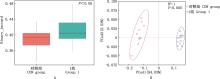
Fig.2
Analysis of Beta diversity of intestinal microbiota in broilers fed with added PPPA,Box plot of Beta index distribution among groups; B,PCoA analysis diagram"

Table 6
Analysis of the differential distribution of intestinal microbial community at the phylum level"
| 项目 Items | 对照组 CON group | 1组 Group 1 | P值P-value |
|---|---|---|---|
| 拟杆菌门 Bacteroidota | 0.4664±0.0217b | 0.8012±0.0073a | <0.001 |
| 厚壁菌门 Firmicutes | 0.5157±0.0206a | 0.1490±0.0044b | <0.001 |
| 变形菌门 Proteobacteria | 0.0129±0.0018b | 0.0313±0.0036a | <0.001 |
| 放线菌门 Actinobacteriota | 0.0040±0.0003b | 0.0175±0.0016a | <0.001 |
| 蓝菌门 Cyanobacteria | 0.0005±0.0001b | 0.0010±0.0002a | <0.001 |
Table 7
Analysis of the differential distribution of intestinal microbial flora at the genus level"
| 项目 Items | 对照组 CON group | 1组 Group 1 | P值P-value |
|---|---|---|---|
| 拟杆菌属 Bacteroides | 0.4226±0.0194b | 0.7544±0.0079a | <0.001 |
| 另枝菌属 Alistipes | 0.0395±0.0165a | 0.0165±0.0010b | <0.001 |
| 埃希-志贺菌属 Escherichia-Shigella | 0.0116±0.0018b | 0.0296±0.0035a | <0.001 |
| 克里斯滕森氏菌属 Christensenella | 0.0003±0.0000b | 0.0053±0.0006a | <0.001 |
| 经黏液真杆菌属 Blautia | 0.0221±0.0027a | 0.0005±0.0000b | <0.001 |
| 栖热粪杆菌属 Coprobacter | 0.0043±0.0003b | 0.0302±0.0013a | <0.001 |
| 粪杆菌属 Faecalibacterium | 0.0190±0.0018a | 0.0023±0.0003b | <0.001 |
| 考拉杆菌属 Phascolarctobacterium | 0.0223±0.0021a | 0.0010±0.0002b | <0.001 |
| 罕见小球菌属 Subdoligranulum | 0.0161±0.0022a | 0.0038±0.0004b | <0.001 |
| 双歧杆菌属 Bifidobacterium | 0.0009±0.0001b | 0.0155±0.0016a | <0.001 |
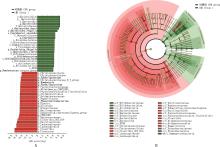
Fig.3
LEfSe analysis of intestinal flora in broilersA, LDA score barplot; B, LEfSe cladogram"

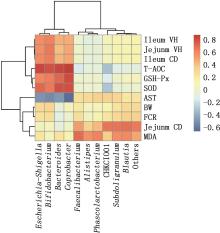
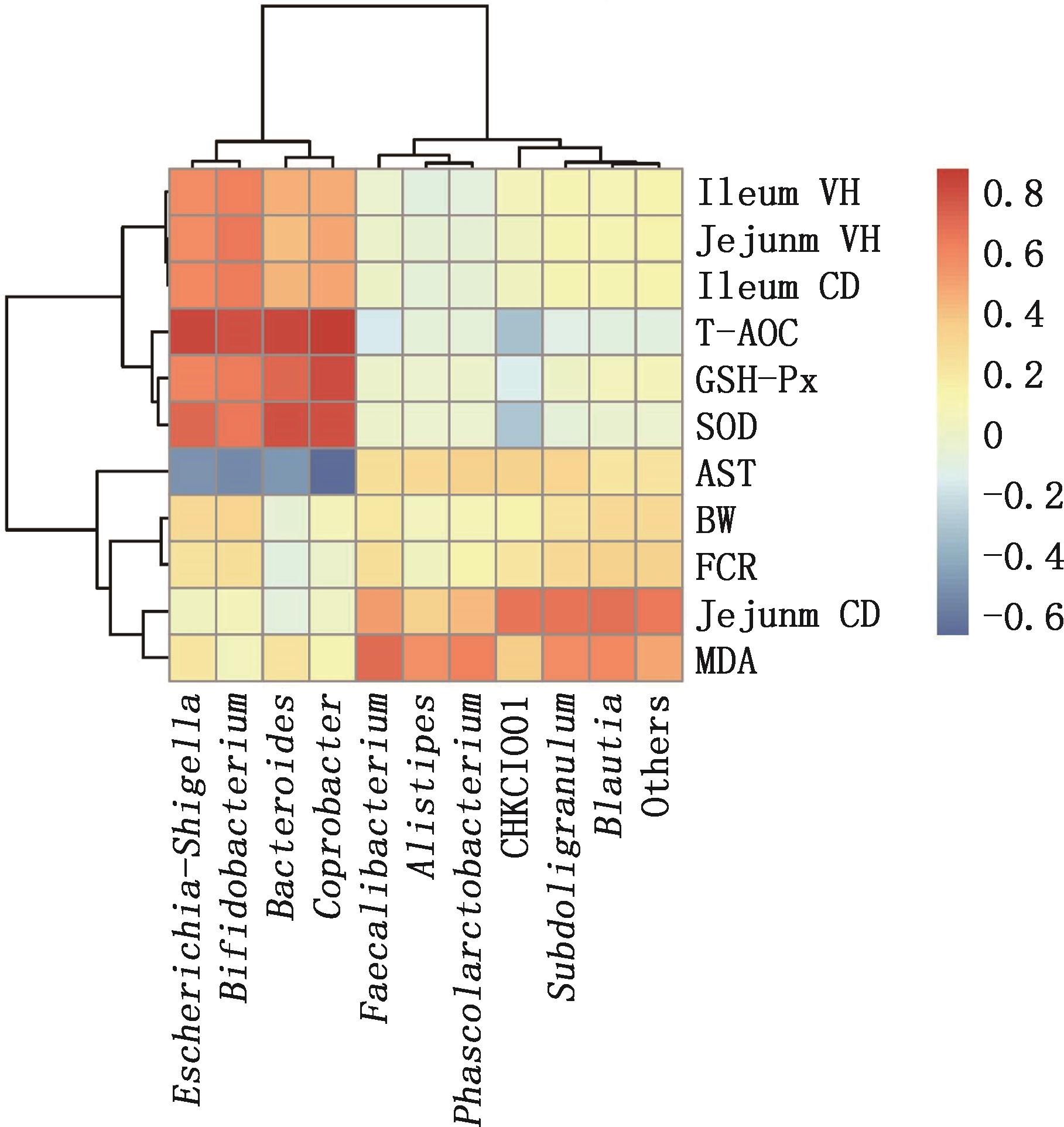
Fig.4
Correlation analysis of intestinal microbiota in broilers"
| [1] | VAN B T P, BROWER C, GILBERT M, et al. Global trends in antimicrobial use in food animals[J]. Proceedings of the National Academy of Sciences of the United States of America, 2015, 112(18): 5649-5654. |
| [2] | TANG K L, CAFFREY N P, NÓBREGA D B, et al. Restricting the use of antibiotics in food-producing animals and its associations with antibiotic resistance in food-producing animals and human beings: A systematic review and Meta-analysis[J]. The Lancet Planetary Health, 2017, 1(8): e316-e326. |
| [3] | EUROPEAN CPMMISSION. Regulation (EC) No 1831/2003 on additives for use in animal nutrition [S]. Official Journal of the European Union, 2003. |
| [4] | 中华人民共和国农业农村部.公告第 194 号:全面禁止在饲料中添加抗生素[Z].2019. |
| MINISTRY OF AGRICULTURE AND RURAL AFFAIRSO OF THE PEOPLE’S REPUBLIC OF CHINA. Announcement No. 194: Total ban on feed- added antibiotics[Z]. 2019.(in Chinese) | |
| [5] | WADE B, KEYBURN A L. The true cost of antimicrobials in broiler production and the potential of plant-based alternatives[J]. Animals, 2021, 11(2): 271. |
| [6] | DHAMA K, LATHEEF S K, MANI S, et al. Antibiotic alternatives: A review with emphasis on probiotics and other microbial derivatives[J]. Journal of Experimental Biology and Agricultural Sciences, 2018, 6(2): 366-383. |
| [7] | LI Y, GUO C, YANG J, et al. Composition and antioxidant activity of pomegranate peel: A review[J]. Food Chemistry, 2021, 341: 128150. |
| [8] | AL-ZOREKY N S. Antimicrobial activity of pomegranate (Punica granatum L.) fruit peels[J]. International Journal of Food Microbiology, 2009, 134(3): 244-247. |
| [9] | BAKKIYARAJ D, NANDHINI J R, MALATHY B, et al. The anti-biofilm potential of pomegranate peel extract against Staphylococcus aureus [J]. Applied Microbiology and Biotechnology, 2017, 101(12): 4611-4623. |
| [10] | CHINMAYI J, POOJA P, VIJAY K,et al. Anti-infective potential of hydroalcoholic extract of Punica granatum peel against Gram-negative bacterial pathogens[J].F1000Research, 2019, 8:70. |
| [11] | 陈敏,刘志伟,何敏,等.石榴皮粉对雏鸭生长性能、屠宰性能、肠道发育和血清抗氧化指标的影响[J].饲料研究,2025,48(1):73-77. |
| CHEN M, LIU Z W, HE M, et al. Effects of pomegranate peel powder on growth performance, slaughter performance, intestinal development, and serum antioxidant indexes of ducklings[J]. Feed Research, 2025, 48(1): 73-77. (in Chinese) | |
| [12] | GHASEMI-SADABADI M, EBRAHIMNEZHAD Y, SHADDEL-TELLI A, et al. Dose-dependent effects of pomegranate peel on gut microbiota and antioxidant status in broilers[J]. Scientific Reports, 2021, 11(1): 1-11. |
| [131] | 谢海伟,郑柏曦,陈勇智.响应面法优化石榴皮总黄酮提取工艺及其抗氧化性能研究[J].化学与生物工程,2023,40(7):11-17. |
| XIE H W, ZHENG B X, CHEN Y Z. Optimization in extraction process of total flavonoids from pomegranate peel by response surface methodology and its antioxidant property[J]. Chemistry and Bioengineering, 2023, 40(7): 11-17. (in Chinese) | |
| [14] | 宋振国,吴小瑜,严琳,等.Folin-Ciocalteu比色法测定石榴皮多酚含量条件的优化研究[J].中国当代医药,2019,26(6):4-7. |
| SONG Z G, WU X Y, YAN L, et al. Optimization study on conditions for the measurement of polyphenol content in pomegranate peel by Folin-Ciocalteu colorimetry[J]. China Modern Medicine, 2019, 26(6): 4-7. (in Chinese) | |
| [15] | 郭晓萍,尹苗,陈希文,等.石榴皮鞣质的提取及体外抑菌活性[J].江苏农业科学,2011,39(3):403-405. |
| GUO X P, YIN M, CHEN X W, et al. Extraction of tannins from pomegranate peel and their in vitro antibacterial activity[J]. Jiangsu Agricultural Sciences, 2011, 39(3): 403-405. (in Chinese) | |
| [16] | WINDISCH W, SCHEDLE K, PLITZNER C, et al. Use of phytogenic products as feed additives for swine and poultry[J]. Journal of Animal Science, 2008, 86(14 ): E140-E148. |
| [17] | CHEN W, HUANG Y, LI W, et al. The potential of pomegranate peel supplementation in Yellow-feathered broilers: Effects on growth performance, serum biochemistry, antioxidant capacity, intestinal health, intestinal microbiota, and duodenal mucosal metabolites[J].Poultry Science, 2025, 104(4): 104983. |
| [18] | GHASEMI-SADABADI M, EBRAHIMNEZHAD Y, MAHERI-SIS N, et al. Effects of supplementation of pomegranate processing by-products and waste cooking oils as alternative feed resources in broiler nutrition[J]. Scientific Reports, 2022, 12(1): 21216. |
| [19] | AHMADIPOUR B, PAT S, ABASZADEH S, et al. Pomegranate peel as a phytogenic in broiler chickens: Influence upon antioxidant, lipogenesis and hypotensive response[J]. Veterinary Medicine and Science, 2021, 7(5): 1907-1913. |
| [20] | GHASEMI-SADABADI M, EBRAHIMNEZHAD Y, MAHERI-SIS N, et al. Immune response and antioxidant status of broilers as influenced by oxidized vegetable oil and pomegranate peel[J]. Journal of Animal Science and Technology, 2021,63(5):1034-1063. |
| [21] | TUFARELLI V, LAUDADIO V, CASALINO E. An extra-virgin olive oil rich in polyphenolic compounds has antioxidant effects in meat-type broiler chickens[J]. Environmental Science and Pollution Research International, 2016, 23(7):6197-6204. |
| [22] | 李治利,尹磊,易先国,等.蜂毒素对青年鹌鹑生长性能、抗氧化功能、肠道机械屏障功能及肠道菌群结构与功能的影响[J].黑龙江畜牧兽医,2024,22:124-132. |
| LI Z L, YIN L, YI X G, et al. Effects of melittin on growth performance, antioxidant function, intestinal mechanical barrier function and intestinal flora structure and function in young quails[J]. Heilongjiang Animal Science and Veterinary Medicine, 2024, 22: 124-132. (in Chinese) | |
| [23] | 黄飘飘, 舒英, 沙尔山别克・阿不地力大,等. 石榴皮粉对拜城油鸡生长期生长性能、屠宰性能及抗氧化性能的影响[J]. 饲料研究, 2020, 43(4): 31-34. |
| HUANG P P, SHU Y, SHALISHANBEKE A, et al. Effect of pomegranate peel powder on growth performance, slaughter performance and antioxidant performance of Baicheng-You chickens [J]. Feed Research, 2020, 43(4): 31-34. (in Chinese) | |
| [24] | SALEH H, GOLIAN A, KERMANSHAHI H, et al. Effects of dietary α-tocopherol acetate, pomegranate peel, and pomegranate peel extract on phenolic content, fatty acid composition, and meat quality of broiler chickens[J]. Journal of Applied Animal Research, 2017, 45(1): 629-636. |
| [25] | MOUNTZOURIS K C, PARASKEUAS V V, FEGEROS K. Priming of intestinal cytoprotective genes and antioxidant capacity by dietary phytogenic inclusion in broilers[J]. Animal Nutrition, 2020,6(3):305-312. |
| [26] | FERLISI F, TANG J, CAPPELLI K, et al. Dietary supplementation with olive oil co-products rich in polyphenols: A novel nutraceutical approach in monogastric animal nutrition[J]. Frontiers in Veterinary Science, 2023,10:1272274. |
| [27] | AKURU E A, MPENDULO C T, OYEAGU C E, et al. Pomegranate (Punica granatum L.) peel powder meal supplementation in broilers: Effect on growth performance, digestibility, carcase and organ weights, serum and some meat antioxidant enzyme biomarkers[J]. Italian Journal of Animal Science, 2021, 20(1): 119-131. |
| [28] | KOGUT M H, GENOVESE K J, SWAGGERTY C L, et al. Inflammatory phenotypes in the intestine of poultry: Not all inflammation is created equal[J]. Poultry Science, 2018, 97(7): 2339-2346. |
| [29] | YEGANI M, KORVER D R. Factors affecting intestinal health in poultry[J]. Poultry Science, 2008, 87(10): 2052-2063. |
| [30] | SURAI P F. Polyphenol compounds in the chicken/animal diet: From the past to the future[J]. Journal of Animal Physiology and Animal Nutrition, 2014, 98(1): 19-31. |
| [31] | XU P, WANG J, CHEN P, et al. Effects of pomegranate (Punica granatum L.) peel on the growth performance and intestinal microbiota of broilers challenged with Escherichia coli [J]. Poultry Science, 2024, 103(2): 103304. |
| [32] | NEYRINCK A M, VAN H V F, BINDELS L B, et al. Polyphenol-rich extract of pomegranate peel alleviates tissue inflammation and hypercholesterolaemia in high-fat diet-induced obese mice: Potential implication of the gut microbiota[J]. British Journal of Nutrition, 2013, 109(5): 802-809. |
| [33] | ESPÍN J C, LARROSA M, GARCÍA-CONESA M T, et al. Biological significance of urolithins, the gut microbial ellagic acid-derived metabolites: The evidence so far[J]. Evidence Based Complementary and Alternative Medicine, 2013,2013:270418. |
| [34] | DJEDJIBEGOVIC J, MARJANOVIC A, PANIERI E, et al. Ellagic acid-derived urolithins as modulators of oxidative stress[J]. Oxidative Medicine and Cellular Longevity, 2020, 2020(1): 5194508. |
| [35] | REIMER R A, MAATHUIS A J, VENEMA K, et al. Effect of the novel polysaccharide PolyGlycopleX® on short-chain fatty acid production in a computer-controlled in vitro model of the human large intestine[J]. Nutrients, 2014, 6(3):1115-1127. |
| [36] | 张谚鹏, 林苗, 肖亚红, 等. 姜黄提取物与石榴皮提取物的复合物对文昌鸡生长性能、血清免疫指标和盲肠微生物的影响[J]. 动物营养学报, 2023, 35(11): 7086-7098. |
| ZHANG Y P, LIN M, XIAO Y H, et al. Effects of compound of Curcuma longa extract and pomegranate peel extract on growth performance, serum immune indexes and cecal microbiota of Wenchang broilers [J]. Chinese Journal of Animal Nutrition, 2023, 35(11): 7086-7098. (in Chinese) | |
| [37] | BARCAN A S, BARCAN R A, VAMANU E. Therapeutic potential of fungal polysaccharides in gut microbiota regulation: Implications for diabetes, neurodegeneration, and oncology[J]. Journal of Fungi, 2024, 10(6): 394. |
| [38] | DURANTI S, LONGHI G, VENTURA M, et al. Exploring the ecology of Bifidobacteria and their genetic adaptation to the mammalian gut[J]. Microorganisms, 2020, 9(1): 8. |
| [39] | MA J, PIAO X, MAHFUZ S, et al. The interaction among gut microbes, the intestinal barrier and short chain fatty acids[J]. Animal Nutrition, 2021,9:159-174. |
| [40] | 杨俊琪.石榴皮多酚的肠道代谢转化及与菌群互作关系研究[D].西安:陕西师范大学,2020. |
| YANG J Q. Intestinal metabolic transformation of pomegranate peel polyphenols and their interaction with gut microbiota[D]. Xi’an: Shaanxi Normal University, 2020. (in Chinese) | |
| [41] | GAO Z, YIN J, ZHANG J, et al. Butyrate improves insulin sensitivity and increases energy expenditure in mice[J]. Diabetes, 2009, 58(7): 1509-1517. |
| [42] | SUKKAR A H, LETT A M, FROST G, et al. Regulation of energy expenditure and substrate oxidation by short-chain fatty acids[J]. Endocrinology, 2019, 242(2): R1-R8. |
| [43] | ZAFAR H, SAIER M H J R. Gut Bacteroides species in health and disease[J]. Gut Microbes, 2021, 13(1): 1-20. |
| [44] | PARKER B J, WEARSCH P A, VELOO A C M, et al. The genus Alistipes: Gut bacteria with emerging implications to inflammation, cancer, and mental health[J]. Frontiers in Immunology, 2020, 11: 906. |
| [45] | CAI T T, YE X L, LI R R, et al. Resveratrol modulates the gut microbiota and inflammation to protect against diabetic nephropathy in mice[J]. Frontiers in Pharmacology, 2020, 11: 1249. |
| [46] | 单雯涵, 薛昱凡, 贺文静, 等. 日粮添加桉叶素对肉鸡生长性能、血清抗氧化指标及肠道健康的影响[J]. 畜牧与兽医, 2025, 57(4): 36-44. |
| SHAN W H, XUE Y F, HE W J, et al. Effect of dietary cineole supplementation on growth performance, serum antioxidant index and intestinal health in broilers[J]. Animal Husbandry & Veterinary Medicine, 2025, 57(4): 36-44. (in Chinese) | |
| [47] | NEYRINCK A M, CATRY E, TAMINIAU B, et al. Chitin-glucan and pomegranate polyphenols improve endothelial dysfunction[J]. Scientific Reports, 2019, 9(1): 14150. |
| [1] | ZHANG Zhiying, HU Xiaodi, PENG Su, ZHANG Xingyue, SHE Peining, HUANG Xiaojie, SHI Dayou. Effects of LPS on the Growth Performance, Serum Biochemistry and Intestinal Health of Mahuang Chickens [J]. China Animal Husbandry & Veterinary Medicine, 2026, 53(2): 659-670. |
| [2] | Zhenzhen JI, Pu CHENG, Lei XI, Tongshuai LIU, Yongfen WANG. Effects of Eucalyptus globulus Essential Oil on Growth Performance, Serum Biochemical Indicators, Antioxidant Capacity and Intestinal Health of Broilers Under Heat Stress [J]. China Animal Husbandry & Veterinary Medicine, 2026, 53(1): 136-150. |
| [3] | Haohui LIANG, Yao QIN, Pan XIONG, Junming CAO, Jia CAI, Junru HU, Xiaoying CHEN, Guoxia WANG. Study on Vitamin B6 Requirements of Juvenile Largemouth Bass (Micropterus salmoides) [J]. China Animal Husbandry & Veterinary Medicine, 2026, 53(1): 190-200. |
| [4] | Chaoping ZHANG, Meifei LAI, Shunyu ZHANG, Zixu LI, Yuyang GAO, Yingjie WU, Ning LIU, Yinghe QIN. Effects of Dietary Astaxanthin on Reproductive Performance, Antioxidant Capacity of Female Rabbits and Growth of Suckling Rabbits [J]. China Animal Husbandry & Veterinary Medicine, 2026, 53(1): 224-232. |
| [5] | Yinghao ZOU, Yong WANG, Lihua SUN, Xing CHEN, Jie WANG, Guohua LIU, Kun WANG, Aijuan ZHENG, Shugui ZHENG. The Effects of Different Levels of Fat Powder on the Egg-laying Performance and Egg Quality of Hy-Line Brown Laying Hens [J]. China Animal Husbandry & Veterinary Medicine, 2026, 53(1): 233-244. |
| [6] | LI Yating, ZHOU Wei, ZHUANG Lei, MU Qiming, JIN Yongyan, ZHAO Jiannan, XIE Ming, ZHOU Zhengkui, XIA Chengqiang, TANG Jing. Effects of Vitamin D3 and 25-hydroxyvitamin D3 on Tibial Quality and Microbial Composition of Breeding Ducks in Late Laying Period [J]. China Animal Husbandry & Veterinary Medicine, 2025, 52(9): 4043-4056. |
| [7] | SHAN Jing, LIU Wuxiong, HE Lingyun, DU Hanxiang, QU Xiangyong, GUO Songchang, SHU Zhixiang, LI Zhiwen, HE Changqing. Comparative Study on Liver Tissue,Intestinal Morphology and Intestinal Flora in Different Breeds of Goslings [J]. China Animal Husbandry & Veterinary Medicine, 2025, 52(9): 4094-4104. |
| [8] | CHEN Bo, WANG Difei, YANG Xuexi, LIU Rui, CHEN Lin, LIU Yue, ZHANG Jize, GAO Yang. Effects of Dietary Supplementation with Squalene on Growth Performance,Meat Quality,and Antioxidant Function in Growing-finishing Pigs [J]. China Animal Husbandry & Veterinary Medicine, 2025, 52(9): 4146-4154. |
| [9] | LU Xiaorong, ZHAO Yiduo, LI Jianxi. Interaction Mechanism of Intestinal Flora-miRNA and Its Influence on Disease Prevention and Treatment [J]. China Animal Husbandry & Veterinary Medicine, 2025, 52(9): 4304-4318. |
| [10] | LI Jianing, JIANG Zhihui, XING Yueteng, MA Shengming. Effects of 1, 8-cineole Supplementation in Diet on the Antioxidant Capacity of Laying Hens and Eggs [J]. China Animal Husbandry & Veterinary Medicine, 2025, 52(7): 3016-3030. |
| [11] | LU Xinxin, FU Kaibo, LI Siman, ZHANG Haihua, ZHANG Haijun, QIU Kai, WU Shugeng. Effect of Dietary Malic Acid Supplemented in the Initial Growth Stage on Growth Performance, Meat Quality, Serum Biochemical and Intestinal Health of Broilers [J]. China Animal Husbandry & Veterinary Medicine, 2025, 52(7): 3104-3115. |
| [12] | HU Bo, XIONG Pan, HU Junru, LU Huijie, ZHOU Jixing, WANG Guoxia. Effects of Dietary Lipid Levels on Growth, Biochemical Parameters of Liver, Digestion, and Antioxidant Capacity in Hybrid Snakehead (Channa argus♂× Channa maculate♀) Larvae [J]. China Animal Husbandry & Veterinary Medicine, 2025, 52(7): 3116-3125. |
| [13] | LI Zhishan, ZHOU Zhaoyue, LIU Tianlong, WANG Shuaiyu, JIANG Haiyang. Analysis of the Effects of Platycodon grandiflorum Ultrafine Powder on the Diversity of Intestinal Flora in Mice Based on 16S rRNA Technology [J]. China Animal Husbandry & Veterinary Medicine, 2025, 52(7): 3372-3385. |
| [14] | WANG Haojie, HUA Tian, CHEN Shihao, BI Yulin, JIANG Yong, WANG Zhixiu, CHEN Guohong, BAI Hao, CHANG Guobin. Research Progress on Effects of Intestinal Flora on Immune System of Livestock and Poultry [J]. China Animal Husbandry & Veterinary Medicine, 2025, 52(7): 3398-3408. |
| [15] | WANG Haotian, LI Junzhe, MEI Xiaoying, LI Longxian, LI Yingying, ZHANG Mingrui, WU Yi. Effects of Cuscuta chinensis and Arctium lappa Compound Plant Extracts on Urine Physicochemical,Serum Antioxidant and Immune Indexes in Adult Cats [J]. China Animal Husbandry & Veterinary Medicine, 2025, 52(6): 2531-2539. |
| Viewed | ||||||
|
Full text |
|
|||||
|
Abstract |
|
|||||
