
China Animal Husbandry & Veterinary Medicine ›› 2026, Vol. 53 ›› Issue (2): 671-681.doi: 10.16431/j.cnki.1671-7236.2026.02.015
• Nutrition and Feed • Previous Articles Next Articles
SUN Lu( ), LI Shufang, WANG Lina, ZHAO Jianxin, LU Henan, WANG Hairong()
Received:2025-07-02
Online:2026-02-20
Published:2026-01-27
Contact:
WANG Hairong
E-mail:1528896248@qq.com;wanghairong97@163.com
CLC Number:
SUN Lu, LI Shufang, WANG Lina, ZHAO Jianxin, LU Henan, WANG Hairong. Effects of Total Alkaloids from Sophora alopecuroides Added to a High-concentrate Diet on Hepatic Glucose Metabolism in Sheep Based on Transcriptome Sequencing[J]. China Animal Husbandry & Veterinary Medicine, 2026, 53(2): 671-681.
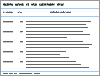
Table 1
Composition and nutrient levels of basal diets (DM basis)"
项目 Items | 组别Groups | |
|---|---|---|
| G1 | G2/S3 | |
| 原料Ingredients | ||
| 混合牧草Mixed hay | 50.00 | 30.00 |
| 玉米Corn | 36.10 | 52.00 |
| 豆粕Soybean meal | 12.00 | 15.20 |
| 石粉Limestone | 0.60 | 1.00 |
| 磷酸氢钙CaHPO4 | 0.10 | 0.10 |
| 食盐NaCl | 0.50 | 0.50 |
| 预混料Premix① | 0.20 | 0.20 |
| 小苏打NaHCO3 | 0.50 | 1.00 |
| 合计Total | 100.00 | 100.00 |
| 营养成分Nutrient components② | ||
| 代谢能ME/(MJ/kg) | 9.53 | 10.20 |
| 粗蛋白质CP | 14.17 | 14.45 |
| 粗脂肪EE | 2.84 | 3.72 |
| 中性洗涤纤维NDF | 33.18 | 25.03 |
| 酸性洗涤纤维ADF | 22.36 | 15.37 |
| 非结构性碳水化合物NSC | 43.60 | 49.90 |
| 钙Ca | 0.77 | 0.71 |
| 磷P | 0.38 | 0.37 |
Table 2
Primer information"
基因 Genes | 引物序列 Primer sequences (5′→3′) | 产物长度 Product length/bp | GenBank登录号 GenBank accession No. |
|---|---|---|---|
| PCK1 | F:GCGGAGTACAAGGGCAAAGT | 83 | XM_004014441.5 |
| R:GCCAGGTACTGGCCAAAGTT | |||
| G6PC1 | F:GGCATCAAACTCCTCTGGGT | 76 | XM_004012951.5 |
| R:GCTGTCCAAAGAGAATCCACTTAAA | |||
| IDH3B | F:GTTGCGGCATCTCAATCTCG | 119 | XM_004014386.6 |
| R:AGTCGGTTGTGGTGCTGTAG | |||
| SDHC | F:TGGGATCCGACACTTGATGT | 107 | XM_004002697.4 |
| R:GCCCTACAGAGGACAACACA | |||
| GAPDH | F:TCGGAGTGAACGGATTTGGC | 76 | NM_001190390.1 |
| R:ACGATGTCCACTTTGCCAGT |
Table 3
Quality analysis of transcription sequencing data"
样品 Samples | 原始数据 Raw reads/条 | 质控数据 Clean reads/条 | Q20/% | Q30/% | GC 含量 GC content/% | 总比对率 Total mapped/% | 唯一比对率 Uniquely mapped/% |
|---|---|---|---|---|---|---|---|
| G1-1 | 48 466 846 | 47 954 082 | 98.04 | 94.12 | 48.97 | 96.48 | 84.97 |
| G1-2 | 56 038 432 | 55 523 466 | 98.08 | 94.24 | 49.67 | 96.41 | 84.88 |
| G1-3 | 48 483 846 | 48 016 986 | 98.07 | 94.24 | 50.16 | 96.67 | 86.77 |
| G2-1 | 50 097 052 | 49 600 336 | 98.13 | 94.39 | 50.03 | 96.45 | 85.92 |
| G2-2 | 52 449 996 | 51 964 618 | 98.10 | 94.27 | 49.28 | 96.82 | 84.83 |
| G2-3 | 48 366 524 | 47 724 756 | 97.87 | 93.75 | 49.91 | 96.32 | 85.56 |
| S3-1 | 50 859 634 | 50 391 610 | 97.28 | 95.35 | 50.31 | 96.89 | 84.90 |
| S3-2 | 51 734 788 | 51 263 466 | 97.30 | 95.38 | 51.33 | 96.53 | 86.93 |
| S3-3 | 49 821 332 | 49 302 912 | 97.40 | 95.54 | 48.96 | 97.01 | 79.20 |
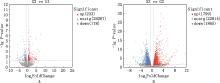
Fig.1
Volcano plot of DEGs between groupsA,G2 vs G1 group;B,S3 vs G2 group. The same as fig.2 and fig.3"
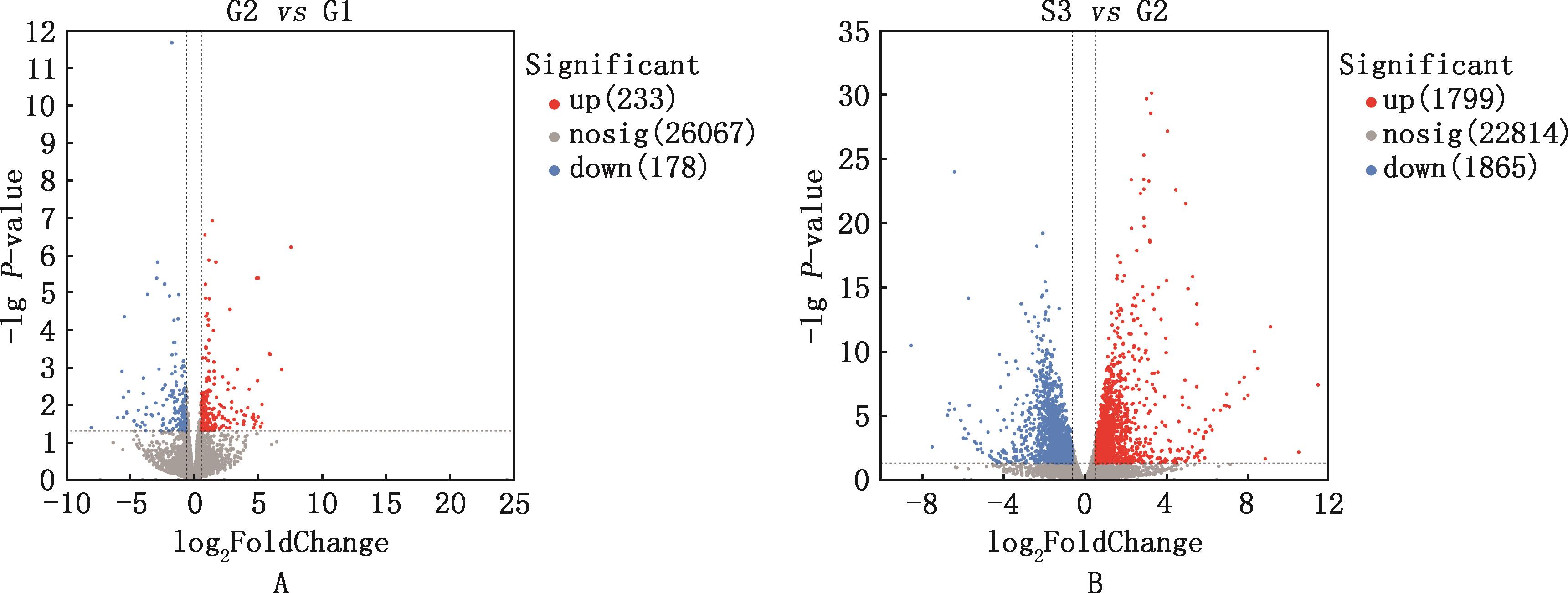
Fig.2
Bubble plot of GO enrichment analysis of DEGs between groups (top 20)"

Fig.3
Bubble plot of KEGG enrichment analysis of sugar metabolism in DEGs between groups"
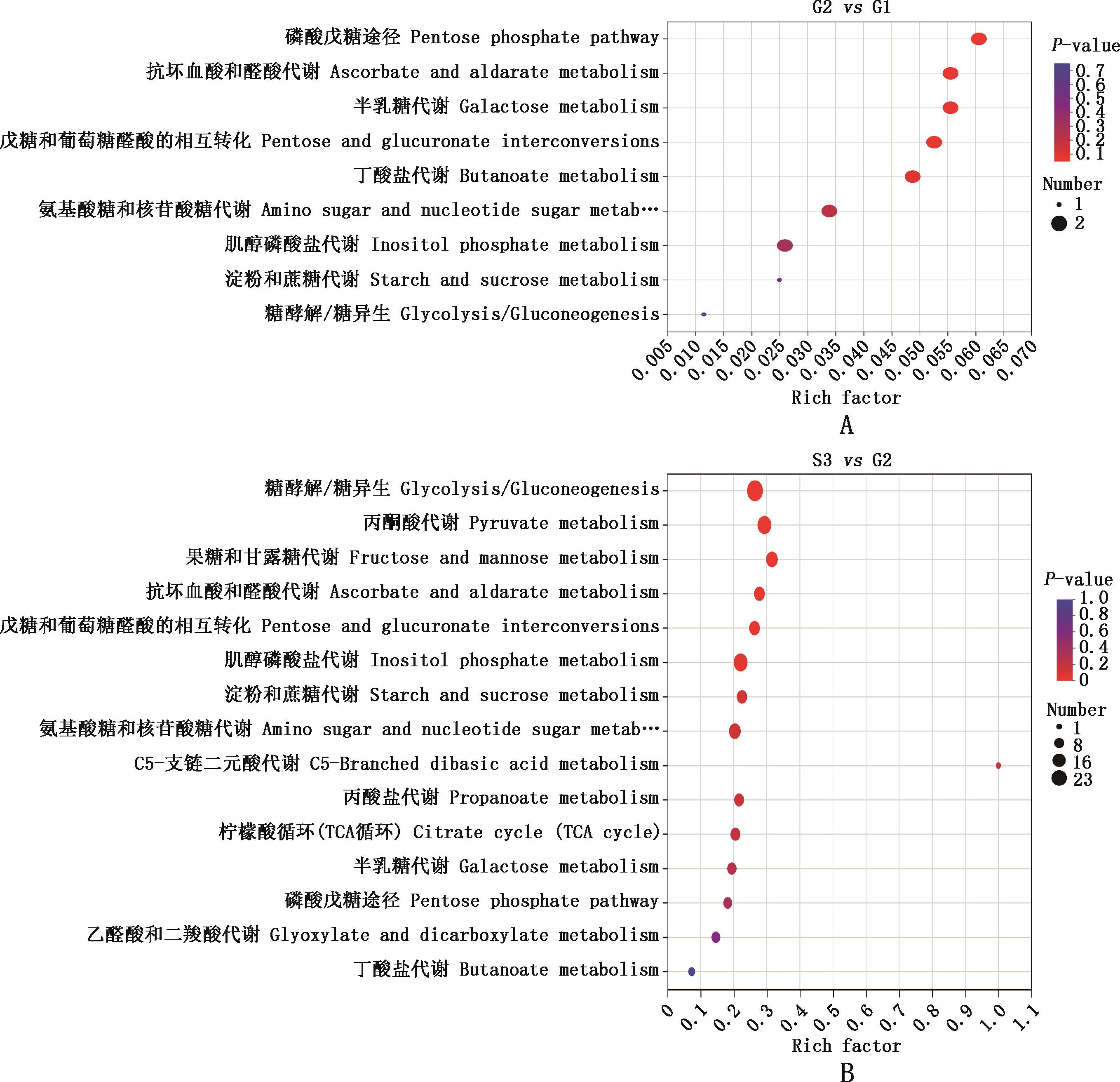
Table 4
Analysis of intergroup differences in gene expression of key enzymes of glucose metabolism"
| 基因Genes | 通路 Pathway | G2 vs G1 | S3 vs G2 |
|---|---|---|---|
| PCK1 | 糖异生 | 0.76 | 2.26* |
| PCK2 | 0.83 | 1.52* | |
| FBP1 | 0.97 | 1.87* | |
| G6PC1 | 0.92 | 3.50* | |
| PC | 0.81 | 2.50* | |
| HK1 | 糖酵解 | 1.18 | 0.48* |
| HK2 | 1.91 | 0.20* | |
| HK3 | 1.19 | 0.35* | |
| PFKP | 1.17 | 0.43* | |
| PKLR | 0.93 | 1.52* | |
| MDH2 | 柠檬酸循环 | 0.97 | 1.57* |
| IDH3B | 0.94 | 1.32 | |
| SDHC | 1.01 | 1.12 |
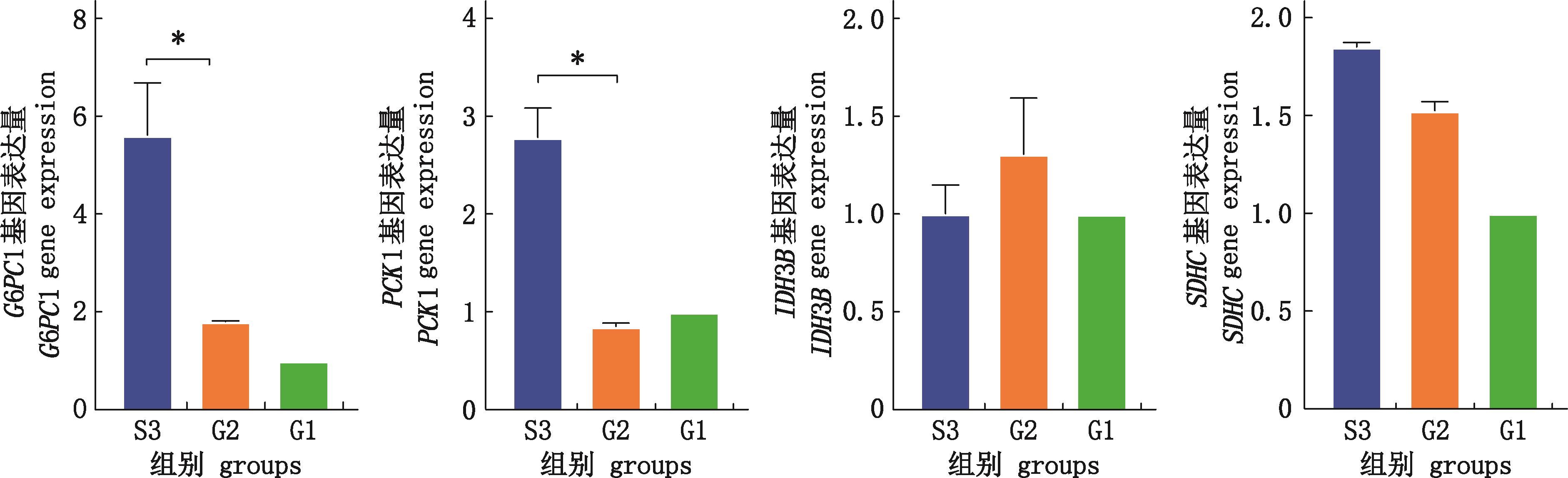
Fig.4
Validation of glucose metabolism-related genes in the sheep liver by Real-time quantitative PCR"
| [1] | SGORLON S, STRADAIOLI G, GABAI G,et al. Variation of starch and fat in the diet affects metabolic status and oxidative stress in ewes[J]. Small Ruminant Research,2007,74(1):123-129. |
| [2] | 李红梅.干奶期不同能量摄食对奶牛糖异生的影响[D].哈尔滨:东北农业大学,2006. |
| LI H M. The effect of different energy intake during the dry period on glyconeogenesis in the periparturient cows[D]. Harbin:Northeast Agricultural University,2006.(in Chinese) | |
| [3] | 史芳芸,邱明宁,李国中,等.苦豆子资源现状、化学成分、毒性及其开发利用研究进展[J].黑龙江畜牧兽医,2019,13:34-38. |
| SHI F Y, QIU M N, LI G Z, et al. Research progress on the resource status, chemical composition, toxicity, exploitation and utilization of Sophora alopecuroides [J]. Heilongjiang Animal Science and Veterinary Medicine,2019,13:34-38. (in Chinese) | |
| [4] | 游菁菁,李月英,沙碧莹,等.中药苦豆子生物碱的研究进展[J].江西中医药大学学报,2015,27(2):109-113. |
| YOU J J, LI Y Y, SHA B Y, et al. Advances in studies on the alkaloid of Sophora alopecuroides L.[J]. Journal of Jiangxi University of Traditional Chinese Medicine,2015,27(2):109-113. (in Chinese) | |
| [5] | 梁 磊,王晓燕,张绪慧,等.苦豆子生物碱抗结肠腺癌细胞株SW620的作用筛选[J].中药材,2008,6:866-869. |
| LIANG L, WANG X Y, ZHANG X H, et al. Screening on alkaloid of Sophora alopecuraides against adenocarcinoma of colon cell line SW620 in vitro [J]. Chinese Herbal Medicine,2008,6:866-869. (in Chinese) | |
| [6] | 张为民,张彦明,张 涛,等.苦豆子生物碱抑菌抗炎作用研究[J].动物医学进展,2005,10:82-85. |
| ZHANG W M, ZHANG Y M, ZHANG T, et al. Studies on antibacterial and anti-inflammafory effect of alkaloid of Sophora alopecuraides L.[J]. Progress in Veterinary Medicine, 2005,10:82-85. (in Chinese) | |
| [7] | 韩燕,周娅,刘泉,等.苦豆子抗内毒素效应的实验研究[J].中药材,2006,10:1066-1069. |
| HAN Y, ZHOU Y, LIU Q, et al. Antiendotoxic effects of Sophora alopecuroides L.[J]. Chinese Herbal Medicine, 2006,10:1066-1069. (in Chinese) | |
| [8] | 安雅雯,杨晓东,郭绍乾,等.高精饲粮中添加苦豆子对杜蒙羔羊血清免疫及抗氧化指标的影响[J].云南农业大学学报(自然科学),2022,37(5):804-811. |
| AN Y W, YANG X D, GUO S Q, et al. Effects of adding Sophora alopecuroides to high grain diet on serum immune and antioxidant indexes of Dumont lamb[J]. Journal of Yunnan Agricultural University (Natural Science Edition), 2022,37(5):804-811. (in Chinese) | |
| [9] | 薛贵平,庞学书,薄爱华,等.苦参碱对免疫性肝损伤保护作用的研究[J].时珍国医国药,2007,6:1302-1303. |
| XUE G P, PANG X S, BO A H, et al. Study on the protective effect of matrine on immune liver injury in rats[J]. Lishizhen Medicine and Materia Medica Research, 2007,6:1302-1303. (in Chinese) | |
| [10] | 覃仁武,邱绍勤,陈赛专,等.苦参碱对硫代乙酰胺诱导的肝纤维化大鼠的影响[J].中成药,2020,42(3):764-767. |
| QIN R W, QIU S Q, CHEN S Z, et al. Effects of matrine on thioacetamide-induced liver fibrosis in rats[J].Chinese Traditional and Herbal Drugs, 2020,42(3):764-767. (in Chinese) | |
| [11] | 谢小青,杨晓娟,卢利霞,等.苦参碱通过P38MAPK和JNK信号通路抑制肝癌细胞增殖的分子机制研究[J].兰州大学学报(医学版),2022,48(1):38-43. |
| XIE X Q, YANG X J, LU L X, et al. Matrine inhibits proliferation and induces apoptosis of hepatocellular carcionma cells by regulating P38MAPK/JNK signaling pathways[J]. Journal of Lanzhou University (Medical Edition),2022,48(1):38-43. (in Chinese) | |
| [12] | 赵建鑫,李述方,卢赫男,等.高精料饲粮条件下添加苦豆子生物碱对杜蒙羔羊生长性能和血清生化指标的影响[J].中国畜牧兽医,2024,51(11):4774-4782. |
| ZHAO J X, LI S F, LU H N, et al. Effects of alkaloids from Sophora alopecuroides on growth performance and serum biochemical indexes of Dumeng lambs fed with high concentrate diet[J]. China Animal Husbandry & Veterinary Medicine,2024,51(11):4774-4782. (in Chinese) | |
| [13] | AN Y, WANG H, GAO A, et al. Effects of Sophora alopecuroidesin added to a high-concentrate diet on the liver immunity and antioxidant function of lambs according to transcriptome analysis[J]. Animals,2024,14(2):182. |
| [14] | 张育浩,张得钧,张本印,等.具有降血糖活性的生物碱及其作用机制[J].中草药,2018,49(15):3692-3702. |
| ZHANG Y H, ZHANG D J, ZHANG B Y, et al. Chemical structures of alkaloids with hypoglycemic activity and their hypoglycemic mechanisms[J]. Chinese Herbal Medicine, 2018,49(15):3692-3702. (in Chinese) | |
| [15] | 王绍庆.亚急性瘤胃酸中毒(SARA)对山羊肝脏免疫机能的影响[D].南京:南京农业大学,2013. |
| WANG S Q. Effect of subacute ruminal acidosis on immune function of liver[D]. Nanjing:Nanjing Agricultural University,2013. (in Chinese) | |
| [16] | FRANK T, RALF W. Non-alcoholic fatty liver disease (NAFLD)/non-alcoholic steatohepatitis (NASH)-related liver fibrosis: Mechanisms, treatment and prevention[J]. Annals of Translational Medicine,2021,9(8):729. |
| [17] | KLEEN J L, HOOIJER G A, REHAGE J, et al. Subacute ruminal acidosis (SARA): A review[J]. Journal of Veterinary Medicine. A, Physiology, Pathology, Clinical Medicine,2003,50(8):406-414. |
| [18] | GUANGJUN C, KAI Z, TIANLE X, et al. Feeding a high-grain diet reduces the percentage of LPS clearance and enhances immune gene expression in goat liver[J]. BMC Veterinary Research,2015,11(1):67. |
| [19] | CAN J, TINGTING Z, ZHIHAO D, et al. Effect of chin brick tea [Camellia sinensis (L.) Kuntze] on lipid metabolism and inflammation by modulating intestinal flora and bile acids in mice with non-alcoholic fatty liver disease[J]. Journal of Ethnopharmacology,2023,318(PB):116950. |
| [20] | 王林枫,赵志伟,杨改青,等.急性内毒素损伤对奶山羊肝脏营养代谢的影响[J].动物营养学报,2012,24(12):2366-2374. |
| WANG L F, ZHAO Z W, YANG G Q, et al. Effects of acute lipopolysaccharide injury on liver nutrition metabolism in dairy goats[J]. Chinese Journal of Animal Nutrition,2012,24(12):2366-2374. (in Chinese) | |
| [21] | 于洋,庞晶晶,张艳芬,等.血糖稳态对神经组织功能影响的机制[J].生命的化学,2024,44(6):1039-1046. |
| YU Y, PANG J J, ZHANG Y F, et al. Mechanism of glucose homeostasis influence on neural tissue function[J]. The Chemistry of Life,2024,44(6):1039-1046. (in Chinese) | |
| [22] | 董海波,王绍庆,贾媛媛,等.长期饲喂高精料日粮对泌乳期山羊血液生化参数及组织中糖代谢相关基因表达的影响[J].草业学报,2014,23(5):295-302. |
| DONG H B, WANG S Q, JIA Y Y, et al. Effect of long-term feeding of high concentrate diet on plasma biochemical parameters and expression of genes involved in glucose metabolism in lactating goats[J]. Acta Prataculturae Sinica,2014,23(5):295-302. (in Chinese) | |
| [23] | GOTO M, YOSHIOKA T, BATTELINO T, et al. TNFalpha decreases gluconeogenesis in hepatocytes isolated from 10-day-old rats[J]. Pediatric Research,2001,49(4):552-557. |
| [24] | 卢德勋.反刍动物葡萄糖营养调控理论体系及其应用[J].畜牧与饲料科学,2010,31(Z1):402-409. |
| LU D X. Theoretical system of glucose nutrition regulation in ruminants and its application[J]. Animal Husbandry and Feed Science,2010,31(Z1):402-409. (in Chinese) | |
| [25] | 李剑虹,杜晓彤,刘火,等.冷刺激下AA肉鸡PCK1基因的表达量[J].贵州农业科学,2014,42(8):142-146. |
| LI J H, DU X T, LIU H, et al. Expression quantity of PCK1 gene of AA broilers under cold stimulation[J]. Guizhou Agricultural Science,2014,42(8):142-146. (in Chinese) | |
| [26] | MODARESSI S, BRECHTEL K, CHRIST B, et al. Human mitochondrial phosphoenolpyruvate carboxykinase 2 gene. Structure, chromosomal localization and tissue-specific expression[J].The Biochemical Journal,1998,333(Pt2):359-366. |
| [27] | TUMMALA S K, GOMES L A, YILMAZ M, et al. Inhibition of De Novo NAD+ synthesis by oncogenic URI causes liver tumorigenesis through DNA damage[J]. Cancer Cell,2014,26(6):826-839. |
| [28] | 罗燕文,田平,华灿枫,等.不同高精料耐受时间对泌乳期山羊肝脏糖脂代谢的影响[J].草业学报,2018,27(1):177-186. |
| LUO Y W, TIAN P, HUA C F, et al. Effects of feeding high concentrate diets on glucose and lipid metabolism in the liver of lactating goats[J]. Acta Prataculturae Sinica,2018,27(1):177-186. (in Chinese) | |
| [29] | 刘火,杜晓彤,闫辰,等.冷刺激下AA肉鸡FBP1基因表达量的研究[J].中国畜牧兽医,2015,42(12):3146-3152. |
| LIU H, DU X T, YAN C, et al. Study on the expression of FBP1 gene in AA broilers under cold stimulating environment[J]. China Animal Husbandry & Veterinary Medicine,2015,42(12):3146-3152. (in Chinese) | |
| [30] | NAGARAJA T G, TITGEMEYER E C. Ruminal acidosis in beef cattle: The current microbiological and nutritional outlook[J]. Journal of Dairy Science,2007,90(S):E17-E38. |
| [31] | 颜耿杰,林镛,苏会吉,等.糖酵解与线粒体功能障碍的关系及其在肝脏疾病中的潜在价值[J].临床肝胆病杂志,2022,38(8):1931-1936. |
| YAN G J, LIN Y, SU H J, et al. Association between glycolysis and mitochondrial dysfunction and its potential value in liver diseases[J]. Journal of Clinical Hepatobiliary Diseases,2022,38(8):1931-1936. (in Chinese) | |
| [32] | SOTO-HEREDERO G, GÓMEZ DE LAS HERAS M M, GABANDÉ-RODRÍGUEZ E, et al. Glycolysis—A key player in the inflammatory response[J]. The FEBS Journal,2020,287(16):3350-3369. |
| [33] | 陈含含.不同精粗比例日粮对绵羊肝脏、肌肉和脂肪组织中碳水化合物代谢通路的影响[D].呼和浩特:内蒙古农业大学,2024. |
| CHEN H H. Effect of different concentrate forage ratio diet on liver, muscle and adipose tissue carbohydrate metabolism and oxidative stress response[D]. Hohhot:Inner Mongolia Agricultural University,2024. (in Chinese) | |
| [34] | 柏会文.丙酮酸激酶基因(PKLR)敲入小鼠模型在低氧适应中的功能研究[D].昆明:云南大学,2019. |
| BO H W. Functional studies of the pyruvate kinase gene (PKLR) knock-in mouse model in hypoxic adaptation[D]. Kunming:Yunnan University,2019. (in Chinese) | |
| [35] | 毛玉帅,段亚冰,周明国,等.琥珀酸脱氢酶抑制剂类杀菌剂抗性研究进展[J].农药学学报,2022,24(5):937-948. |
| MAO Y S, DUAN Y B, ZHOU M G, et al. Research progress of the resistance to succinate dehydrogenase inhibitors[J]. Chinese Journal of Pesticide Science,2022,24(5):937-948. (in Chinese) | |
| [36] | 林美佳,曾也婷,王心睿,等.异柠檬酸脱氢酶基因突变治疗的研究进展[J].协和医学杂志,2023,14(2):346-352. |
| LIN M J, ZENG Y T, WANG X R, et al. Research progress of isocitrate dehydrogenase gene mutation therapy[J]. Concordia Medical Journal,2023,14(2):346-352. (in Chinese) | |
| [37] | YANKOVSKAYA V, HORSEFIELD R, TÖRNROTH S, et al. Architecture of succinate dehydrogenase and reactive oxygen species generation[J]. Science,2003,299(5607):700-704. |
| [38] | 袁铭君,李军德,邢建永,等.家鸡MDH2基因克隆、生物信息学分析及原核表达载体构建[J].中国现代中药,2023,25(8):1646-1654. |
| YUAN M J, LI J D, XING J Y, et al. Cloning, bioinformatics analysis, and prokaryotic expression vector construction of MDH2 in Gallus gallus domesticus [J]. China Modern Chinese Medicine, 2023,25(8):1646-1654. (in Chinese) |
| [1] | Yang YANG, Xing CAO, Bin CHEN, Wujun LIU. Comparison of Gene Expression in Liver and Rumen Microbiota Composition Differences Between Duolang Sheep and Hu Sheep Based on Omics Approaches and Their Impacts on Environmental Adaptability [J]. China Animal Husbandry & Veterinary Medicine, 2026, 53(2): 711-722. |
| [2] | Changchang LI, Yinglian WU, Zhenxiang YANG, Lingui LI, Rongyan QIN, Yanfeng LIU, Guishan XU, Wenqi WANG, Qiyu DIAO. Effects of Suaeda salsa Extract on Rumen Fermentation Parameters and Gastrointestinal Microbiota Community Structure of Hu Sheep [J]. China Animal Husbandry & Veterinary Medicine, 2026, 53(2): 749-760. |
| [3] | Zhenxiang YANG, Lingui LI, Changchang LI, Wenbin MA, Yanfeng LIU, Huiguo YANG, Wenqi WANG, Changqing LI. Effect of Adding Yeast Cultures During Mid to Late Gestation on Production Performance, Postpartum Serum Indices and Rumen Fermentation Parameters in Ewes [J]. China Animal Husbandry & Veterinary Medicine, 2026, 53(2): 810-818. |
| [4] | Zaidong HUA, Ying CHEN, Nian ZHANG, Shuai GUO, Qi XIONG. Research Progress and Application of Somatic Cell Nuclear Transfer Technology in Sheep [J]. China Animal Husbandry & Veterinary Medicine, 2026, 53(1): 119-126. |
| [5] | DANG Danqi, KONG Xiaohui, TIAN Haoliang, LIAN Hongxia, GAO Tengyun, ZHANG Liangyu, ZHANG Liyang, FU Tong. Effects of Peanut Vine Compound Extruded Feed on Growth Performance, Rumen Fermentation and Microbial Composition of Fattening Hu Sheep [J]. China Animal Husbandry & Veterinary Medicine, 2025, 52(9): 4082-4093. |
| [6] | ZHAO Runze, MIN Zhaoling, NIU Naiqi, ZONG Wencheng, YAN Yibo, ZHANG Longchao. Identification of Major Genes Affecting the Number of Thoracic Vertebrae in Beijing Black Pigs Based on the Joint Analysis of GWAS and Embryonic Gene Expression Differences in Divergently Selected Lines [J]. China Animal Husbandry & Veterinary Medicine, 2025, 52(9): 4182-4194. |
| [7] | LUO Chunyan, BAI Feng, TENG Wen, AMINIGULI·Abulizi, MAERZIYA·Yasen, ZHOU Xirong, NAZAKAITI·Ainiwaner, MAISITUERGULI·Abulitipu, ZHANG Yuntao, JI Xinmin, ZHANG Yanhua. Genetic Structure Analysis of Turpan Black Sheep Based on Simplified Genome Sequencing [J]. China Animal Husbandry & Veterinary Medicine, 2025, 52(9): 4216-4225. |
| [8] | TIAN Jindong, TA La, LI Weiwei, XU Huijuan, WU Jianghong, WUDUBALA, HU Sile, CAO Wenya, SONG Hongli, FU Shaoyin, LI Chun. Screening of Candidate Genes Related to Cashmere Shedding in Cashmere Goats Based on Transcriptome and Proteome Analysis [J]. China Animal Husbandry & Veterinary Medicine, 2025, 52(8): 3497-3514. |
| [9] | DENG Yunqi, SHI Bingang, ZHAO Zhidong, HU Jiang, ZHANG Xiaolan. Transcriptome Analysis of Tianzhu White Yak Skin at Different Age Stages and Identification of Immune-regulating Genes [J]. China Animal Husbandry & Veterinary Medicine, 2025, 52(8): 3515-3526. |
| [10] | ZHONG Bingqian, SUBINUR Eli, ZHU Aiwen, SUN Yan, WANG Yutao, YAN Wei. Transcriptional Regulation of VTN Gene Promoter in Sheep Rumen Epithelial Cells [J]. China Animal Husbandry & Veterinary Medicine, 2025, 52(8): 3527-3539. |
| [11] | ZHANG Zhaoling, LI Xiongxiong, WANG Yanchi, JIAO Ting, TAN Xianyi, LIU Chao, ZHAO Shengguo, CAI Yuan. Effect of Yeast Cultures on Growth Performance,Blood Physiological and Biochemical Indexes and Rumen Fermentation Parameters in Lambs [J]. China Animal Husbandry & Veterinary Medicine, 2025, 52(8): 3563-3573. |
| [12] | ZHU Shuo, SUN Jinghua, BAO Jingjing, SHANG Mingyu, LIU Tianyi, XIONG Jinke, YANG Peifu, YAO Shuhai, SUN Xintian, HE Jianning, YANG Huiguo, ZHANG Li. Polymorphisms of MAP2K6 Gene and Its Association Analysis with Growth Traits in Hu Sheep [J]. China Animal Husbandry & Veterinary Medicine, 2025, 52(8): 3695-3706. |
| [13] | LI Wei, HUANG Qiaoyan, WANG Xinkun, GU Ruohuai, SUN Huiping, ZHU Lexiao, XING Feng. Cloning, Sequence Analysis and Protein Expression of LIN28A Gene Promoter in Duolang Sheep [J]. China Animal Husbandry & Veterinary Medicine, 2025, 52(7): 2992-3003. |
| [14] | CAI Wenjing, CI Qiuyang, TANG Lin, LIU Hang, SUN Xinming, CHEN Yang, JIANG Huaizhi. Differential Expression Analysis of FABP4 Gene in Mammary Gland of Small-tailed Han Sheep Before and After Pregnancy [J]. China Animal Husbandry & Veterinary Medicine, 2025, 52(7): 3234-3241. |
| [15] | NIU Shuran, PAN Jianfeng, RONG Youjun, AO Xiaofang, WANG Yihan, SHANG Fangzheng, WANG Ruijun, ZHANG Yanjun. Advances on the Application of Circular RNA in Important Economic Traits in Sheep [J]. China Animal Husbandry & Veterinary Medicine, 2025, 52(6): 2468-2481. |
| Viewed | ||||||
|
Full text |
|
|||||
|
Abstract |
|
|||||
