
China Animal Husbandry & Veterinary Medicine ›› 2026, Vol. 53 ›› Issue (1): 119-126.doi: 10.16431/j.cnki.1671-7236.2026.01.011
• Review • Previous Articles Next Articles
HUA Zaidong1( ), CHEN Ying1, ZHANG Nian1, GUO Shuai2, XIONG Qi1()
Received:2025-05-27
Online:2026-01-05
Published:2025-12-26
Contact:
XIONG Qi
E-mail:zaidonghua@163.com;phenixxq@163.com
CLC Number:
HUA Zaidong, CHEN Ying, ZHANG Nian, GUO Shuai, XIONG Qi. Research Progress and Application of Somatic Cell Nuclear Transfer Technology in Sheep[J]. China Animal Husbandry & Veterinary Medicine, 2026, 53(1): 119-126.
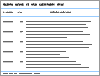
Table 1
Representative cases in somatic cell cloning sheep/goat research"
克隆物种 Clone species | 年份 Year | 供体细胞类型 Donor cell type | 技术改进 Technical improvement | 完成单位 Implementing agency | 参考文献 References |
|---|---|---|---|---|---|
多利羊 Dolly sheep | 1997 | 成年绵羊乳腺细胞 | 首次实现体细胞核移植 | 英国罗斯林研究所 | Wilmut等[ |
济宁青山羊 Jining Qing Grey goat | 2000 | 成年山羊耳缘组织成纤维细胞 | 建立山羊克隆技术体系 | 西北农林科技大学 | 郭继彤等[ |
波尔山羊 Boer goat | 2002 | 胎儿成纤维细胞 | 实现品种间克隆(波尔山羊体细胞与萨能奶山羊卵母细胞) | 上海转基因研究中心 | 陈建泉等[ |
宁夏滩羊 Ningxia Tan sheep | 2024 | 胎儿成纤维细胞 | 结合基因编辑与克隆技术 | 西北农林科技大学 | 惠思远等[ |
藏羊 Tibetan sheep | 2024 | 藏羊皮肤细胞 | 高原适应性胚胎培养系统 | 西北农林科技大学 | Han等[ |
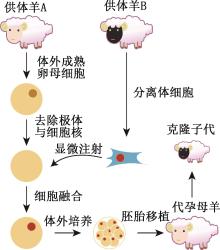
Fig.1
Process of SCNT technology"
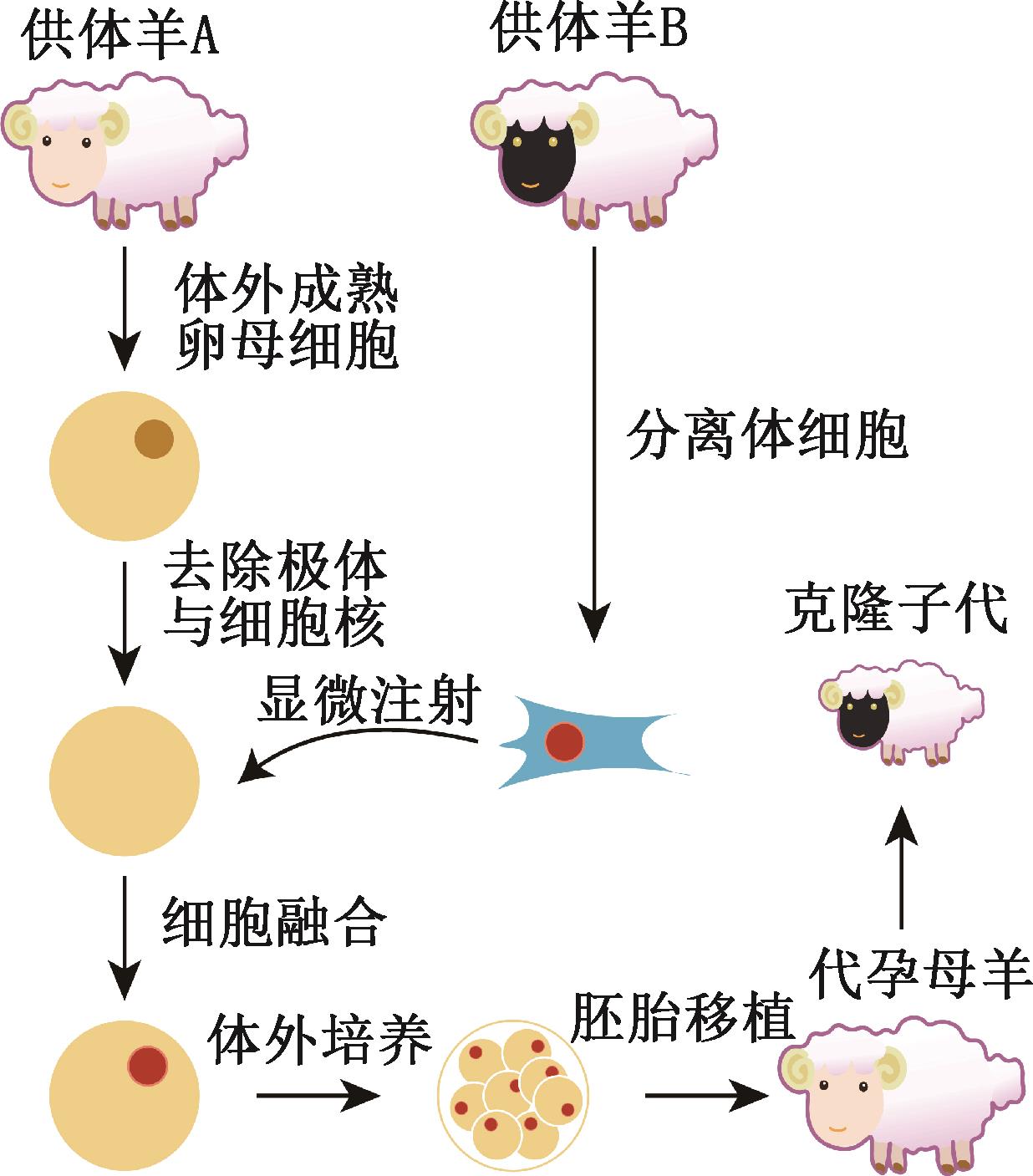
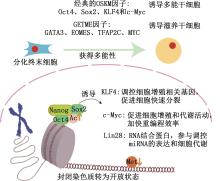
Fig.2
Key factors and mechanism of nuclear reprogr-ammingAc,Acetylation;Met, Methylation;Oct4, Octamer-binding transcription factor 4;Sox2, SRY box transcription factor 2;Nanog, Homologous box transcription factor Nanog"

Table 2
Effect of intervention on epigenetics"
干预措施 Intervention | 目标物种 Target species | 表观差异纠正 Epigenetic correction | 作用 Effect | 参考文献 References |
|---|---|---|---|---|
| TSA+Kdm4d | 食蟹猴 | H3K9me3去甲基化 | 妊娠率提高 | Liu等[ |
| Xist KO+Kdm4d | 小鼠 | H3K9me3去甲基化 | EPI分化延迟 | Li等[ |
| C35 | 小鼠 | 5hmC抑制 | 促进重编程 | Singh等[ |
| P300 | 小鼠 | 组蛋白巴豆酰化 | 促进囊胚发育 | Gao等[ |
| [1] | WILMUT I, SCHNIEKE A E, MCWHIR J, et al. Viable offspring derived from fetal and adult mammalian cells[J]. Nature, 1997, 385(6619):810-813. |
| [2] | 郭继彤.成年体细胞克隆山羊研究[D].杨凌:西北农林科技大学,2000. |
| GUO J T. Cloned goats from adult somatic cells by nuclear transfer[D].Yangling: Northwest A&F University, 2000. (in Chinese) | |
| [3] | 陈建泉,潘 勇,赵建阳,等.山羊品种间体细胞核移植研究[J].实验生物学报,2002,4:278-282. |
| CHEN J Q, PAN Y, ZHAO J Y, et al. Study on the cloning goat by cross-breed somatic cell nuclear transfer[J]. Shi Yan Sheng Wu Xue Bao,2002,4:278-282. (in Chinese) | |
| [4] | 惠思远. RXFP2基因敲除滩羊的制备及表型分析[D].杨凌:西北农林科技大学,2023. |
| HUI S W. Preparation and phenotypic analysis of RXFP2 knockout Tan sheep[D]. Yangling: Northwest A&F University, 2023. (in Chinese) | |
| [5] | HAN B, TIAN D, LI X, et al. Multiomics analyses provide new insight into genetic variation of reproductive adaptability in Tibetan sheep[J]. Molecular Biology and Evolution, 2024, 41(3):msae058. |
| [6] | SINCLAIR K D, CORR S A, GUTIERREZ C G, et al. Healthy ageing of cloned sheep[J]. Nature Communications, 2016, 7:12359. |
| [7] | RIDEOUT W M 3 RD, EGGAN K, JAENISCH R. Nuclear cloning and epigenetic reprogramming of the genome[J]. Science, 2001, 293(5532):1093-1098. |
| [8] | POLEJAEVA I A, CHEN S H, VAUGHT T D, et al. Cloned pigs produced by nuclear transfer from adult somatic cells[J]. Nature, 2000, 407(6800):86-90. |
| [9] | LEE B C, KIM M K, JANG G, et al. Dogs cloned from adult somatic cells[J]. Nature, 2005, 436(7051):641. |
| [10] | 王志贤.过表达oTLR4转基因绵羊抗布鲁氏菌病能力的评估及其机制研究[D].北京:中国农业大学,2017. |
| WANG Z X. The evaluation of the resistance of transgenic sheep overexpressing oTLR4 to brucellosis and its mechanism [D].Beijing: China Agricultural University, 2017. (in Chinese) | |
| [11] | SHAKWEER W M E, KRIVORUCHKO A Y, DESSOUKI S M, et al. A review of transgenic animal techniques and their applications[J]. Journal of Genetic Engineering and Biotechnology, 2023, 21(1):55. |
| [12] | FU B, MA H, LIU D. 2-cell-like cells: An avenue for improving SCNT efficiency[J]. Biomolecules, 2022, 12(11): 1611. |
| [13] | 苏文龙, 李 璐, 孟娜娜,等.绵羊卵丘细胞细胞周期同步化对核移植胚胎发育的影响[J].中国畜牧兽医,2015,42(3):658-662. |
| SU W L, LI L, MENG N N, et al. Effects on somatic cell nuclear transfer embryos development of cell cycle synchronization of sheep cumulus cells[J]. China Animal Husbandry & Veterinary Medicine, 2015, 42(3):658-662. (in Chinese) | |
| [14] | WANG J, WANG L, WANG Z, et al. Vitamin C down-regulates the H3K9me3-dependent heterochromatin in buffalo fibroblasts via PI3K/PDK1/SGK1/KDM4A signal axis[J]. Theriogenology, 2023, 200:114-124. |
| [15] | VAN DER REEST J, NARDINI CECCHINO G, HAIGIS M C, et al. Mitochondria: Their relevance during oocyte ageing[J]. Ageing Research Reviews, 2021, 70:101378. |
| [16] | ISHIGAKI M, KASHIWAGI S, WAKABAYASHI S, et al. In situ assessment of mitochondrial respiratory activity and lipid metabolism of mouse oocytes using resonance Raman spectroscopy[J]. Analyst, 2021, 146(23):7265-7273. |
| [17] | BYRNE J A, PEDERSEN D A, CLEPPER L L, et al. Producing primate embryonic stem cells by somatic cell nuclear transfer[J]. Nature, 2007, 450(7169):497-502. |
| [18] | TACHIBANA M, AMATO P, SPARMAN M, et al. Human embryonic stem cells derived by somatic cell nuclear transfer[J]. Cell, 2013, 153(6):1228-1238. |
| [19] | 李 勇,程 龙,孙 毅,等.不同方法对滩羊卵母细胞孤雌激活及重构胚发育影响的研究[J].中国兽医学报,2015,35(9):1557-1561. |
| LI Y, CHENG L, SUN Y, et al. The effects of different methods on Tan sheep oocyte parthenogenetic activation and embryo culture system [J]. Chinese Journal of Veterinary Science, 2015, 35(9):1557-1561. (in Chinese) | |
| [20] | 石俊松,罗绿花,周 荣,等.延迟激活对猪克隆胚胎体外、体内发育效率的影响[J].中国生物工程杂志,2019,39(4):16-23. |
| SHI J S, LUO H L, ZHOU R, et al. Delayed activation can improve in vitro and in vivo developmental capacity of pig cloned embryos[J]. China Biotechnology, 2019, 39(4):16-23. (in Chinese) | |
| [21] | BAGCHI I C, BAGCHI M K. Maternal-fetal mechanisms underlying adaptation to hypoxia during early pregnancy[J]. Trends in Endocrinology and Metabolism, 2024, 35(12):1091-1099. |
| [22] | HUAN Y, ZHU J, HUANG B, et al. Trichostatin A rescues the disrupted imprinting induced by somatic cell nuclear transfer in pigs[J]. PLoS One, 2015, 10(5):e0126607. |
| [23] | SCOGNAMIGLIO R, CABEZAS-WALLSCHEID N, THIER M C, et al. Myc depletion induces a pluripotent dormant state mimicking diapause[J]. Cell, 2016, 164(4):668-680. |
| [24] | 尹修远,王 建,李拥军,等.同期发情技术在绵羊生产上的应用[J].当代畜牧,2018,30:18-20. |
| YIN X Y, WANG J, LI Y J, et al. Application of simultaneous oestrus technology in sheep production [J]. Contemporary Animal Husbandry, 2018, 30:18-20. (in Chinese) | |
| [25] | 陈贱兰.超声多普勒血流监测在高危妊娠筛查中的应用价值[J].吉林医学,2024,45(12):2929-2931. |
| CHEN J L. Application value of ultrasonic Doppler blood flow monitoring in high-risk pregnancy screening [J]. Jilin Medical Journal, 2024, 45(12):2929-2931. (in Chinese) | |
| [26] | CAO Z, HONG R, DING B, et al. TSA and BIX-01294 induced normal DNA and histone methylation and increased protein expression in porcine somatic cell nuclear transfer embryos[J]. PLoS One, 2017, 12(1):e0169092. |
| [27] | XU R, ZHU Q, ZHAO Y, et al. Unreprogrammed H3K9me3 prevents minor zygotic genome activation and lineage commitment in SCNT embryos[J]. Nature Communications, 2023, 14(1):4807. |
| [28] | O’DWYER M R, AZAGURY M, FURLONG K, et al. Nucleosome fibre topology guides transcription factor binding to enhancers[J]. Nature, 2025, 638(8049):251-260. |
| [29] | SUN Y, HU X, HUANG X, et al. Hypertranscription of rDNA responsible for nucleolar remodelling is a doorman for acquiring pluripotency[J]. Cell Proliferation, 2025,4:e70052. |
| [30] | XU L, IDREES M, JOO M D, et al. Constitutive expression of TERT enhances β-klotho expression and improves age-related deterioration in early bovine embryos[J]. International Journal of Molecular Sciences, 2021, 22(10):5327. |
| [31] | SAHIN E, COLLA S, LIESA M, et al. Telomere dysfunction induces metabolic and mitochondrial compromise[J]. Nature, 2011, 470(7334):359-365. |
| [32] | INOUE Y, AOKI S, ITO J, et al. Telomere length determines the mitochondrial copy number in blastocyst-stage embryos[J]. Mitochondrion, 2024, 77:101887. |
| [33] | SHIM H S, IACONELLI J, SHANG X, et al. TERT activation targets DNA methylation and multiple aging hallmarks[J]. Cell, 2024, 187(15):4030-4042.e13. |
| [34] | WANG L Y, LI Z K, WANG L B, et al. Overcoming intrinsic H3K27me3 imprinting barriers improves post-implantation development after somatic cell nuclear transfer[J]. Cell Stem Cell, 2020, 27(2):315-325.e5. |
| [35] | TSUKAMOTO T, MIZUTA H, SAKAI E, et al. Evaluation of the correlation between nuclear localization levels and genome editing efficiencies of Cas12a fused with nuclear localization signals[J]. Journal of Pharmaceutical Sciences, 2025, 114(2):841-848. |
| [36] | LIU Z, CAI Y, WANG Y, et al. Cloning of Macaque monkeys by somatic cell nuclear transfer[J]. Cell, 2018, 172(4):881-887.e7. |
| [37] | LI Y, ZHENG C, LIU Y, et al. Inhibition of Wnt activity improves peri-implantation development of somatic cell nuclear transfer embryos[J]. National Science Review, 2023, 10(9):nwad173. |
| [38] | SINGH A K, ZHAO B, LIU X, et al. Selective targeting of TET catalytic domain promotes somatic cell reprogramming[J]. Proceedings of the National Academy of Sciences of the United States of America, 2020, 117(7):3621-3626. |
| [39] | GAO D, LI C, LIU S Y, et al. P300 regulates histone crotonylation and preimplantation embryo development[J]. Nature Communications, 2024, 15(1):6418. |
| [40] | FENG R, ZHAO J, ZHANG Q, et al. Generation of anti-mastitis gene-edited dairy goats with enhancing lysozyme expression by inflammatory regulatory sequence using ISDra2-TnpB system[J]. Advanced Science, 2024, 11(38):e2404408. |
| [41] | GIM G M, EOM K H, KWON D H, et al. Generation of double knockout cattle via CRISPR-Cas9 ribonucleoprotein (RNP) electroporation[J]. Journal of Animal Science and Biotechnology, 2023, 14(1):103. |
| [42] | WISELY S M, RYDER O A, SANTYMIRE R M, et al. A road map for 21st century genetic restoration: Gene pool enrichment of the black-footed ferret[J]. Journal of Heredity, 2015, 106(5):581-592. |
| [43] | LAN T, YANG S, LI H, et al. Large-scale genome sequencing of giant pandas improves the understanding of population structure and future conservation initiatives[J]. Proceedings of the National Academy of Sciences of the United States of America, 2024, 121(36):e2406343121. |
| [44] | 伊恩·维尔穆特.从克隆羊多利到个性化治疗[J].科技导报,2019,37(2):29-30. |
| WILMUT I. From Dolly to personalised medicine [J]. Science & Technology Review, 2019, 37(2):29-30. (in Chinese) | |
| [45] | MIKHALCHENKO A, GUTIERREZ N M, FRANA D, et al. Induction of somatic cell haploidy by premature cell division[J]. Science Advances, 2024, 10(10):eadk9001. |
| [46] | YOSHINO T, SUZUKI T, NAGAMATSU G, et al. Generation of ovarian follicles from mouse pluripotent stem cells[J].Science, 2021, 373(2021):eabe0237. |
| [1] | SUN Lu, LI Shufang, WANG Lina, ZHAO Jianxin, LU Henan, WANG Hairong. Effects of Total Alkaloids from Sophora alopecuroides Added to a High-concentrate Diet on Hepatic Glucose Metabolism in Sheep Based on Transcriptome Sequencing [J]. China Animal Husbandry & Veterinary Medicine, 2026, 53(2): 671-681. |
| [2] | YANG Yang, CAO Xing, CHEN Bin, LIU Wujun. Comparison of Gene Expression in Liver and Rumen Microbiota Composition Differences Between Duolang Sheep and Hu Sheep Based on Omics Approaches and Their Impacts on Environmental Adaptability [J]. China Animal Husbandry & Veterinary Medicine, 2026, 53(2): 711-722. |
| [3] | LI Changchang, WU Yinglian, YANG Zhenxiang, LI Lingui, QIN Rongyan, LIU Yanfeng, XU Guishan, WANG Wenqi, DIAO Qiyu. Effects of Suaeda salsa Extract on Rumen Fermentation Parameters and Gastrointestinal Microbiota Community Structure of Hu Sheep [J]. China Animal Husbandry & Veterinary Medicine, 2026, 53(2): 749-760. |
| [4] | YANG Zhenxiang, LI Lingui, LI Changchang, MA Wenbin, LIU Yanfeng, YANG Huiguo, WANG Wenqi, LI Changqing. Effect of Adding Yeast Cultures During Mid to Late Gestation on Production Performance, Postpartum Serum Indices and Rumen Fermentation Parameters in Ewes [J]. China Animal Husbandry & Veterinary Medicine, 2026, 53(2): 810-818. |
| [5] | DANG Danqi, KONG Xiaohui, TIAN Haoliang, LIAN Hongxia, GAO Tengyun, ZHANG Liangyu, ZHANG Liyang, FU Tong. Effects of Peanut Vine Compound Extruded Feed on Growth Performance, Rumen Fermentation and Microbial Composition of Fattening Hu Sheep [J]. China Animal Husbandry & Veterinary Medicine, 2025, 52(9): 4082-4093. |
| [6] | LUO Chunyan, BAI Feng, TENG Wen, AMINIGULI·Abulizi, MAERZIYA·Yasen, ZHOU Xirong, NAZAKAITI·Ainiwaner, MAISITUERGULI·Abulitipu, ZHANG Yuntao, JI Xinmin, ZHANG Yanhua. Genetic Structure Analysis of Turpan Black Sheep Based on Simplified Genome Sequencing [J]. China Animal Husbandry & Veterinary Medicine, 2025, 52(9): 4216-4225. |
| [7] | ZHONG Bingqian, SUBINUR Eli, ZHU Aiwen, SUN Yan, WANG Yutao, YAN Wei. Transcriptional Regulation of VTN Gene Promoter in Sheep Rumen Epithelial Cells [J]. China Animal Husbandry & Veterinary Medicine, 2025, 52(8): 3527-3539. |
| [8] | ZHANG Zhaoling, LI Xiongxiong, WANG Yanchi, JIAO Ting, TAN Xianyi, LIU Chao, ZHAO Shengguo, CAI Yuan. Effect of Yeast Cultures on Growth Performance,Blood Physiological and Biochemical Indexes and Rumen Fermentation Parameters in Lambs [J]. China Animal Husbandry & Veterinary Medicine, 2025, 52(8): 3563-3573. |
| [9] | ZHU Shuo, SUN Jinghua, BAO Jingjing, SHANG Mingyu, LIU Tianyi, XIONG Jinke, YANG Peifu, YAO Shuhai, SUN Xintian, HE Jianning, YANG Huiguo, ZHANG Li. Polymorphisms of MAP2K6 Gene and Its Association Analysis with Growth Traits in Hu Sheep [J]. China Animal Husbandry & Veterinary Medicine, 2025, 52(8): 3695-3706. |
| [10] | LI Wei, HUANG Qiaoyan, WANG Xinkun, GU Ruohuai, SUN Huiping, ZHU Lexiao, XING Feng. Cloning, Sequence Analysis and Protein Expression of LIN28A Gene Promoter in Duolang Sheep [J]. China Animal Husbandry & Veterinary Medicine, 2025, 52(7): 2992-3003. |
| [11] | CAI Wenjing, CI Qiuyang, TANG Lin, LIU Hang, SUN Xinming, CHEN Yang, JIANG Huaizhi. Differential Expression Analysis of FABP4 Gene in Mammary Gland of Small-tailed Han Sheep Before and After Pregnancy [J]. China Animal Husbandry & Veterinary Medicine, 2025, 52(7): 3234-3241. |
| [12] | NIU Shuran, PAN Jianfeng, RONG Youjun, AO Xiaofang, WANG Yihan, SHANG Fangzheng, WANG Ruijun, ZHANG Yanjun. Advances on the Application of Circular RNA in Important Economic Traits in Sheep [J]. China Animal Husbandry & Veterinary Medicine, 2025, 52(6): 2468-2481. |
| [13] | ZHOU Lusong, ZHAO Yuanyuan, YANG Yuwei, ZHAO Qingyu, MA Qing, TANG Chaohua, ZHANG Huiyan, ZHANG Junmin, QIN Yang, QIN Yuchang. Effects of Sophora alopecuroides and Alkaloids from Sophora alopecuroides on Growth Performance and Rumen Microbiota of Tan Sheep [J]. China Animal Husbandry & Veterinary Medicine, 2025, 52(6): 2540-2551. |
| [14] | ZHANG Chengrui, WEI Xuesheng, ZHANG Mingzhu, WANG Jie, FAN Dingkun, ZHANG Juan, ZHU Dezhi, GUO Fusuo, ZHANG Naifeng. Protein Requirements of Growing Hu Sheep Ewe Lambs During 3 to 5 Months of Age [J]. China Animal Husbandry & Veterinary Medicine, 2025, 52(5): 2128-2139. |
| [15] | SHAN Mingzhu, ZHOU Lisheng, NAOMING Gaowa, ZHANG Xiaoxu, XU Yan, CHU Mingxing, PAN Zhangyuan. The Classification Study of Ovine Horn Type [J]. China Animal Husbandry & Veterinary Medicine, 2025, 52(5): 2177-2186. |
| Viewed | ||||||
|
Full text |
|
|||||
|
Abstract |
|
|||||
