
China Animal Husbandry & Veterinary Medicine ›› 2026, Vol. 53 ›› Issue (1): 489-498.doi: 10.16431/j.cnki.1671-7236.2026.01.044
• Basic Veterinary Medicine • Previous Articles Next Articles
WANG Qilin1( ), CAO Runlai1, LIU Peiwen1, LIU Ziyu1, XUE Zhuqing1, DU Haixia2, ZHANG Yue2, ZHANG Minjing2, LI Yacong1, WANG Weiyang1, CONG Yanfang2, WANG Xiaoxu1(), LIU Zhijie1()
Received:2025-04-22
Online:2026-01-05
Published:2025-12-26
Contact:
WANG Xiaoxu, LIU Zhijie
E-mail:wangqilin@caas.cn;wangxiaoxussdd@126.com;liuzhijie@caas.cn
CLC Number:
WANG Qilin, CAO Runlai, LIU Peiwen, LIU Ziyu, XUE Zhuqing, DU Haixia, ZHANG Yue, ZHANG Minjing, LI Yacong, WANG Weiyang, CONG Yanfang, WANG Xiaoxu, LIU Zhijie. Isolation, Identification and Biological Characteristics Analysis of Bordetella bronchiseptica from Raccoon dog(Nyctereutes procyonoides)[J]. China Animal Husbandry & Veterinary Medicine, 2026, 53(1): 489-498.
Table 1
Primers for isolate identification"
基因 Genes | 引物序列 Primer sequences (5′→3′) | 片段长度 Fragment length/bp | 退火温度 Annealing temperature/℃ | 参考文献 Reference |
|---|---|---|---|---|
| 16S rRNA | F:AGAGTTTGATCMTGGCTCAG | 1 500 | 56 | 赵梦溪等[ |
| R:GGTTACCTTGTTACGACTT | ||||
| fla | F:AGGCTCCCAAGAGAGAAAGGCTT | 237 | 58 | 张瑞华等[ |
| R:TGGCGCCTGCCCTATC |
Table 2
Primer information for virulence genes and drug resistance genes"
分类 Classification | 基因 Genes | 引物序列 Primer sequences (5′→3′) | 片段长度 Fragment length/bp | |
|---|---|---|---|---|
毒力基因 Virulence genes | prn | F:CAGCGTCGATTTCCAGCAGCC | R:TCCYGCATGACGACCAGCTT | 138 |
| bvgs | F:ATTACCTCCCATCATCCGAA | R:TCTTGACGACCGGATGGTT | 351 | |
| fla | F:CCCCCGCACATTTCCGAACTTC | R:AGGCTCCCAAGAGAGAAAGGC | 164 | |
| fhaB | F:GCGCAGAACATCACCAATG | R:TGAAATACTCCATGGCGGAC | 475 | |
| cyaA | F:CTACGAGCAGTTCGAGTTTC | R:TATTCATGTCGCCGTCGTA | 377 | |
| dnt | F:CGTTCGGCTGGGAGATGG | R:CCGGGCGGTACTTGGGAT | 491 | |
耐药基因 Drug resistance genes | blaOXA | F:GTGAAGCGTGTTGGTTAT | R:AGCCTACTTGTGGGTCTA | 274 |
| blaTEM | F:TTCCGTGTCGCCCTTATTCC | R:TATCCGCCTCCATCCAGTCT | 622 | |
| blaCTX | F:GTTGTTATTTCGTATCTTCCAG | R:ATTCGGTTCGCTTTCACT | 311 | |
| blaSHV | F:GACCGCTGGGAAACGGAACT | R:CCCGCAGATAAATCACCACAA | 307 | |
| ermA | F:TAATGAACGCTTAATGTCAG | R:GTTTACCGCTTCTTTAGTCA | 269 | |
| ermB | F:CATTTAACGACGAAACTGG | R:CGGGTAAGTTTTATTAAGACAC | 407 | |
| parC | F:CCTTGCGCTACATGAATTTA | R:TCAATAGCAGCTCGGAATAT | 380 | |
| cmlA | F:GTACGACAGCGAGCACAATT | R:ATTCCAGCGGCGTAACACAA | 544 | |
| tetC | F:TCGGAATCTTGCACGCCCTC | R:CGCCTACAATCCATGCCAACCC | 360 | |
| catA | F:GGATCTCTTATGACCAACTA | R:GGCATCGGCTTGATTGAATT | 494 | |
| sul1 | F:TTTCCTGACCCTGCGCTCTA | R:ATTGCCGATCGCGTGAAGTT | 405 | |
| floR | F:CGTTTATGCCAACCGTCCTG | R:ACGATCATTACAAGCGCGACA | 402 | |
| gyrA | F:ACGGTCTCAAGCCTGTGCATC | R:CTCCTGTTCGCTGCCGTCGTA | 350 | |

Fig.1
The colony morphology and Gram staining microscopic examination results of the isolateA, TSB agar plate; B, MAC agar plate; C, Gram staining microscopy examination (1 000×)"

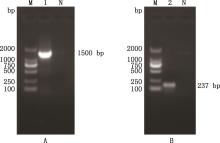
Fig.2
PCR amplification and identification results of 16S rRNA (A) and fla gene (B) of the isolateM, DL2000 DNA Marker;1, PCR amplification product of 16S rRNA;N, Negative control;2, PCR amplification product of fla gene"
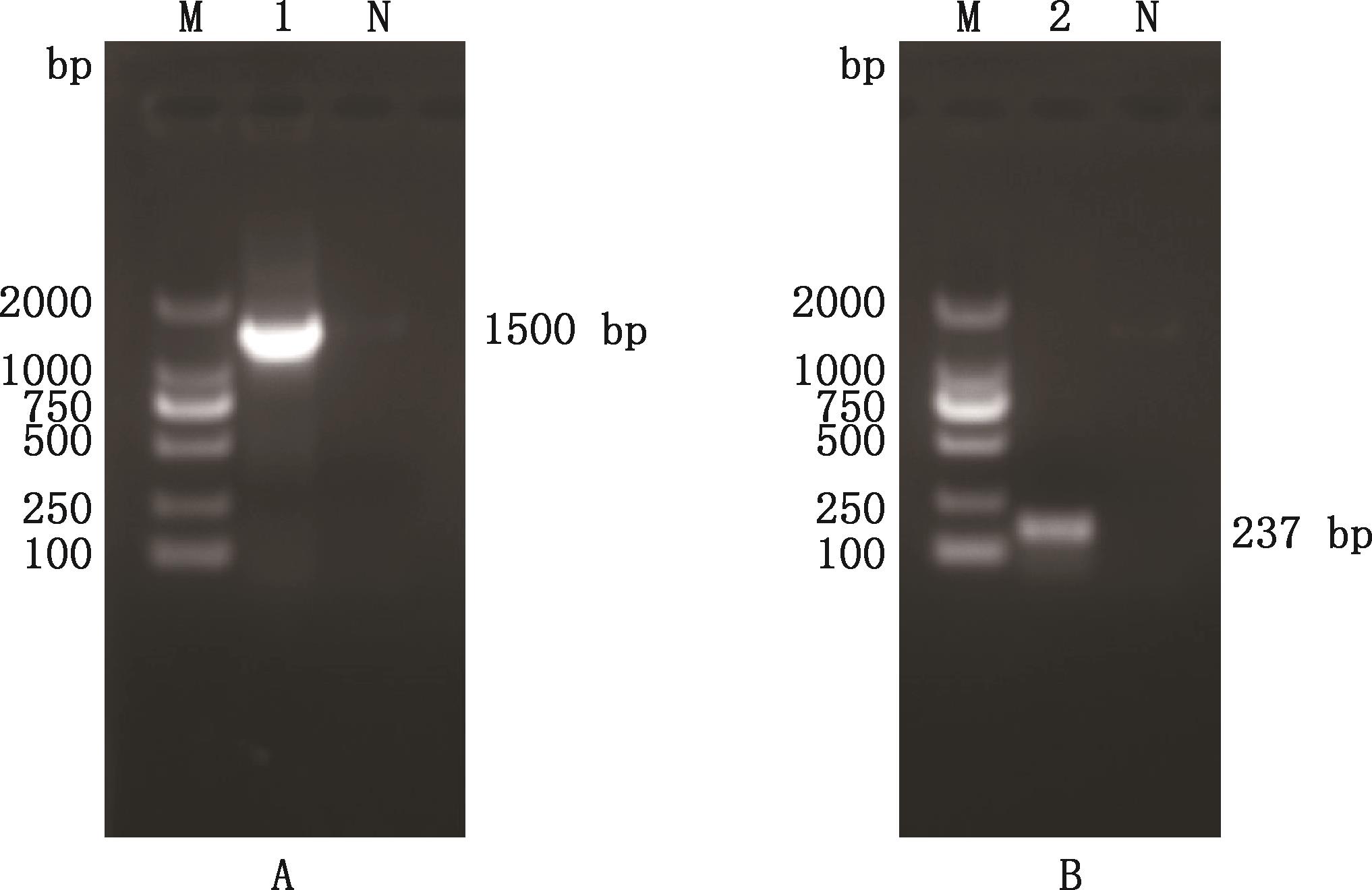
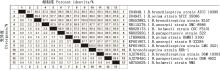
Fig.3
Similarity alignment of the 16S rRNA gene sequences between the isolate and the reference strains"

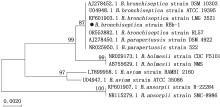
Fig.4
Phylogenetic tree based on 16S rRNA gene"

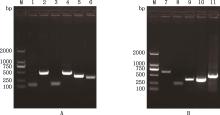
Fig. 5
PCR amplification detection results of virulence genes (A) and drug resistance genes (B) of the isolateM,DL2000 DNA Marker;1-6, The virulence genes prn, bvgs, fla, fhaB, cyaA and dnt, respectively;7-11, The drug resistance genes blaTEM, blaSHV, parC, tetC and gyrA, respectively"
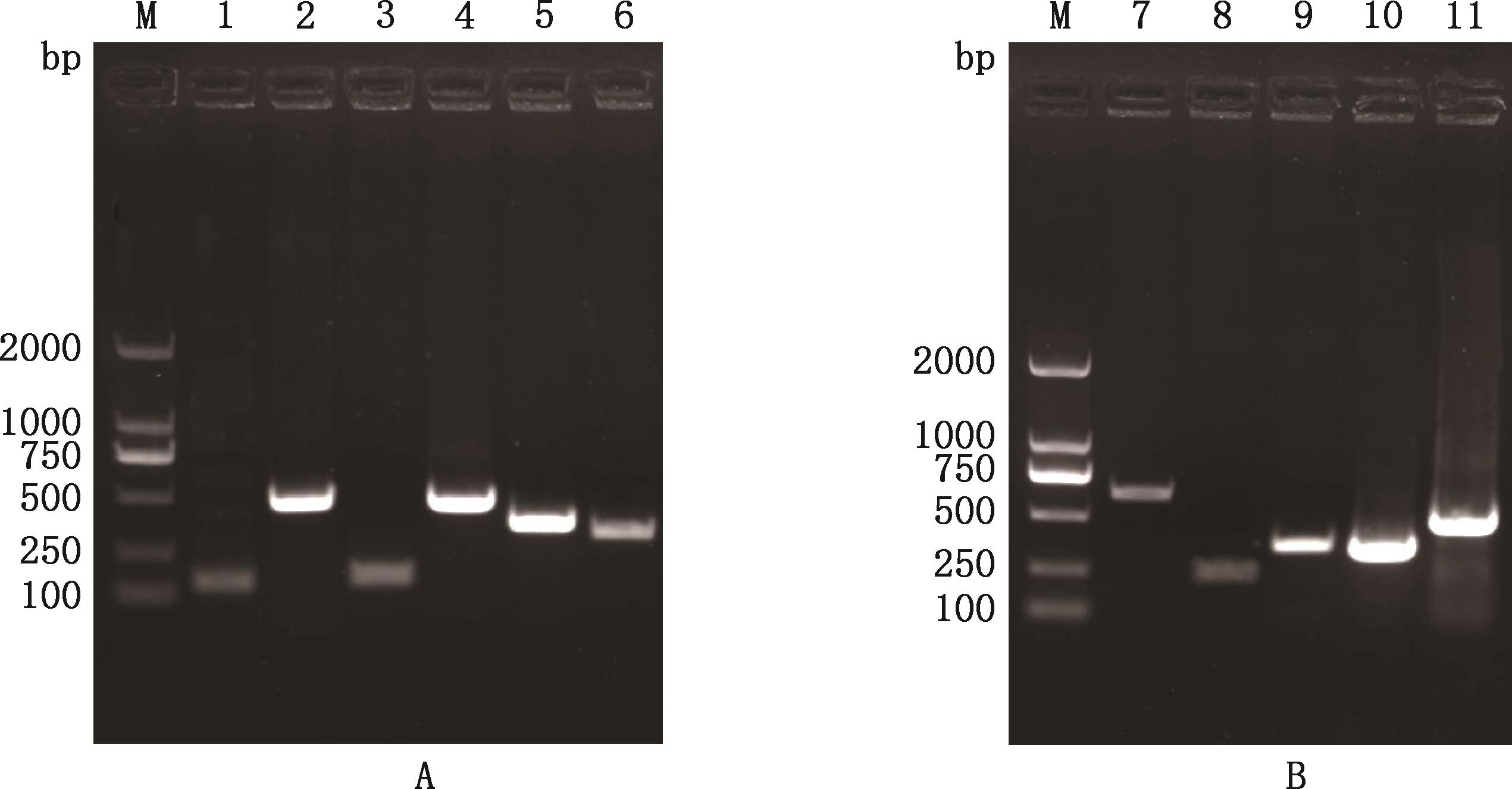
Table 3
Drug sensitivity test results of the isolate"
分类 Classification | 抗菌药物 Antibacterial | 判定标准 Judgment standards/mm | 抑菌圈直径 IZD/mm | 结果 Results | ||
|---|---|---|---|---|---|---|
| R | I | S | ||||
青霉素类 Penicillins | 苯唑西林 Oxacillin | ≤10 | 11~12 | ≥13 | 6 | R |
| 氨苄西林 Ampicillin | ≤13 | 14~16 | ≥17 | 6 | R | |
| 哌拉西林 Piperacillin | ≤17 | 18~20 | ≥21 | 6 | R | |
头孢菌素类 Cephalosporins | 头孢氨苄 Cefalexin | ≤14 | 15~17 | ≥18 | 6 | R |
| 头孢唑林 Cefazolin | ≤14 | 15~17 | ≥18 | 6 | R | |
| 头孢拉定 Cefradine | ≤14 | 15~17 | ≥18 | 6 | R | |
| 头孢呋辛 Cefuroxime | ≤14 | 15~17 | ≥18 | 6 | R | |
| 头孢他啶 Ceftazidime | ≤14 | 15~17 | ≥18 | 25 | S | |
| 头孢曲松 Ceftriaxone | ≤13 | 14~20 | ≥21 | 16 | I | |
| 头孢哌酮 Cefoperazone | ≤15 | 16~20 | ≥21 | 28 | S | |
氨基糖苷类 Aminoglycosides | 丁胺卡那 Amikacin | ≤14 | 15~16 | ≥17 | 18 | S |
| 庆大霉素 Gentamicin | ≤12 | 13~14 | ≥15 | 20 | S | |
| 卡那霉素 Kanamycin | ≤13 | 14~17 | ≥18 | 18 | S | |
| 新霉素 Neomycin | ≤12 | 13~16 | ≥17 | 18 | S | |
四环素类 Tetracyclines | 四环素 Tetracycline | ≤14 | 15~18 | ≥19 | 6 | R |
| 多西环素 Doxycycline | ≤12 | 13~15 | ≥16 | 14 | I | |
大环内酯类 Macrolides | 红霉素 Erythromycin | ≤13 | 14~22 | ≥23 | 16 | I |
| 麦迪霉素 Midecamycin | ≤13 | 14~17 | ≥18 | 6 | R | |
喹诺酮类 Quinolones | 诺氟沙星 Norfloxacin | ≤12 | 13~16 | ≥17 | 21 | S |
| 氧氟沙星 Ofloxacin | ≤12 | 13~15 | ≥16 | 22 | S | |
| 环丙沙星 Ciprofloxacin | ≤15 | 16~20 | ≥21 | 27 | S | |
林可酰胺类 Lincosamides | 克林霉素 Clindamycin | ≤14 | 15~20 | ≥21 | 6 | R |
| 糖肽类 Glycopeptides | 万古霉素 Vancomycin | ≤9 | 10~11 | ≥12 | 6 | R |
| 磺胺类 Sulfonamides | 复方星诺明 Compound sulfamethoxazole | ≤10 | 11~15 | ≥16 | 6 | R |
| 硝基呋喃类 Nitrofurans | 呋喃唑酮 Furazolidone | ≤14 | 15~16 | ≥17 | 6 | R |
Table 4
Pathogenicity test results of the isolate"
菌液浓度 Bacterial solution concentration/(CFU/mL) | 死亡数 Number of deaths/只 | 死亡率 Death rate/% |
|---|---|---|
| 0 | 0 | 0 |
| 1.6×10⁵ | 0 | 0 |
| 1.6×10⁶ | 0 | 0 |
| 1.6×10⁷ | 2 | 25 |
| 1.6×10⁸ | 7 | 87.5 |
| 1.6×10⁹ | 8 | 100 |
| [1] | 陈东前,张玉瑾,王建秋,等.河北省圈养貉隐孢子虫流行现状调查[J].安徽科技学院学报,2024, 38(1):7-12. |
| CHEN D Q, ZHANG Y J, WANG J Q, et al.Prevalence of Cryptosporidium spp. in captive-bred raccoon dogs in Hebei province[J]. Journal of Anhui Science and Technology University,2024, 38(1):7-12.(in Chinese) | |
| [2] | 张野民,石庆龙.数理统计在广义农林生产与生态中应用研究[J].农业与技术,2014,34(8): 81. |
| ZHANG Y M, SHI Q L. Application of mathematical statistics in agriculture and forestry production and ecology[J]. Agriculture and Technology, 2014,34(8): 81.(in Chinese) | |
| [3] | GONG Q L, LI D, DIAO N C, et al. Mink Aleutian disease seroprevalence in China during 1981-2017: A systematic review and Meta-analysis[J].Microbial Pathogenesis,2020,139:103908. |
| [4] | 李倩倩,靳元元,赵 强,等.狐、貉源大肠杆菌分离鉴定及毒力基因检测[J].微生物学通报, 2022,49(3):1048 -1056. |
| LI Q Q, JIN Y Y, ZHAO Q, et al. Isolation, identification, and virulence gene detection of Escherichia coli from fox and raccoon dog[J]. Microbiology China, 2022,49(3):1048-1056.(in Chinese) | |
| [5] | CHEN D Q, WANG Q Y, LI Q Q, et al. The first report of Tritrichomonas foetus and Tetratrichomonas buttreyi in raccoon dogs (Nyctereutes procyonoides) in China[J]. Acta Parasitologica, 2024,69(3):1352-1358. |
| [6] | QIN S Y, CHU D, SUN H T, et al. Prevalence and genotyping of Toxoplasma gondii infection in raccoon dogs (Nyctereutes procyonoides) in Northern China[J]. Vector-Borne and Zoonotic Disease, 2020,20(3):231-235. |
| [7] | MIGUELENA CHAMORRO B, DE LUCA K, SWAMINATHAN G, et al. Bordetella bronchiseptica and Bordetella pertussis: Similarities and differences in infection, immuno-modulation, and vaccine considerations[J]. Clinical Microbiology Reviews,2023,36(3): e0016422. |
| [8] | HAMIDOU SOUMANA I, LINZ B, HARVILL E T. Environmental origin of the genus Bordetella [J]. Frontiers in Microbiology,2017,8:28. |
| [9] | MATTOO S, CERRY J D. Molecular pathogenesis, epidemiology, and clinical manifestations of respiratory infections due to Bordetella pertussis and other Bordetella subspecies[J]. Clinical Microbiology Reviews,2005,18(2):326-382. |
| [10] | DANIELS H L, SABELLA C. Bordetella pertussis (pertussis)[J]. Paediatric Respiratory Reviews, 2018,39(5):247-257. |
| [11] | 王潘龙,赵 悦,孙 强,等.犬支气管败血波氏杆菌的分离鉴定和灭活疫苗初步应用[J].中国兽医杂志,2024,60(7):41-48. |
| WANG P L, ZHAO Y, SUN Q, et al. Isolation and identification of Bordetella bronchiseptica in canines and preliminary application of inactivated vaccine[J]. Chinese Journal of Veterinary Medicine, 2024,60(7):41-48.(in Chinese) | |
| [12] | 刘世霞.水貂支气管败血波氏杆菌的分离鉴定[J].中国畜禽种业,2015,11(7):65-67. |
| LIU S X.Isolation and identification of Bordetella bronchiseptica from minks[J]. The Chinese Livestock and Poultry Breeding, 2015,11(7):65-67.(in Chinese) | |
| [13] | 张倩文,刘玉梅,王玉琴,等.兔源性支气管败血波氏杆菌和金黄色葡萄球菌的分离鉴定及抗菌药物敏感性分析[J].中国养兔杂志,2022,6:17-21. |
| ZHANG Q W, LIU Y M, WANG Y Q, et al. Isolation and identification of Bordetella bronchosepticum and Staphylococcus aureus from rabbits and analysis of antimicrobial susceptibility[J].Chinese Journal of Rabbit Farming,2022,6:17-21.(in Chinese) | |
| [14] | 赵梦溪,聂民财,徐 雷,等.四川省猪源支气管败血波氏杆菌的分离鉴定及耐药基因和毒力基因检测分析[J].云南农业大学学报(自然科学),2023,38(2):212-219. |
| ZHAO M X, NIE M C, XU L, et al. Isolation and identification of porcine Bordetella bronchiseptica and detection and analysis of its drug resistance genes and virulence genes in Sichuan province[J].Journal of Yunnan Agricultural University (Natural Science),2023,38(2):212-219.(in Chinese) | |
| [15] | 张瑞华,于永乐,张 鸿,等.猪支气管败血波氏杆菌主要毒力基因的检测[J].中国兽医杂志,2022,58(5):29-32. |
| ZHANG R Y, YU Y L, ZHANG H, et al. Detection of main virulence genes in Bordetella bronchiseptica strains from swine[J]. Chinese Journal of Veterinary Medicine,2022,58(5):29-32.(in Chinese) | |
| [16] | 曹洪志,李成贤,彭茜翎,等.家兔支气管败血波氏杆菌的分离鉴定及耐药基因检测[J].饲料工业,2024,45(5):70-76. |
| CAO H Z, LI C X, PENG Q L, et al. Isolation and identification of Bordetella bronchiseptica from rabbit and detection of resistance gene[J].Feed Industry,2024,45(5):70-76.(in Chinese) | |
| [17] | CLINICAL AND LABORATORY STANDARDS INSTITUTE. Performance standards for antimicrobial susceptibilitytesting-31st edition: CLSI M100-ed31 [S]. Malvern:Clinical and Laboratory Standards Institute, 2020. |
| [18] | JOHN K, YURIY T, KEITH G. A very rare entity: Bordetella bronchiseptica infection in a Human immunodeficiency virus (HIV)-infected patient[J]. Chest, 2015,148(4):96A. |
| [19] | BRANISLAV K, CHRISTIANE W L, NORA N, et al. Association between Pneumocystis spp. and co-infections with Bordetella bronchiseptica, Mycoplasma hyopneumoniae and Pasteurella multocida in Austrian pigs with pneumonia[J]. The Veterinary Journal, 2016,207:177-179. |
| [20] | DESIREE V, MAREN W, WOLFGANG B, et al. Bordetella bronchiseptica promotes adherence, colonization, and cytotoxicity of Treptococcus suis in a porcine precision-cut lung slice model[J]. Virulence,2020,12 (1):84-95. |
| [21] | EDWARDS J A, GROATHOUS N A, BOITANO S. Bordetella bronchiseptica adherence to cilia is mediated by multiple adhesin factors and blocked by surfactant protein A[J]. Infection and Immunity, 2005,73(6):3618-3626. |
| [22] | ZHANG Y, YANG H, GUO L, et al. Isolation, antimicrobial resistance phenotypes, and virulence genes of Bordetella bronchiseptic from pigs in China, 2018-2020[J]. Frontiers in Veterinary Science,2021,8:672716. |
| [23] | BROCKMEIER S L, REGISTER K B, MAGYAR T, et al. Role of the dermonecrotic toxin of Bordetella bronchiseptica in the pathogenesis of respiratory disease in swine[J]. Infection and Immunity,2002,70(2):481-490. |
| [24] | GUISO N. Bordetella adenylate cyclase-hemolysin toxins[J]. Toxins (Basel),2017,9(9):277. |
| [25] | LÖPEZ-BOADO Y S, COBB L M, DEORA R. Bordetella bronchiseptica flagellin is a proinflammatory determinant for airway epithelial cells[J].Infection and Immunity,2005,73(11):7525-7534. |
| [26] | PRÜLLER S, RENSCH U, MEEMKEN D, et al. Antimicrobial susceptibility of Bordetella bronchiseptica isolates from swine and companion animals and detection of resistance genes[J]. PLoS One,2015,10(8):e0135703. |
| [27] | HUSNA A, RAHMAN M M, BADRUZZAMAN A T M, et al. Extended-spectrum β-lactamases (ESBL): Challenges and opportunities[J]. Biomedicines, 2023,11(11):2937. |
| [28] | 诸明欣,张焕容,张 斌,等. 猪支气管败血波氏杆菌的分离鉴定及部分生物学特性的研究[J].中国兽医科学,2017,47(3):341-345. |
| ZHU M X, ZHANG H R, ZHNAG B, et al. Isolation,identification and biological characterization of Bordetella bronchiseptica from swine[J].Chinese Veterinary Science,2017,47(3):341-345.(in Chinese) | |
| [29] | 李雅卓,颜亚松,王 昊,等.犬源支气管败血波氏杆菌的分离鉴定和全基因组测序分析[J].中国兽医杂志,2024,60(11):24-31. |
| LI Y Z, YAN Y S, WANG H, et al. Isolation,identification and whole genome sequencing analysis of a canine Bordetella bronchiseptica strain[J].Chinese Journal of Veterinary Medicine,2024,60(11):24-31.(in Chinese) | |
| [30] | 姜睿姣,张鹏飞,王 印,等. 西部白眉长臂猿支气管败血波氏杆菌的分离鉴定及其耐药基因检测[J].西北农业学报,2020,29(5):668-674. |
| JIANG R J, ZHANG P F, WANG Y, et al. Isolation and identification of Bordetella bronchiseptica from western Hylobates hoolock and detection of resistance gene[J].Acta Agriculturae Boreali-occidentalis Sinica,2020,29(5):668-674.(in Chinese) |
| [1] | ZHANG Sui, CHENG Chunjie, YANG Chun, CHEN Mengjiao, CHENG Jing, ZHOU Linyi, LI Yongqing, WANG Xiaoying, LIU Wenxiao. Isolation, Identification and Pathogenicity Analysis of Dairy Cow-derived Klebsiella pneumoniae and Mannheimia haemolytica [J]. China Animal Husbandry & Veterinary Medicine, 2026, 53(2): 903-915. |
| [2] | ZHANG Min, LI Yingxiao, ZHANG Lulu, HE Shuhai, QU Zhehui, QIN Dongsheng, LIU Jicheng, JIAO Fengchao. Whole Genome Amplification and Phylogenetic Analysis of Duck Astrovirus Type 1 Xinyang Strain [J]. China Animal Husbandry & Veterinary Medicine, 2026, 53(2): 959-972. |
| [3] | ZHANG Xinxin, ZHANG Yue, CUI An, LI Jinru, ZHANG Yunjing, HE Lixia, YANG Guijun, REN Yudong, LI Guangxing. Isolation, Identification and Genetic Evolution Analysis of PEDV Epidemic Strains in Heilongjiang Province [J]. China Animal Husbandry & Veterinary Medicine, 2026, 53(1): 378-389. |
| [4] | LIAN Kaiqi, WANG Yuhang, MENG Xiangfeng, ZHANG Mingliang, ZHOU Lingling. Isolation, Identification and Drug Resistance Analysis of Pathogenic Escherichia coli from Pavo cristatus [J]. China Animal Husbandry & Veterinary Medicine, 2026, 53(1): 448-458. |
| [5] | WANG Ya, LI Zhiguo, LUO Rongyan, LIU Ruiguo, ZUO Zhicai, MA Xiaoping. Isolation, Identification, Phylogenetic Analysis and Drug Sensitivity Test of Trichophyton verrucosum from Beef Cattle in Sichuan [J]. China Animal Husbandry & Veterinary Medicine, 2026, 53(1): 459-468. |
| [6] | LI Fuxiang, SONG Jianling, LI Zhanhong. Isolation, Identification and Biological Characterization of Actinobacillus pleuropneumoniae Serotype 7 from Pigs in Yunnan [J]. China Animal Husbandry & Veterinary Medicine, 2026, 53(1): 499-508. |
| [7] | ZHAO Xuejian, CHEN Xiaoliang, FENG Xiaowei, ZHANG Kang, MA Xiaojun, LI Jianxi. Investigation of the Pathogen of Calf Diarrhea in Gansu Region and Isolation, Identification and Drug Resistance Analysis of Clostridium perfringens [J]. China Animal Husbandry & Veterinary Medicine, 2025, 52(8): 3927-3938. |
| [8] | DAI Lin, HUAI Zhifang, WANG Baowei, ZHANG Ming'ai, FAN Wenlei, ZHANG Jing, WANG Binghan, QI Guofeng. Isolation, Identification and Biological Properties and Safety of A Lactiplantibacillus plantarum Strain [J]. China Animal Husbandry & Veterinary Medicine, 2025, 52(7): 3070-3083. |
| [9] | LU Chong, WANG Yuyan, FU Han, LI Tongyang, MIAO Ronghao, LU Yabin, LI Jianlong, LIU Jianhua, GUO Qingyong, MAI Zhanhai, KUANG Ling. Isolation and Identification of the Main Pathogenic Bacteria of Aborted Yili Foals and Their Pathogenicity [J]. China Animal Husbandry & Veterinary Medicine, 2025, 52(7): 3344-3358. |
| [10] | ZHAO Yilong, TANG Na, JING Changhua, XU Qingqing, YIN Xiusheng, WANG Haiming, SUN Jing, LIN Panpan, DONG Lin, LIU Jishan, CAO Rongfeng. Isolation,Identification and Biological Characteristics of a Strain of Lumpy Skin Disease Virus [J]. China Animal Husbandry & Veterinary Medicine, 2025, 52(6): 2790-2799. |
| [11] | YANG Qinhong, YANG Jia, DUAN Wenjie, ZHANG Yongxian, ZHU Youshuai, YANG Shaohong, HE Cheng, YIN Hongbin, LI Suhua. Isolation and Identification of a High-temperature Tolerant Bacillus thermoamylovorans and Optimization of Its Enzyme Production Conditions [J]. China Animal Husbandry & Veterinary Medicine, 2025, 52(6): 2839-2850. |
| [12] | WU Peng, YUAN Yang, YANG Yunyun, FENG Yi, WANG Yan, YANG Ying, CHEN Jiangfeng, JIANG Haibo, WEN Ming. Diagnosis and Pathogen Identification of a Case of Mixed Infection of Duck Plague Virus and Pasteurella multocida in Breeding Goose [J]. China Animal Husbandry & Veterinary Medicine, 2025, 52(5): 2253-2265. |
| [13] | WU Yue, SHI Xingya, ZHANG Shuai, ZHAO Yunhuan, GUO Liming, ZUO Yuzhu, FAN Jinghui. Isolation and Identification of Porcine Pseudorabies Virus and Genetic Evolution Analysis of gE and gC Genes [J]. China Animal Husbandry & Veterinary Medicine, 2025, 52(5): 2266-2277. |
| [14] | YU Kun, ZHAO Jie, MA Qin, SHI Yanhong, ZHANG Xiao, LIU Zihan, ZHANG Xinting, WANG Jianhua, LI Yufeng. Isolation,Identification,Drug Resistance and Pathogenicity Analysis of Salmonella Enteritidis from Commercial Meat Ducks [J]. China Animal Husbandry & Veterinary Medicine, 2025, 52(5): 2353-2363. |
| [15] | LONG Baoqin, WANG Huixiang, YU Linjin, HAERLEHA·Amantai, CHEN Haoran, XU Mengjiao, SHI Longxing, LI Youwen. Isolation,Identification and Biological Characteristics Analysis of Two Strains of Klebsiella pneumoniae from Quail [J]. China Animal Husbandry & Veterinary Medicine, 2025, 52(5): 2364-2378. |
| Viewed | ||||||
|
Full text |
|
|||||
|
Abstract |
|
|||||
