
China Animal Husbandry & Veterinary Medicine ›› 2026, Vol. 53 ›› Issue (1): 299-309.doi: 10.16431/j.cnki.1671-7236.2026.01.027
• Physiological and Biochemical • Previous Articles Next Articles
LIU Xiangxi( ), LI Haiying(), ZHAO Xiaoyu(), WU Yingping, YAO Yingying, WANG Zening
Received:2025-03-24
Online:2026-01-05
Published:2025-12-26
Contact:
LI Haiying, ZHAO Xiaoyu
E-mail:2160426177@qq.com;lhy-3@163.com;729115360@qq.com
CLC Number:
LIU Xiangxi, LI Haiying, ZHAO Xiaoyu, WU Yingping, YAO Yingying, WANG Zening. Analysis of Metabolite Changes Before and After Exercise in Tumbler Pigeons Based on Untargeted Metabolomics[J]. China Animal Husbandry & Veterinary Medicine, 2026, 53(1): 299-309.
Table 1
Conditions of mobile phase for liquid chromatography"
| 时间 Time/min | A相 Phase A/% | B相 Phase B/% |
|---|---|---|
| 0 | 98 | 2 |
| 1.5 | 98 | 2 |
| 3.0 | 15 | 85 |
| 10.0 | 0 | 100 |
| 10.1 | 98 | 2 |
| 11.0 | 98 | 2 |
| 12.0 | 98 | 2 |
Table 2
Changes of blood gas indexes before and after tumbler pigeons"
| 项目 Items | 运动前静息状态 BF | 运动力竭后状态 AF |
|---|---|---|
| pH | 7.54±0.06 | 7.57±0.08 |
| 二氧化碳分压 PvCO2/(mmHg) | 28.05±4.95a | 22.67±3.96b |
| 氧分压 PvO2/(mmHg) | 54.50±10.97 | 55.00±12.52 |
| 钠离子 Na+/(mmol/L) | 143.38±2.02 | 141.42±4.33 |
| 钾离子 K+/(mmol/L) | 4.51±0.28 | 4.06±0.64 |
| 氯离子 Cl-/(mmol/L) | 122.68±7.39 | 117.99±7.03 |
| 钙离子 Ca2+/(mmol/L) | 1.13±0.10 | 1.14±0.07 |
| 红细胞压积 Hct/% | 49.83±4.92A | 37.67±3.45B |
| 总二氧化碳 TCO2/(mmol/L) | 24.40±2.26a | 21.33±3.11b |
| 血红蛋白 Hb/(g/dL) | 16.98±1.72A | 12.84±1.14B |
| 碳酸氢根 HCO3 -/(mmol/L) | 23.55±2.16 | 20.66±3.08 |
| 血中碱剩余 BE/(mmol/L) | 3.17±1.34 | 3.17±1.89 |
| 氧饱和度 SvO2/% | 90.16±5.86 | 91.63±3.92 |
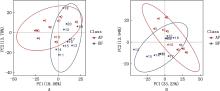
Fig.1
PCA in the positive ion mode (A) and negative ion mode (B)"
Fig.2
PLS-DA score scatter plot and rank validation plot① A, PLS-DA dispersion diagram in positive ion mode; B, PLS-DA dispersion diagram in negative ion mode; C,PLS-DA sequencing verification diagram in positive ion mode; D, PLS-DA sequencing verification diagram in negative ion mode.② R2Y, The explanatory rate of the model; Q2Y, The predictive ability of the model"

Table 3
Plasma differential metabolites (under positive ion mode)"
| 代谢物 Metabolites | 变量投影重要度 VIP | P值 P-value | 差异倍数FC | 趋势Trend |
|---|---|---|---|---|
| 2,4,6-三乙基-1,3,5-三聚硫代甲 2,4,6-triethyl-1,3,5-trithiane | 2.3760 | 0.0001 | 1.3744 | 上调 |
| 3-氨基哌啶-2-酮 3-amino-2-piperidinone | 2.2041 | 0.0001 | 0.4805 | 下调 |
| 八氢吡咯并[1,2-a]嘧啶 Octahydropyrrolo[1,2-a]pyrimidine | 1.9827 | 0.0002 | 0.1513 | 下调 |
| 6-甲基蝶啶-2,4-二胺 6-methylpteridine-2,4-diamine | 2.3008 | 0.0003 | 1.2909 | 上调 |
| 2-[4-(硫氧基)苯基]乙酸 2-[4-(sulfooxy)phenyl]acetic acid | 2.4273 | 0.0003 | 1.2755 | 上调 |
| 甘胺酰-亮氨酸 Glycyl-leucine | 1.8748 | 0.0003 | 0.4005 | 下调 |
| 马钱苷元 Loganetin | 1.9983 | 0.0003 | 1.2315 | 上调 |
| 4-氨基-1-哌啶羧酸 4-amino-1-piperidinecarboxylic acid | 1.8593 | 0.0003 | 0.3605 | 下调 |
| 2-氨基庚二酸 2-aminopimelic acid | 2.3013 | 0.0004 | 0.7261 | 下调 |
| 氨基己酸 Aminocaproic acid | 1.8567 | 0.0005 | 0.6540 | 下调 |
异丙基-β-D-硫代半乳糖苷 Isopropyl-beta-D-thiogalactopyranoside | 2.1870 | 0.0008 | 1.3232 | 上调 |
| 6-顺式-二十二碳烯酰胺 6-cis-docosenamide | 2.0952 | 0.0009 | 0.4456 | 下调 |
| 丙氨酸乳酸丙酮酸 Alanine lactate pyruvate | 2.2152 | 0.0010 | 1.3760 | 上调 |
| 依西美坦 Exemestane | 1.8318 | 0.0010 | 1.3586 | 上调 |
| 2-羟基己酸 2-hydroxycaproic acid | 2.0974 | 0.0010 | 1.2133 | 上调 |
| 2-甲氧基-4-甲基苯酚 Creosol | 1.8253 | 0.0011 | 1.2076 | 上调 |
| 白术内酯Ⅱ Atractylenolide Ⅱ | 2.1406 | 0.0013 | 1.6185 | 上调 |
| 琥珀酰腺苷 Succinyladenosine | 1.8547 | 0.0013 | 1.9650 | 上调 |
| 6-硫尿酸盐 6-thiourate | 1.6895 | 0.0015 | 1.2690 | 上调 |
| 5-羟基吲哚-3-乙醇 5-hydroxytryptophol | 2.1198 | 0.0016 | 4.6378 | 上调 |
Table 4
Plasma differential metabolites (under negative ion mode)"
| 代谢物Metabolites | 变量投影重要度 VIP | P值 P-value | 差异倍数 FC | 趋势 Trend |
|---|---|---|---|---|
| 别嘌呤醇核糖苷 Allopurinol riboside | 2.1416 | 0.0003 | 1.7445 | 上调 |
| N-磺酰氧基-PhIP N-sulfonyloxy-PhIP | 2.3812 | 0.0004 | 5.5731 | 上调 |
4-羟基-3-甲氧基苯基乙二醇-4-硫酸钾盐 3-methoxy-4-hydroxyphenylglycol sulfate | 1.7104 | 0.0004 | 2.2270 | 上调 |
| 2-甲鸟苷 N2-methylguanosine | 2.0365 | 0.0006 | 1.5517 | 上调 |
| 鞘磷脂 Sphingomyelin | 1.7497 | 0.0007 | 1.7190 | 上调 |
4-氮杂螺[双环[2.2.2]辛烷-2,2'-[ 4-Azaspiro[bicyclo[2.2.2]octane-2,2'-[ | 1.6836 | 0.0007 | 1.6386 | 上调 |
| 反式-乌头酸 Trans-aconitic acid | 2.0426 | 0.0007 | 1.8028 | 上调 |
| 溶血磷酸酯 Lysophosphatidic acid | 1.7385 | 0.0007 | 1.8393 | 上调 |
| 紫花前胡醇 Decursinol | 1.7847 | 0.0009 | 0.3373 | 下调 |
| β-L-岩藻糖-1-磷酸酯 Beta-L-fucose-1-phosphate | 1.7468 | 0.0010 | 1.8657 | 上调 |
| 阿替洛辛 Altiloxin | 1.9086 | 0.0011 | 1.6540 | 上调 |
| 野鸢尾黄素 Irigenin | 1.4937 | 0.0011 | 0.3213 | 下调 |
| 十七烷酸/珠光脂酸 Heptadecanoic acid | 1.7263 | 0.0011 | 0.5517 | 下调 |
(2S)-2-氨基-4-(2-氨基-4-氯苯基)-4-氧代丁酸 (2S)-2-amino-4-(2-amino-4-chlorophenyl)-4-oxobutanoic acid | 1.7373 | 0.0011 | 2.0131 | 上调 |
| 甲基丙二酸 Methylmalonic acid | 1.5220 | 0.0011 | 1.5604 | 上调 |
| 紫质胆素原 Porphobilinogen | 1.8592 | 0.0011 | 1.5314 | 上调 |
| (-)-6-氯表儿茶素 (-)-6-chloroepicatechin | 1.7430 | 0.0011 | 1.7425 | 上调 |
| 十六碳烯酸(顺-9)/棕榈油酸 Palmitoleic acid | 1.7861 | 0.0014 | 0.5123 | 下调 |
| 二十烯酸 Paullinic acid | 1.8793 | 0.0014 | 0.3134 | 下调 |
| 十八碳烯酸(顺-6)/岩芹酸 Petroselinic acid | 1.7771 | 0.0015 | 0.4686 | 下调 |
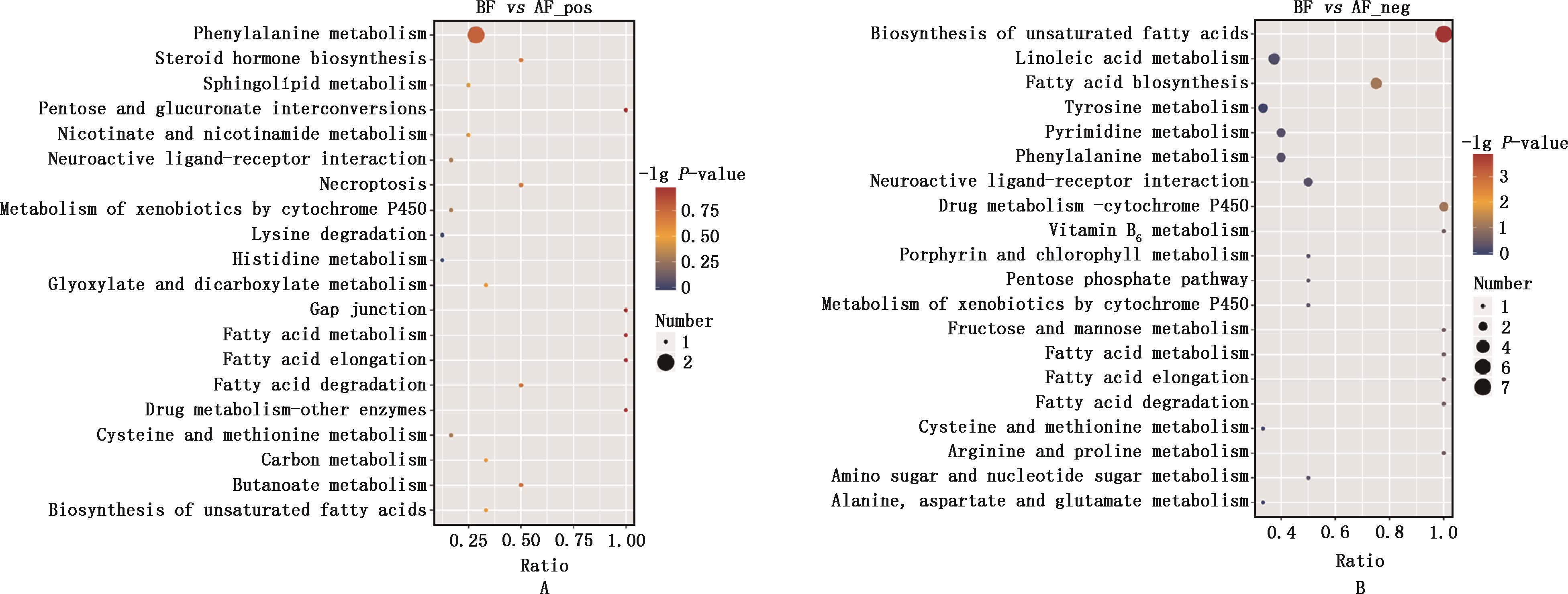
Fig.3
KEGG enrichment bubble plot for the tumbler pigeon movementA, Positive ion pattern; B, Negative ion pattern"
| [1] | 杨理程, 吴锐琼, 李培健, 等. 基于Sanger测序方法检测赛鸽竞翔相关基因的单核苷酸多态性[J]. 福建农业科技, 2024, 55(7): 1-9. |
| YANG L C, WU R Q, LI P J, et al. Detection of single nucleotide polymorphisms in genes associated with homing behavior in racing pigeons based on Sanger sequencing method[J]. Fujian Agricultural Science and Technology, 2024, 55(7): 1-9. (in Chinese) | |
| [2] | 帕提古丽·亚森, 米吉提·伊明江, 乃菲萨·艾力, 等. 新疆翻飞鸽种质与传统驯养方法保护研究[J]. 甘肃畜牧兽医, 2021, 51(1): 14-17. |
| PATIGUL Y S, MIJITI Y M J, NAFISA A L, et al. Research on breeding and conservation of Xinjiang tumbler pigeon varieties and traditional domestication methods[J]. Gansu Animal Husbandry and Veterinary, 2021, 51(1): 14-17. (in Chinese) | |
| [3] | 谢成侠. 我国养鸽历史及其与进化论的关系[J]. 动物学杂志, 1979, 23(1): 34-38. |
| XIE C X. History of pigeon breeding in China and its relationship with evolutionary theory[J]. Chinese Journal of Zoology, 1979, 23(1): 34-38. (in Chinese) | |
| [4] | ENTRIKIN R K, BRYANT S H. Tumbling in pigeons[J]. Nature, 1974, 252(5485): 706-708. |
| [5] | 何 伟, 梁 民. 大强度运动前后血pH值、血气指标、Hb、电解质变化特点及其相互关系的研究[J]. 成都体育学院学报, 2000, 41(5): 84-88. |
| HE W, LIANG M. pH value, blood-air, Hb and electrolyte-metebolism disturbances of blood and their correlation before and after high-intension-fatigue exercise[J]. Journal of Chengdu Sport University, 2000, 41(5): 84-88. (in Chinese) | |
| [6] | POHJANEN E, THYSELL E, JONSSON P, et al. A multivariate screening strategy for investigating metabolic effects of strenuous physical exercise in human serum[J]. Journal of Proteome Research, 2007, 6(6): 2113-2120. |
| [7] | KLEIN D J, MCKEEVER K H, MIREK E T, et al. Metabolomic response of equine skeletal muscle to acute fatiguing exercise and training[J]. Frontiers in Physiology, 2020, 11: 110. |
| [8] | 王 未, 郭永清, 王 志, 等. 呼和浩特市地区英国纯血马的生理生化指标的测定[J]. 内蒙古农业大学学报(自然科学版), 2014, 35(6): 10-13. |
| WANG W, GUO Y Q, WANG Z, et al. Physiological and biochemical data of measurement of thoroughbred in Hohhot[J]. Journal of Inner Mongolia Agricultural University (Natural Science Edition), 2014, 35(6): 10-13. (in Chinese) | |
| [9] | 武 博, 高珍珍, 杜 山, 等. 穴位埋线对纯血马运动性疲劳的改善作用研究[J]. 黑龙江畜牧兽医, 2023,18: 66-71. |
| WU B, GAO Z Z, DU S, et al. Study on the improvement effects of acupoint catgut embedding on exercise fatigue in thoroughbred horses[J]. Heilongjiang Animal Science and Veterinary Medicine, 2023, 66(18): 66-71. (in Chinese) | |
| [10] | 倪静颖, 汤新维, 屠 迪. 一例犬双侧皮下输尿管绕道手术治疗报告[J]. 湖南畜牧兽医, 2024, 46(6): 36-38. |
| NI J Y, TANG X W, TU D. Bilateral subcutaneous ureteral diversion surgery in a dog: A case report[J]. Hunan Journal of Animal Science & Veterinary Medicine, 2024, 46(6): 36-38. (in Chinese) | |
| [11] | 王建文, 姚新奎, 李林玲, 等. 不同运动对伊犁马血气指标的影响[J]. 中国兽医学报, 2020, 40(12): 2374-2379. |
| WANG J W, YAO X K, LI L L, et al. Effects of different exercise on blood-gas indexes in Yili horse[J]. Chinese Journal of Veterinary Science, 2020, 40(12): 2374-2379. (in Chinese) | |
| [12] | 王金禄, 王 菁, 张富强, 等. 优秀网球运动员运动负荷的监督与控制[J]. 天津体育学院学报, 2005, 25(4): 88. |
| WANG J L, WANG J, ZHANG F Q, et al. The supervise and control of sport load in elite tennis athletes[J]. Journal of Tianjin University of Sport, 2005, 25(4): 88. (in Chinese) | |
| [13] | 朱 旦,刘北忠,邓一平,等.重竞技运动员赛前RBC、Hct、Hb、CK及SOD的动态监测[J].实用临床医学,2003,4:21-23. |
| ZHU D, LIU B Z, DENG Y P, et al. Dynamic monitoring the levels of RBC, Hct, Hb, CK and SOD among the athletes of heavy athletic events before the contest[J]. Practical Clinical Medicine, 2003, 4: 21-23. (in Chinese) | |
| [14] | BALL D. Metabolic and endocrine response to exercise: Sympathoadrenal integration with skeletal muscle[J]. Journal of Endocrinology, 2015, 224(2): R79-R95. |
| [15] | HARGREAVES M. Skeletal muscle metabolism during exercise in humans[J]. Clinical and Experimental Pharmacology and Physiology, 2000, 27(3): 225-228. |
| [16] | ENEA C, SEGUIN F, PETITPAS-MULLIEZ J, et al. 1H NMR-based metabolomics approach for exploring urinary metabolome modifications after acute and chronic physical exercise[J]. Analytical and Bioanalytical Chemistry, 2010, 396(3): 1167-1176. |
| [17] | OHMURA H, MUKAI K, TAKAHASHI Y, et al. Metabolomic analysis of skeletal muscle before and after strenuous exercise to fatigue[J]. Scientific Reports, 2021, 11(1): 11261. |
| [18] | 许 彤. L-岩藻糖的从头合成和核苷类化合物的高效合成研究[D]. 上海: 华东理工大学, 2021. |
| XU T. De novo synthesis of L-fucose and efficient synthesis of nucleoside[D]. Shanghai: East China University of Science and Technology, 2021. (in Chinese) | |
| [19] | SANCHIS-GOMAR F,PAREJA-GALEANO, PEREZ-QUILIS C, al et,Effects of allopurinol on exercise-induced muscle damage :New therapeutic approaches?[J].Cell Stress Chaperones,2015,20(1):3-13. |
| [20] | 孙远方, 马 勇, 王建文, 等. 速度型伊犁马短途比赛前后血浆代谢组学研究[J]. 动物营养学报, 2024, 36(4): 2561-2571. |
| SUN Y F, MA Y, WANG J W, et al. Study on plasma metabolomics before and after short distance race of speed Yili horses[J]. Chinese Journal of Animal Nutrition, 2024, 36(4): 2561-2571. (in Chinese) | |
| [21] | 刘兴丽.灌注竹叶提取物对不同环境温度下小鼠物质代谢的影响[D].南充:西华师范大学,2021. |
| LIU X L. Effects of infusion of bamboo leaf extract on material metabolism in mice under dfifferent environmental temperatures[D]. Nanchong: China West Normal University, 2021. (in Chinese) | |
| [22] | 牛笑怡.基于酸枣仁汤有效部位多糖药效基础代谢组学研究[D].沈阳:沈阳药科大学,2018. |
| NIU X Y. Metabonomics study based on efficacy of polysaccharides from Suanzaoren decoction[D]. Shenyang: Shenyang Pharmaceutical University, 2018. (in Chinese) | |
| [23] | PECHLIVANIS A, KOSTIDIS S, SARASLANIDIS P, et al. 1H NMR-based metabonomic investigation of the effect of two different exercise sessions on metabolic fingerprint of human urine[J]. Journal of Proteome Research, 2010, 9(12): 6405-6416. |
| [24] | 贾银浩. 男子中长跑运动员一次800米跑后尿液代谢组学特征及电针调控的代谢通路探讨[D]. 上海: 上海体育学院, 2016. |
| JIA Y H. The metabolomics characteristics and the regulation of electoral needling on male middle-distance athletes who had finished once 800 meter race[D]. Shanghai: Shanghai University of Sport, 2016. (in Chinese) | |
| [25] | 吴 娜, 朱 璠, 徐伟鸿, 等. 基于代谢组学和肠道菌群探讨黄芩汤对溃疡性结肠炎小鼠的影响[J].中成药, 2024, 46(12): 4188-4196. |
| WU N, ZHU F, XU W H, et al. Effects of Huangqin decoction on ulcerative colitis mice based on metabolomics and gut microbiota[J]. Chinese Traditional Patent Medicine, 2024, 46(12): 4188-4196. (in Chinese) | |
| [26] | MONIRUJJAMAN M, FERDOUSE A. Metabolic and physiological roles of branched-chain amino acids[J]. Advances in Molecular Biology, 2014, 2014: 364976. |
| [27] | 陈遇洁, 卢忠华, 梁诗佳, 等. 基于出生队列的代谢组学分析新生儿出生体重与胎便代谢物之间的关系[J]. 色谱, 2024, 42(11): 1024-1031. |
| CHEN Y J, LU Z H, LIANG S J, et al. Analysis of the relationship between neonatal birth weight and meconium metabolites based on birth cohort mrtabolomics[J]. Chinese Journal of Chromatography, 2024, 42(11): 1024-1031. (in Chinese) | |
| [28] | LEE J Y, JIN H K, BAE J S. Sphingolipids in neuroinflammation: A potential target for diagnosis and therapy[J]. Biochemistry and Molecular Biology Reports, 2020, 53(1): 1-8. |
| [29] | 汪增钰, 刘宝红, 乔 亮, 等. 非靶向脂质组学揭示巨噬细胞泡沫化进程脂质代谢功能失调[J]. 高等学校化学学报, 2024, 45(11): 128-136. |
| WANG Z Y, LIU B H, QIAO L, et al. Untargeted lipidomics reveals lipid metabolism dysfunction during macrophage foaming[J]. Chemical Journal of Chinese Universities, 2024, 45(11): 128-136. (in Chinese) | |
| [30] | 刘秀雨. 基于代谢组学的白黄链霉菌TD-1帕马霉素高产技术研究[D]. 天津: 天津科技大学, 2023. |
| LIU X Y. Study on the technoligy of Streptomyces alboflavus TD-1 with high pamamycin production based on metabolomics[D]. Tianjin: Tianjin University of Science and Technology, 2023. (in Chinese) | |
| [31] | SUN W, SUN J, LI M, et al. Effects of dietary sodium butyrate supplementation on growth performance, carcass traits and intestinal microbiota of growing-finishing pigs[J]. Journal of Applied Microbiology, 2020, 128(6): 1613-1623. |
| [32] | STEPHENS F B, CONSTANTIN-TEODOSIU D, GREENHAFF P L. New insights concerning the role of carnitine in the regulation of fuel metabolism in skeletal muscle[J]. The Journal of Physiology, 2007, 581(2): 431-444. |
| [33] | 马超鑫. 不同赛道维护方式对1600 m速度赛伊犁马运动性能和机体代谢的影响[D]. 乌鲁木齐: 新疆农业大学, 2022. |
| MA C X. Effects of different track maintenance methods on sports performance and body metabolism of Yili horse in 1600 m speed race[D]. Urumqi: Xinjiang Agricultural University, 2022. (in Chinese) | |
| [34] | CICERO A F G, DESIDERI G, GROSSI G, et al. Serum uric acid and impaired cognitive function in a cohort of healthy young elderly: Data from the Brisighella study[J]. Internal and Emergency Medicine, 2015, 10(1): 25-31. |
| [35] | HELLSTEN Y, SVENSSON M, SJÖDIN B, et al. Allantoin formation and urate and glutathione exchange in human muscle during submaximal exercise[J]. Free Radical Biology and Medicine, 2001, 31(11): 1313-1322. |
| [36] | KANĎÁR R, ZÁKOVÁ P, MUZÁKOVÁ V. Monitoring of antioxidant properties of uric acid in humans for a consideration measuring of levels of allantoin in plasma by liquid chromatography[J]. Clinica Chimica Acta, 2006, 365(1-2): 249-256. |
| [37] | KANĎÁR R, ŠTRAMOVÁ X, DRÁBKOVÁ P, et al. A monitoring of allantoin, uric acid, and malondialdehyde levels in plasma and erythrocytes after ten minutes of running activity[J]. Physiological Research, 2014, 63(6): 753-762. |
| [38] | GUS’KOV E P, KLETSKII M E, KORNIENKO I V, et al. Allantoin as a free-radical scavenger[J]. Doklady Biochemistry and Biophysics, 2002, 383: 105-107. |
| [39] | GYÖRGY H, CRONSTEIN N B. Adenosine: An endogenous regulator of innate immunity[J].Trends in Immunology,2004,25(1):33-39. |
| [40] | OHTA A, SITKOVSKY M. Role of G-protein-coupled adenosine receptors in downregulation of inflammation and protection from tissue damage[J].Nature,2001,414(6866):916-920. |
| [41] | CSHULTE G, FREDHOLM B B. Signalling from adenosine receptors to mitogen-activated protein kinases [J].Cellular Signalling,2003,15(9):813-827. |
| [1] | CHEN Ping, XIE Jianpeng, HE Zhenfu, WANG Fei. Effects of Diets with Different Protein Levels on Rumen Metabolism in Yaks [J]. China Animal Husbandry & Veterinary Medicine, 2026, 53(1): 165-178. |
| [2] | LI Jianing, JIANG Zhihui, XING Yueteng, MA Shengming. Effects of 1, 8-cineole Supplementation in Diet on the Antioxidant Capacity of Laying Hens and Eggs [J]. China Animal Husbandry & Veterinary Medicine, 2025, 52(7): 3016-3030. |
| [3] | YU Mengbo, MA Haotian, LI Yang, PAN Ruixue, LONG Yuner, ZHAO Yining, MA Yi, ZHOU Shuzhen. Whole Genome Sequencing Analysis of a Strain of Bacillus velezensis G02 [J]. China Animal Husbandry & Veterinary Medicine, 2025, 52(5): 1977-1986. |
| [4] | YANG Xinshuo, CHANG Danyi, XU Dandan, ZHANG Haihua, MA Qiugang, HUANG Shimeng. Advances in the Impact of Tryptophan and Its Bacterial Metabolites on Intestinal Barrier Function and Growth Performance in Livestock and Poultry [J]. China Animal Husbandry & Veterinary Medicine, 2025, 52(2): 636-644. |
| [5] | DUAN Yali, CHEN Qian, YANG Wanlu, GAO Pengfei, CAO Riliang, HU Guangying. Effects of Compound Chinese Herbal Medicine Feed Additives on the Intestinal Microbiota and Muscle Metabolism in Pigs [J]. China Animal Husbandry & Veterinary Medicine, 2025, 52(12): 5560-5574. |
| [6] | HUANG Jinlong, OUYANG Wen, HENG Shibing, WANG Tongliang, HUANG Yunjiang, HU Aoyun, PENG Xuan, MENG Jun, YAO Xinkui, WANG Jianwen, REN Wanlu, ZENG Yaqi. Study on Difference of Energy Metabolism Characterization in Yili Horses with Different Exercise Performances in an 80 km Endurance Race [J]. China Animal Husbandry & Veterinary Medicine, 2025, 52(11): 5040-5052. |
| [7] | QIAN Shiyu, YAO Ruyu, ZHANG Hetong, XING Wenhui, WU Jiahui, LI Yuanyuan, ZHAO Chunjiang. Advances in Equine Exercise Metabolome and Its Associated Metabolic Pathways [J]. China Animal Husbandry & Veterinary Medicine, 2025, 52(11): 5053-5062. |
| [8] | ZHANG Suhan, MAO Peichun, TIAN Xiaoxia, GUO Yuxia, ZHENG Mingli, MENG Lin. Effects of Grazing on Chicory Grassland Under Forest on Caecum Microflora and Metabolites of Beijing-You Chickens [J]. China Animal Husbandry & Veterinary Medicine, 2025, 52(1): 133-146. |
| [9] | ZHAO Qingmei, CUI Shengwei, GUO Shihui, YU Yongtao, LIANG Taiyu, LI Huanyu. Characteristics of Microbiota and Metabolites in Feces of Calves with Diarrhea [J]. China Animal Husbandry & Veterinary Medicine, 2024, 51(9): 4092-4105. |
| [10] | WANG Changtong, YANG Liandi, YIN Li, WANG Le, ZHANG Jin, ZUO Fuyuan, HUANG Wenming. Effects of Heat Stress on the Structure and Metabolites of Fecal Flora of Goats [J]. China Animal Husbandry & Veterinary Medicine, 2024, 51(8): 3288-3300. |
| [11] | JIANG Lu, LIANG Bencong, XU Zejun, YANG Gaiqing, YANG Sihan, CHEN Qixin, WANG Xianwei, HU Yeyong, WANG Linfeng, GAO Tengyun. Effects of Guanidine Acetic Acid and Alpha-lipoic Acid Supplementation on Rumen Microbita and Metabolites in Sheep [J]. China Animal Husbandry & Veterinary Medicine, 2024, 51(6): 2375-2387. |
| [12] | HAN Zixiang, YAO Xinkui, ZANG Changjiang, MENG Jun, ZENG Yaqi, WANG Chuankun, YANG Liping, XUE Yuheng, LI Pengcheng, WANG Jianwen. Effects of Conditioning Training at Different Stages on Fecal Metabolomics in Yili Horses [J]. China Animal Husbandry & Veterinary Medicine, 2024, 51(2): 568-580. |
| [13] | ZHANG Xingyan, LAN Haien, YI Xianfeng, YANG Kai, ZHU Wen, LAN Xi, ZHOU Junhua, CHEN Zhonghua. Metabolomics Analysis of Fermented Elephant Grass and It’s Effects on the Growth Performance and Serum Biochemical Indicators of Pigs [J]. China Animal Husbandry & Veterinary Medicine, 2024, 51(11): 4802-4811. |
| [14] | KONG Weiyi, WANG Feifei, YUE Kang, QIN Junjie, ZHU Hao, GUO Yansheng. Effect of Guiqi Yimu Oral Liquid on Plasma Metabolites in Postpartum Dairy Cows Based on UPLC-MS/MS Metabolomics Technology [J]. China Animal Husbandry & Veterinary Medicine, 2023, 50(3): 913-923. |
| [15] | WANG Guang, ZOU Jiahao, ZHANG Yongtao, LI Dexian, LI Xueqing, YU Mengqi, CHEN Lu, YUAN Yuxin, LI Guang. Difference Analysis of Metabolites in Testis of Guanzhong Dairy Goats at Different Developmental Stages [J]. China Animal Husbandry & Veterinary Medicine, 2022, 49(9): 3453-3464. |
| Viewed | ||||||
|
Full text |
|
|||||
|
Abstract |
|
|||||
