中国畜牧兽医 ›› 2026, Vol. 53 ›› Issue (1): 266-275.doi: 10.16431/j.cnki.1671-7236.2026.01.024

• 营养与饲料 • 上一篇    下一篇

基于化学衍生和质谱技术的苹婆酸定量方法研究

王芙蓉1,2(), 冯潇慧2, 冯胜楠2, 张正杰2, 王玉娇2, 孟庆石2(), 张春香1()   

  1. 1.山西农业大学动物科学学院,太谷 030801
    2.中国农业科学院北京畜牧兽医研究所,畜禽营养与饲养全国重点实验室,北京 100193
  • 收稿日期:2025-04-02 出版日期:2026-01-05 发布日期:2025-12-26
  • 通讯作者: 孟庆石,张春香 E-mail:wangfurong0131@163.com;mengqingshi@caas.cn;chunxiangzhang@sxau.edu.cn
  • 作者简介:王芙蓉,E-mail:wangfurong0131@163.com
  • 基金资助:
    中央级公益性科研院所基本科研业务费专项(Y2024PT01);现代农业产业技术体系(2024-14)

Quantification of Sterculic Acid Based on Chemical Derivatization and Mass Spectrometry Technology

WANG Furong1,2(), FENG Xiaohui2, FENG Shengnan2, ZHANG Zhengjie2, WANG Yujiao2, MENG Qingshi2(), ZHANG Chunxiang1()   

  1. 1.College of Animal Science,Shanxi Agricultural University,Taigu 030801,China
    2.State Key Laboratory of Animal Nutrition and Feeding,Institute of Animal Science,Chinese Academy of Agricultural Sciences,Beijing 100193,China
  • Received:2025-04-02 Online:2026-01-05 Published:2025-12-26
  • Contact: MENG Qingshi, ZHANG Chunxiang E-mail:wangfurong0131@163.com;mengqingshi@caas.cn;chunxiangzhang@sxau.edu.cn

摘要:

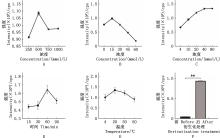
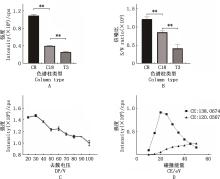
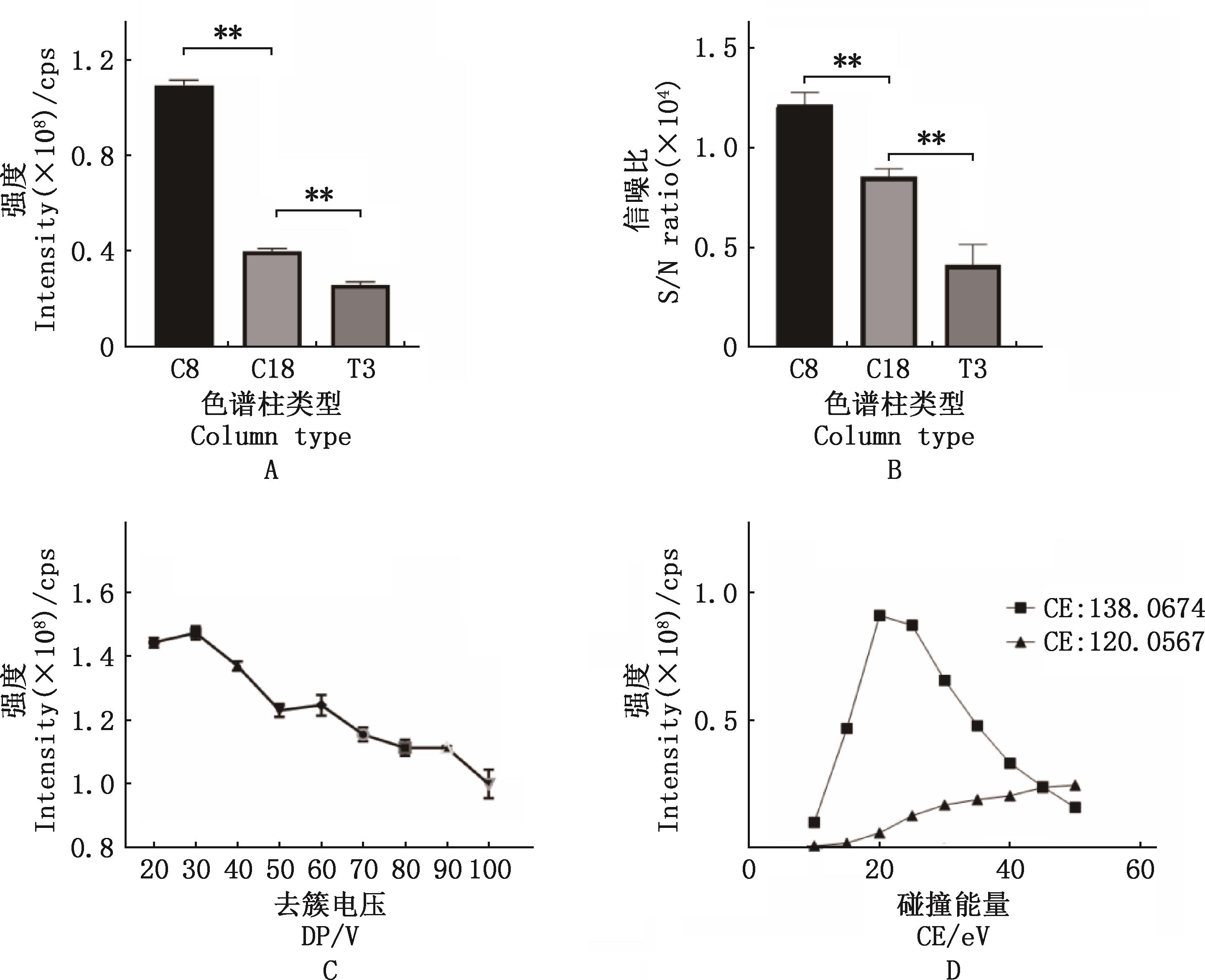
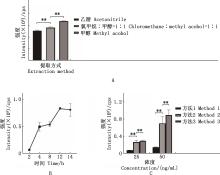
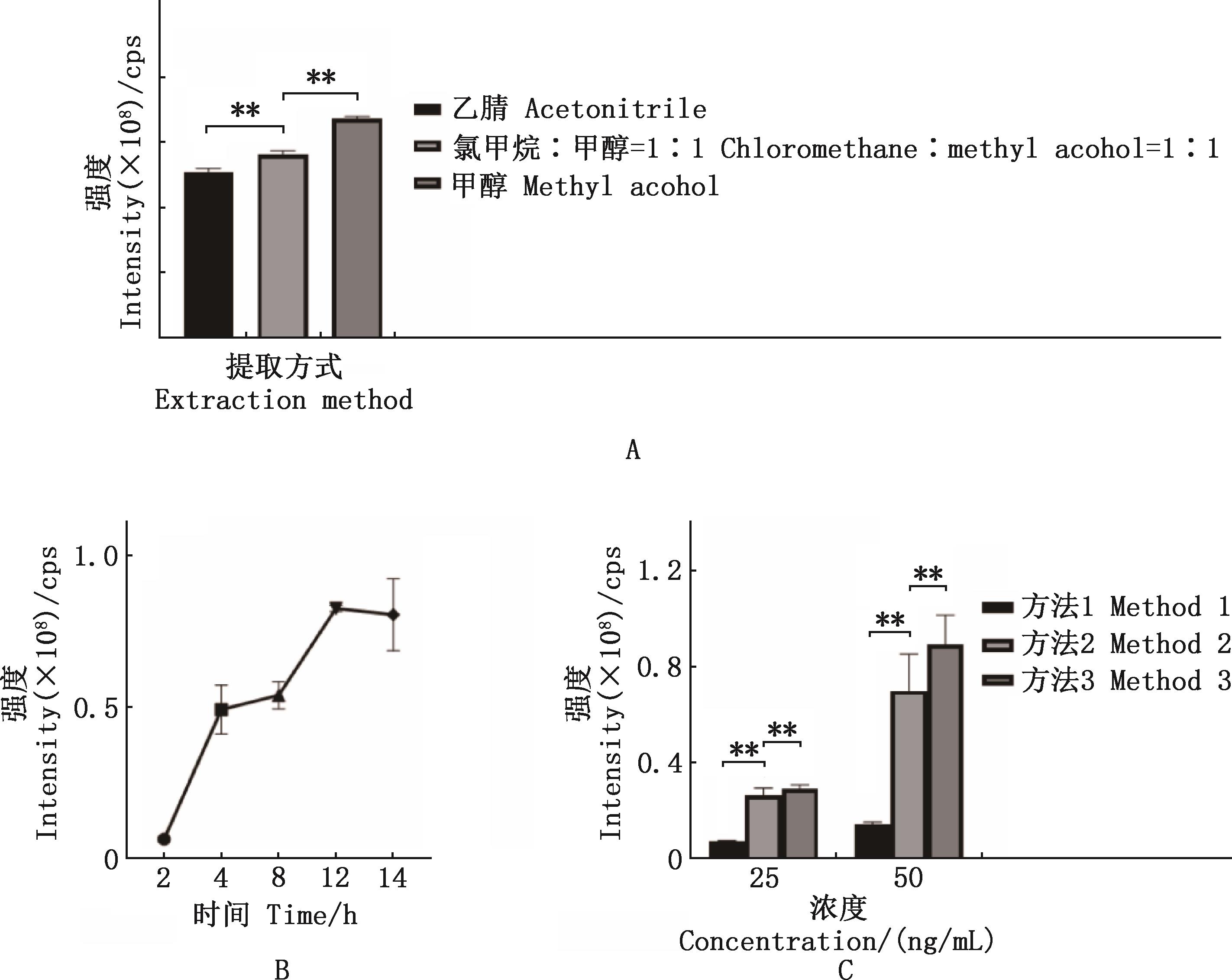
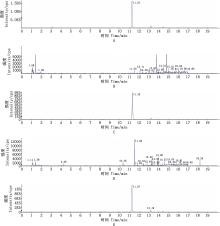
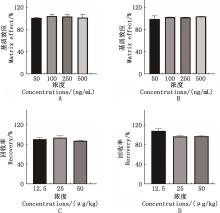
目的 试验旨在建立准确测定棉粕和饲料中苹婆酸含量的检测方法,以合理利用棉粕蛋白资源。 方法 通过优化2-吡啶甲酰肼与苹婆酸的反应条件、苹婆酸提取流程和质谱检测参数,建立采用外标法的液相色谱-串联质谱(LC-MS/MS)定量苹婆酸的方法,并考察该检测方法的线性范围、检测限、定量限、回收率、批内与批间精密度和准确度,使用该方法进行实际样品检测。 结果 优化后2-吡啶甲酰肼与苹婆酸的最佳反应溶液组成为500 mmol/L EDC、15 mmol/L HOAt和40 mmol/L 2-吡啶甲酰肼,最佳反应温度为20 ℃,最佳反应时间为60 min。游离态苹婆酸的最佳提取液为甲醇,结合态苹婆酸最佳水解条件为50 ℃水解12 h。苹婆酸在1~1 000 ng/mL范围内线性关系良好,相关系数(r)均>0.99,检测限为5 μg/kg,定量限为12.5 μg/kg。游离态苹婆酸的回收率为80.13%~95.30%,批内变异系数为1.01%~2.21%,批间变异系数为1.61%~2.38%;结合态苹婆酸的回收率为85.46%~105.20%,批内变异系数为0.79%~2.01%,批间变异系数为3.40%~6.22%。经实际样品验证,建立方法可以精确测定棉油、棉粕、脱酚棉粕和棉籽蛋白原料中的苹婆酸,检测范围在0.09~1 812.76 mg/kg之间。 结论 本研究建立的LC-MS/MS检测方法具有高灵敏度、高准确度和高精密度等优点,适用于饲料中游离态和结合态苹婆酸的检测,可为合理利用棉粕提供技术支撑。

关键词: 苹婆酸; 棉粕; 衍生化; 定量

Abstract:

Objective This study aimed to establish an accurate method for determining the sterculic acid content in cottonseed meal and feed to facilitate the rational utilization of cottonseed meal protein resources. Method By optimizing the reaction conditions of 2-pyridinecarboxylic hydrazide with sterculic acid, the extraction process of sterculic acid and mass spectrometry parameters, a liquid chromatography tandem mass spectrometry (LC-MS/MS) method for quantifying sterculic acid using external standards was successfully established. The performance of the method was evaluated by examining its linear range, limit of detection, limit of quantification, recovery, precision (intra-assay and inter-assay) and accuracy, along with application to analyze actual samples. Result After optimization, the optimal reaction mixture composition for the reaction of sterculic acid with 2-pyridinecarboxylic hydrazide was determined as 500 mmol/L EDC, 15 mmol/L HOAt and 40 mmol/L 2-pyridinecarboxylic hydrazide. The optimal reaction temperature and time were established as 20 ℃ and 60 min, respectively. Methanol was found to be the best extracting solution for free sterculic acid, while the best hydrolysis conditions for bound sterculic acid were 50 ℃ for 12 h. The method demonstrated a good linear relationship for sterculic acid over the range of 1 to 1 000 ng/mL, with correlation coefficients (r) all greater than 0.99. The limit of detection and limit of quantification were were determined to be 5 and 12.5 μg/kg, respectively. For free sterculic acid, the recovery ranged from 80.13% to 95.30%, with intra coefficient of variation of 1.01% to 2.21% and inter coefficient of variation of 1.61% to 2.38%. For esterified sterculic acid, the recovery ranged from 85.46% to 105.20%, with intra coefficient of variation of 0.79% to 2.01% and inter coefficient of variation of 3.40% to 6.22%. The optimized method had been successfully applied to quantified sterculic acid in cottonseed oil, cure cottonseed meal, degossypoled cottonseed meal and cottonseed protein samples, with concentrations ranging from 0.09 to 1 812.76 mg/kg. Conclusion The established LC-MS/MS method had the advantages of high sensitivity, high accuracy and high precision. It was suitable for quantifying free and esterified sterculic acid in feed and provides technical support for the appropriate utilization of cotton meal.

Key words: sterculic acid; cottonseed meal; derivatization; quantification

中图分类号: