
China Animal Husbandry & Veterinary Medicine ›› 2026, Vol. 53 ›› Issue (2): 948-958.doi: 10.16431/j.cnki.1671-7236.2026.02.039
• Preventive Veterinary Medicine • Previous Articles Next Articles
ZHU Xiaoli1,2( ), WANG Shao1,2, DONG Hui1,2, CHENG Xiaoxia1,2, JIANG Dandan1, XIAO Shifeng1,2, CHEN Shaoying1,2(), CHEN Shilong1,2()
Received:2025-06-12
Online:2026-02-20
Published:2026-01-27
Contact:
CHEN Shaoying, CHEN Shilong
E-mail:zhuxiaoli0226@163.com;chensy58@163.com;CSL6116@163.com
CLC Number:
ZHU Xiaoli, WANG Shao, DONG Hui, CHENG Xiaoxia, JIANG Dandan, XIAO Shifeng, CHEN Shaoying, CHEN Shilong. Preparation of Monoclonal Antibodies Against Duck Short Beak and Dwarfism Syndrome Virus and Establishment of a Competitive ELISA Detection Method[J]. China Animal Husbandry & Veterinary Medicine, 2026, 53(2): 948-958.
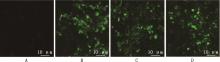
Fig.1
IFA identification results of the characteristics of 3 monoclonal antibodies (100×)A,Normal MDEF cells;B-D, MDEF cells infected with SBDSV detected using monoclonal antibodies D5-3, G11-23 and H2-27 as primary antibodies, respectively"
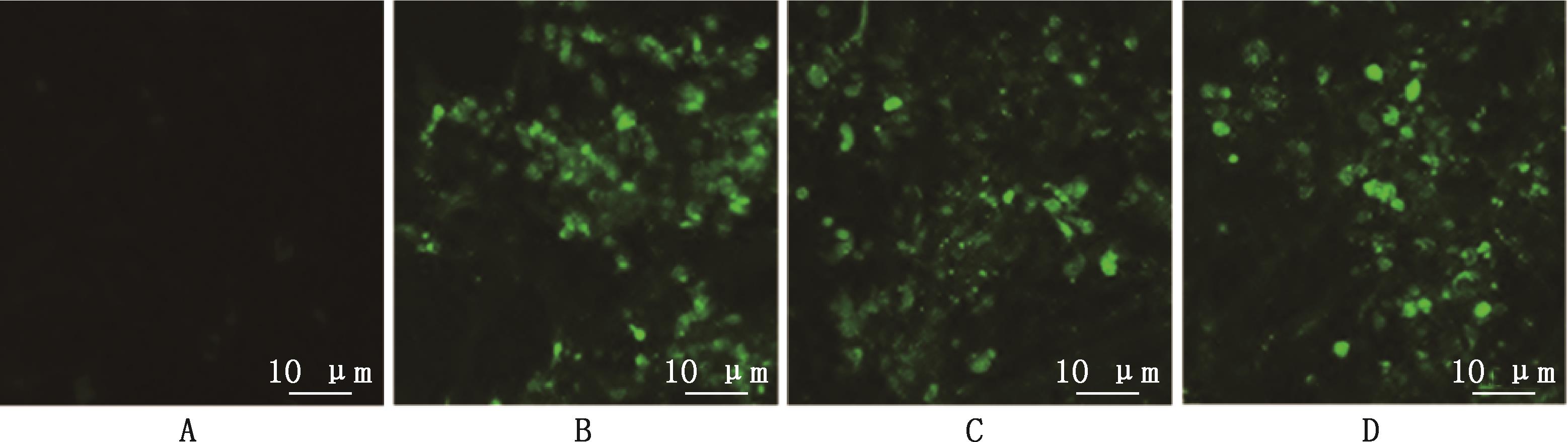
Table 1
Identification result of latex sensitization characteristics of 3 monoclonal antibodies"
单克隆抗体 Monoclonal antibodies | SBDSV | MDPV | MDRV | DPMV | DHV-1 | DTMUV | 正常组织悬液 Normal tissue | 正常胚液 NEF |
|---|---|---|---|---|---|---|---|---|
| D5-3 | - | - | - | - | - | - | - | - |
| G11-23 | - | - | - | - | - | - | - | - |
| H2-27 | 25 | - | - | - | - | - | - | - |
Table 2
Determination of optimal coating antigen concentration and monoclonal antibody dilution (D492 nm value)"
| 抗原包被浓度 | 单克隆抗体稀释度 Dilution of monoclonal antibody | ||
|---|---|---|---|
| Coating antigen concentration/(mg/mL) | 1∶1 000 | 1∶2 000 | 1∶4 000 |
| 0.2 | 1.929 | 1.465 | 1.088 |
| 0.1 | 1.546 | 1.018 | 0.936 |
| 0.05 | 1.333 | 0.913 | 0.821 |
Table 3
Determination of optimal serum dilution (D492 nm value)"
| 项目 | 血清稀释度Serum dilution | |||
|---|---|---|---|---|
| Items | 1∶50 | 1∶100 | 1∶200 | 1∶400 |
| 阳性Positive | 0.133 | 0.127 | 0.115 | 0.155 |
| 阴性Negative | 1.042 | 0.973 | 0.933 | 1.172 |
| PI/% | 83.21 | 89.72 | 94.86 | 72.10 |
Table 4
Determination of optimal blocking solution(D492 nm value)"
项目 Items | 封闭液 Blocking solution | |
|---|---|---|
| 1% BSA | 5%脱脂奶粉 | |
| 5% skimmed milk powder | ||
| 阳性Positive | 0.104 | 0.185 |
| 阴性Negative | 0.993 | 1.172 |
| PI/% | 90.23 | 69.54 |
Table 5
Determination of optimal dilution of enzyme labeled secondary antibody (D492 nm value)"
| 项目 | 酶标二抗稀释度 Dilution of enzyme labeled secondary antibody | |||
|---|---|---|---|---|
| Items | 1∶4 000 | 1∶5 000 | 1∶6 000 | 1∶7 000 |
| 阳性Positive | 0.133 | 0.122 | 0.192 | 0.205 |
| 阴性Negative | 1.142 | 0.954 | 0.923 | 0.916 |
| PI/% | 75.92 | 92.03 | 87.54 | 86.80 |
Table 6
Results of specificity test"
| 待检血清 Serum to be tested | D492 nm值D492 nm value | PI/% | 结果 Results |
|---|---|---|---|
| MDPV+ | 1.005 | 13.46 | - |
| MDRV+ | 1.106 | 4.69 | - |
| DPMV+ | 1.111 | 4.26 | - |
| DHV-1+ | 1.097 | 5.51 | - |
| DTMUV+ | 1.103 | 4.98 | - |
| SBDSV- | 1.139 | 1.91 | - |
| SBDSV+ | 0.1536 | 86.77 | + |
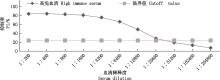
Fig.2
Results of sensitivity test"
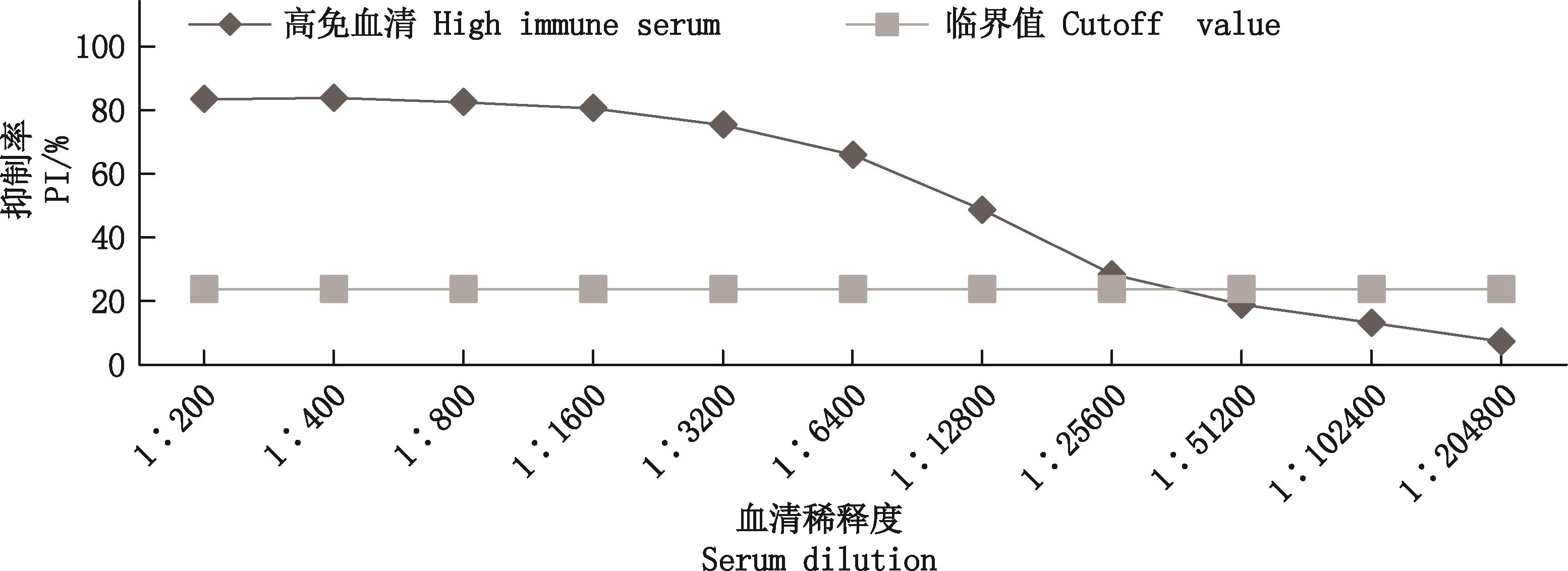
Table 7
Results of repeatability test"
| 血清样本 Serum samples | 批内试验 Intra-assay | 批间试验 Inter-assay | |||
|---|---|---|---|---|---|
平均值±标准差 Mean±SD | 变异系数 CV/% | 平均值±标准差 Mean±SD | 变异系数 CV/% | ||
阳性血清 Positive serum | 1 | 87.79±4.12 | 4.69 | 87.53±3.45 | 3.94 |
| 2 | 85.50±4.86 | 5.68 | 86.02±3.09 | 3.59 | |
| 3 | 88.75±3.46 | 3.90 | 87.97±3.46 | 3.93 | |
阴性血清 Negative serum | 4 | 4.44±0.19 | 4.36 | 9.04±0.47 | 5.18 |
| 5 | 6.85±0.37 | 5.41 | 6.06±0.25 | 4.21 | |
| 6 | 3.22±0.18 | 5.46 | 11.29±0.63 | 5.61 | |
Table 8
Concordance assay between competitive ELISA and LPAI methods"
样品来源 Sample source | LPAI | 竞争ELISA cELISA | 总计 Total | |
|---|---|---|---|---|
| 阳性 Positive | 阴性 Negative | |||
人工感染 Experimental infection | 阳性 Positive | 100 | 0 | 100 |
| 阴性 Negative | 10 | 9 | 19 | |
| 总计 Total | 110 | 9 | 119 | |
临床采样 Clinical sampling | 阳性 Positive | 63 | 1 | 64 |
| 阴性 Negative | 12 | 16 | 28 | |
| 总计 Total | 75 | 17 | 92 | |
| [1] | VILLATTE D. Maladie de Derzsy ou hepatonephrite-ascite de l’oison et du caneton de Barbarie (h.n.a.) ou parvovirose[J]. In Manuel Pratique des Maladies des Palmipedes, 1989,1:114-117. |
| [2] | LU Y S, LIN D F, LEE Y L, et al. Infectious bill atrophy syndrome caused by Parvovirus in a co-outbreak with duck viral hepatitis in duckling in Taiwan[J]. Avian Diseases, 1993,37(2):591-596. |
| [3] | PALYA V, ZOLNAI A, BENYEDA Z, et al. Short beak and dwarfism syndrome of mule duck is caused by a distinct lineage of Goose parvovirus[J]. Avian Pathology, 2009,38(2):175-180. |
| [4] | 陈少莺,程晓霞,陈仕龙,等.半番鸭新型小鹅瘟病毒病研究简报[J].福建农业科技,2015,46(7):23-25. |
| CHEN S Y, CHENG X X, CHEN S L, et al. Short report: A new emerging disease in mule ducks caused by a Novel goose parvovirus[J]. Fujian Agricultural Science and Technology, 2015,46(7):23-25. (in Chinese) | |
| [5] | 吴南洋,黄梅清,陈少莺,等.鸭短嘴矮小综合征的流行病学调查[J].中国家禽,2016,38(4),66-67. |
| WU N Y, HUANG M Q, CHEN S Y, et al. Epidemiological investigation of short beak dwarf syndrome in ducks[J]. China Poultry, 2016,38(4),66-67. (in Chinese) | |
| [6] | XIAO S F, CHEN S L, CHENG X X, et al. The newly emerging duck-origin Goose parvovirus in China exhibits a wide range of pathogenicity to main domesticated waterfowl[J]. Veterinary Microbiology, 2017,203:252-256. |
| [7] | 肖世峰,程晓霞,陈仕龙,等.短喙与矮小综合征鹅细小病毒对樱桃谷鸭的致病性研究[J].中国预防兽医学报,2016,38(9):690-694. |
| XIAO S F, CHENG X X, CHEN S L, et al. Pathogenicity of Short beak goose parvovirus in Cherry Valley ducks[J]. Chinese Journal of Preventive Veterinary Medicine, 2016,38(9):690-694. (in Chinese) | |
| [8] | MATCZUK A K, CHMIELEWSKA-WŁADYKA M, SIEDLECKA M, et al. Short beak and dwarfism syndrome in ducks in Poland caused by Novel goose parvovirus[J]. Animals (Basel), 2020,10(12):2397. |
| [9] | WANG J, WANG J, CUI Y, et al. Development of a TaqMan-based Real-time PCR assay for the rapid and specific detection of novel duck-origin Goose parvovirus[J]. Molecular and Cellular Probes, 2017,34:56-58. |
| [10] | 李鹏飞.新型鹅细小病毒检测方法的建立及流行病学调查[D].泰安: 山东农业大学,2018. |
| LI P F. Development of detective methods and epidemiological investigation of Novel goose parvovirus-related virus[D]. Tai’an: Shandong Agricultural University, 2018. (in Chinese) | |
| [11] | YANG J, CHEN H, WANG Z, et al. Development of a quantitative loop-mediated isothermal amplification assay for the rapid detection of Novel goose parvovirus[J]. Frontiers in Microbiology, 2017,8:2472. |
| [12] | LI P, ZHANG R, CHEN J, et al. Development of a duplex semi-nested PCR assay for detection of Classical goose parvovirus and Novel goose parvovirus-related virus in sick or dead ducks with short beak and dwarfism syndrome[J]. Journal of Virological Methods, 2017,249:165-169. |
| [13] | 程晓霞,朱小丽,林锋强,等.3种鸭源细小病毒的抗原相关性研究[J].中国农学通报,2018,34(4):143-146. |
| CHENG X X, ZHU X L, LIN F Q, et al. Study on antigenic correlation of three duck origin Parvovirus[J]. Chinese Agricultural Science Bulletin, 2018,34(4):143-146. (in Chinese) | |
| [14] | 肖世峰,程晓霞,陈仕龙,等.短喙矮小综合征灭活苗母源抗体消长及其被动保护研究[J].中国预防兽医学报,2018,40(8):743-746. |
| XIAO S F, CHENG X X, CHEN S L, et al. Determination of maternal antibody variation against short beak and dwarfism syndrome inactivated vaccine and the protection for ducklings[J]. Chinese Journal of Preventive Veterinary Medicine, 2018,40(8):743-746. (in Chinese) | |
| [15] | 朱小丽,陈少莺,林锋强,等.应用胶乳凝集技术诊断番鸭小鹅瘟病[J].中国预防兽医学报,2012,34(9):715-718. |
| ZHU X L, CHEN S Y, LIN F Q, et al. Development of the latex agglutination diagnostic method of Muscovy duck gosling plague[J]. Chinese Journal of Preventive Veterinary Medicine, 2012,34(9):715-718. (in Chinese) | |
| [16] | 李 琦.新型鸭细小病毒DS15株的分离鉴定及VP2蛋白在昆虫细胞中的表达[D].兰州:甘肃农业大学,2017. |
| LI Q.Identification of Novel duck parvovirus DS15 strain and expression of VP2 protein in insect cells[D]. Lanzhou: Gansu Agricultural University, 2017. (in Chinese) | |
| [17] | 张淑莹,阮洪玲,文双云,等.小鹅瘟诊断技术研究进展[J].吉林畜牧兽医,2020,41(6):7-8. |
| ZHANG S Y, RUAN H L, WEN S Y, et al. Recent advances in diagnostic techniques for Goose parvovirus infection[J]. Jilin Animal Husbandry and Veterinary Medicine, 2020,41(6):7-8. (in Chinese) | |
| [18] | 迟晓栋.鹅细小病毒感染的流行病学、临床特征、诊断技术与防控措施[J].现代畜牧科技,2022,2:99-100. |
| CHI X D. Epidemiology, clinical characteristics, diagnostic techniques and preventive and control measures of Goose mosaic virus infection[J]. Modern Animal Husbandry Science & Technology, 2022, 2:99-100. (in Chinese) | |
| [19] | 俞 博,朱小丽,程晓霞,等.应用间接免疫荧光法诊断鸭短嘴矮小综合征[J].福建农业学报,2017,32(12):1332-1334. |
| YU B, ZHU X L, CHENG X X, et al. Diagnosis of duckling short beak and dwarfism syndrome by indirect immunofluorescence assay[J]. Fujian Journal of Agricultural Sciences, 2017,32(12):1332-1334. (in Chinese) | |
| [20] | 苏晓娜.水禽细小病毒的分离鉴定及VP3-ELISA方法的建立[D].广州:华南农业大学,2017. |
| SU X N. Isolation and identification of waterfowl Parvovirus, and development of a VP3-ELISA for the detection of Muscovy duck parvovirus antibody[D]. Guangzhou: South China Agricultural University, 2017. (in Chinese) | |
| [21] | HAYRAPETYAN H, TRAN T, TELLEZ-CORRALES E, et al. Enzyme-linked immunosorbent assay: Types and applications[J]. Methods in Molecule Biology, 2023,2612:1-17. |
| [22] | 朱小丽,陈少莺,程晓霞,等.小鹅瘟病毒单克隆抗体的制备及特性鉴定[J].中国动物传染病学报,2011,19(6):20-24. |
| ZHU X L, CHEN S Y, CHENG X X, et al. Generation and characterization of monoclonal antibodies against Goose parvovirus[J]. Chinese Journal of Animal Infectious Diseases, 2011,19(6):20-24. (in Chinese) | |
| [23] | 杨大为,刘书怡,蔺雅婷,等.猪伪狂犬病病毒gB蛋白单克隆抗体的制备及竞争ELISA检测方法的建立[J].中国畜牧兽医,2024,51(12):5439-5448. |
| YANG D W, LIU S Y, LIN Y T, et al. Preparation of monoclonal antibody against gB protein of Porcine pseudorabies virus and development of a competitive ELISA detection method[J]. China Animal Husbandry & Veterinary Medicine, 2024,51(12):5439-5448. (in Chinese) | |
| [24] | 陈吉敏,李辉煌,赖连杰,等.鸭坦布苏病毒检测方法及疫苗研究进展[J].中国畜牧兽医,2023,50(4):1329-1339. |
| CHEN J M, LI H H, LAI L J, et al. Advance on detection methods and vaccines of Duck Tembusu virus[J]. China Animal Husbandry & Veterinary Medicine, 2023,50(4):1329-1339. (in Chinese) | |
| [25] | 李阳,孙睿雪,陈天杰,等.施马伦贝格病毒N蛋白原核表达及间接ELISA抗体检测方法的建立[J].中国畜牧兽医, 2025,52(8):3877-3887. |
| LI Y, SUN R X, CHEN T J, et al. Expression and purification of Schmallenberg virus nucleocapsid protein using the Bac-to-Bac baculovirus expression system[J]. China Animal Husbandry & Veterinary Medicine, 2025,52(8):3877-3887. (in Chinese) | |
| [26] | WANG J Y, WANG Y, LI Y L, et al. Reproduction and pathogenesis of short beak and dwarfish syndrome in Cherry Valley Pekin ducks infected with the rescued Novel goose parvovirus[J]. Virulence, 2022,13(1):844-858. |
| [27] | YANG Y T, DENG Z C, ZHANG L J, et al. Novel goose parvovirus VP1 targets IRF7 protein to block the type Ⅰ interferon upstream signaling pathway[J]. Poultry Science, 2024,103(9):104065. |
| [28] | HUO X, CHEN Y, ZHU J, et al. Evolution, genetic recombination, and phylogeography of Goose parvovirus[J]. Comparative Immunology, Microbiology and Infectious Diseases, 2023,102:102079. |
| [29] | NILSSON B. Enzyme-linked immunosorbent assays[J]. Current Opinion in Immunology, 1989,2(6):898-904. |
| [30] | 马 瑶,汪宏才,唐 晟,等.鸭源新型鹅细小病毒抗体间接ELISA检测方法的建立及应用[J].中国兽医学报,2023,43(10):2042-2048. |
| MA Y, WANG H C, TANG S, et al. Establishment and application of an indirect ELISA method for detection of antibodies for a Novel goose parvovirus from ducks[J]. Chinese Journal of Veterinary Science, 2023,43(10):2042-2048. (in Chinese) | |
| [31] | 王 燕.新型鹅细小病毒VP3抗体特异性ELISA检测方法的建立[D].保定:河北大学,2017. |
| WANG Y. Development of a specific ELISA method for detecting VP3 protein of Novel goose parvovirus[D]. Baoding: Hebei University, 2017. (in Chinese) | |
| [32] | 孙大鹏.检测新型鹅细小病毒抗体的间接ELISA方法的建立及应用[D].泰安:山东农业大学,2018. |
| SUN D P. Establishment and application of an indirect ELISA method for antibody detection of Novel goose parvovirus[D]. Tai’an: Shandong Agricultural University, 2018. (in Chinese) | |
| [33] | 董 璇.鸭源鹅细小病毒单克隆抗体制备及其阻断ELISA方法的建立[D].长春:吉林农业大学,2023. |
| DONG X. Preparation of monoclonal antibody to duck-origin Goose parvovirus and establishment of blocking ELISA method[D]. Changchun: Jilin Agricultural University, 2023. (in Chinese) |
| [1] | LI Yumeng, WU Yongbao, WU Sen, XU Tong, WANG Ning, LU Zhentao, REN Wenwen, WANG Qimeng, CAO Junting, YANG Yiwen, XING Guangnan, TANG Jing, HOU Shuisheng, WEN Zhiguo. Difference Analysis of Growth Performance, Carcass Performance and Plasma Biochemical Indicators of Meat Ducks with Different Feed Efficiency [J]. China Animal Husbandry & Veterinary Medicine, 2026, 53(2): 692-702. |
| [2] | Min ZHANG, Yingxiao LI, Lulu ZHANG, Shuhai HE, Zhehui QU, Dongsheng QIN, Jicheng LIU, Fengchao JIAO. Whole Genome Amplification and Phylogenetic Analysis of Duck Astrovirus Type 1 Xinyang Strain [J]. China Animal Husbandry & Veterinary Medicine, 2026, 53(2): 959-972. |
| [3] | Bing LI, Mingqing XU, Dongmin HAO, You WANG, Huihui LI, Mingtian MAO, Mian WU, Chengguang LU, Jing TANG, Suyun LIANG, Zhanbao GUO, Zhengkui ZHOU, Shuisheng HOU, Yi TANG. Isolation and Identification of a Novel Duck Orbivirus Causing Decreased Egg Production in Breeding Ducks [J]. China Animal Husbandry & Veterinary Medicine, 2026, 53(1): 390-401. |
| [4] | HE Xu, WAN Weican, LIU Yang, HUANG Xuan, ZHANG Xu, DENG Ping, HU Yan, YAN Haifeng, DAI Qiuzhong, JIANG Guitao, LI Chuang. Analysis of Population Genetic Structure and Genetic Diversity of Youxian Partridge Duck Based on Whole Genome Resequencing [J]. China Animal Husbandry & Veterinary Medicine, 2025, 52(9): 4195-4204. |
| [5] | HU Xiaoyang, HUANG Jingjing, PENG Duo, ZHANG Dabing. Comparison of Biological Properties of Duck Hepatitis A Virus Genotype 3 Attenuated Strain and Its Reversion Strain [J]. China Animal Husbandry & Veterinary Medicine, 2025, 52(9): 4284-4290. |
| [6] | JIANG Yanping, SUN Jian, LIU Wei, LI Bolong, BAI Huitao, YANG Jing, LI Jiaxuan, CUI Wen, ZHOU Han, HAN Jianchun, TANG Lijie. Establishment of Direct Immunofluorescence Assay for IBDV and Its Preliminary Application [J]. China Animal Husbandry & Veterinary Medicine, 2025, 52(9): 4368-4378. |
| [7] | WANG Xianjiong, JIN Yu, XIA Ying, ZHANG Bingyin, DONG Siyan, JIN Chunmei, YU Longzheng. Preparation and Identification of Monoclonal Antibodies Against Theileria orientalis P33 Protein [J]. China Animal Husbandry & Veterinary Medicine, 2025, 52(8): 3800-3809. |
| [8] | ZHENG Hao, LIU Mengyun, WANG Mingyu, DONG Xia, SHI Liangyu, YU Bo, YANG Yu, ZHOU Ao, CHEN Xing. Cloning, Bioinformatics and Tissue Expression Analysis of ARHGDIB Genes in Ducks [J]. China Animal Husbandry & Veterinary Medicine, 2025, 52(7): 3004-3015. |
| [9] | DAI Lin, HUAI Zhifang, WANG Baowei, ZHANG Ming'ai, FAN Wenlei, ZHANG Jing, WANG Binghan, QI Guofeng. Isolation, Identification and Biological Properties and Safety of A Lactiplantibacillus plantarum Strain [J]. China Animal Husbandry & Veterinary Medicine, 2025, 52(7): 3070-3083. |
| [10] | XIA Huanting, ZHENG Chuntian, LI Kaichao, JIANG Liying, CHEN Wei, WANG Shuang, XIA Weiguang, JIN Chenglong, HUANG Xuebing, WANG Shenglin, ZHANG Yanan. Effects of Dietary Quercetin Supplementation on Egg Production Performance, Eggshell Mechanical Property and Lipid Metabolism in Aged Laying Ducks [J]. China Animal Husbandry & Veterinary Medicine, 2025, 52(7): 3126-3135. |
| [11] | LYU Xueze, REN Haiyuan, WANG Liang, XIE Shiyong, YANG Weifang, LIU Jun, WU Shugeng, WU Dimei, LIU Yanhan. Effects of Overfeeding Time on Growth Performance,Slaughter Performance, Nutritional Quality and Intestinal Morphology of Pekin Ducks [J]. China Animal Husbandry & Veterinary Medicine, 2025, 52(6): 2582-2591. |
| [12] | WEI Huangsiwu, ZHANG Xingyi, HUANG Xiaohua, LIU Changjin, WU Wenjie, SHEN Zhengqiao, LUO Feng, DENG Shunzhou. Eukaryotic Expression of Porcine Rotavirus VP6 Protein and Preparation and Application of Its Monoclonal Antibody [J]. China Animal Husbandry & Veterinary Medicine, 2025, 52(6): 2750-2761. |
| [13] | LU Meixi, LI Huihui, TANG Yi, LIANG Suyun, HOU Shuisheng. Effect of DHAV-3 Infection on the Bile Secretion Pathway in Ducklings of Different Ages [J]. China Animal Husbandry & Veterinary Medicine, 2025, 52(6): 2830-2838. |
| [14] | SONG Xinghui, YANG Pengkun, DONG Xuanzhi, CHEN Gaokun, YANG Beibei, CAI Yilin, LIU Jian, LYU Huifang, ZHAO Li, ZHANG Xiaozhan. Diagnosis,Treatment and Pathogen Analysis of Mixed Infection of Riemerella anatipestifer, Escherichia coli and Duck Circovirus [J]. China Animal Husbandry & Veterinary Medicine, 2025, 52(6): 2935-2945. |
| [15] | WANG Haoyun, WANG Shenglin, JIN Chenglong, ZHANG Yanan, XIA Weiguang, CHEN Wei, HUANG Xuebing, LI Kaichao, ZHENG Chuntian, WANG Shuang. Study on Energy,Protein and Amino Acid Utilization of Corn Germ Meal from Different Regions by Cherry Valley Ducks [J]. China Animal Husbandry & Veterinary Medicine, 2025, 52(5): 2149-2156. |
| Viewed | ||||||
|
Full text |
|
|||||
|
Abstract |
|
|||||
