
China Animal Husbandry & Veterinary Medicine ›› 2026, Vol. 53 ›› Issue (2): 959-972.doi: 10.16431/j.cnki.1671-7236.2026.02.040
• Preventive Veterinary Medicine • Previous Articles Next Articles
ZHANG Min1,2( ), LI Yingxiao1,2(), ZHANG Lulu1, HE Shuhai1,2, QU Zhehui1,2, QIN Dongsheng3, LIU Jicheng1,2, JIAO Fengchao1,2()
Revised:2025-06-11
Online:2026-02-20
Published:2026-01-27
Contact:
LI Yingxiao, JIAO Fengchao
E-mail:xyzhangmin629@163.com;liyingxiao81@163.com;fengchaojiao@163.com
CLC Number:
ZHANG Min, LI Yingxiao, ZHANG Lulu, HE Shuhai, QU Zhehui, QIN Dongsheng, LIU Jicheng, JIAO Fengchao. Whole Genome Amplification and Phylogenetic Analysis of Duck Astrovirus Type 1 Xinyang Strain[J]. China Animal Husbandry & Veterinary Medicine, 2026, 53(2): 959-972.
Table 1
Primer information for pathogen detection"
病毒 Viruses | 引物序列 Primer sequences (5'→3') | 产物长度 Product length/bp | 退火温度 Annealing temperature/℃ | 参考文献 References |
|---|---|---|---|---|
| AAstV | F:GAYTGGACNMGNTWYGAYGGNACNATNCC | 434 | 45 | Todd等[ |
| R:YTTNACCCACATNCCRAA | ||||
| GAstV | F:ATTCTTGGCTCGGTTGTC | 489 | 54 | Zhang等[ |
| R:CCTGTGTTGCTCCTTCTC | ||||
| DHAV1 | F:GGAGGTGGTGCTGAAATAT | 214 | 55 | Chen等[ |
| R:CATGTGCCTGGACAGAT | ||||
| DHAV3 | F:GAAATCTGCACTCAATGGAGAG | 289 | 55 | Chen等[ |
| R:CCCAGGAAATGATTGGTCAG | ||||
| NGPV | F:GACTTAGACAGGCTTATGAAC | 781 | 55 | 杨晶等[ |
| R:ATTGCTGGTGAACTGGATT | ||||
| ARV | F:TAGCCACACCCGTGCTAGGA | 850 | 55 | 杨晶等[ |
| R:ATAGAGGTRTTRATACCACG | ||||
| DPV | F:ATGTCTAATTCTGGAGGTTC | 354 | 52 | 杨晶等[ |
| R:TTATCGCTGATCGTCTG | ||||
| DTMUV | F:GCCACGGAATTAGCGGTTGT | 401 | 55 | 杨晶等[ |
| R:TAATCCTCCATCTCAGCGGTGTAG | ||||
| NDV | F:CTGCACATAGAAGAGGAGCTA | 427 | 55 | 杨晶等[ |
| R:CTGGTGCTGGTAGTCATGG | ||||
| AIV | F:GGGAGCAAAAGCAGGAGT | 1413 | 53 | 杨晶等[ |
| R:GGAGTAGAAACAAGGAGTTTTTT | ||||
| DuCV | F:TGGGGACCACTCATACGATT | 449 | 55 | 杨晶等[ |
| R:ATGCGTGAGAGTTGACGACT | ||||
| FAdV | F:CAACTACATCGGGTTCAGGGATAACTTC | 766 | 55 | 杨晶等[ |
| R:CCAGTTTCTGTGGTGGTTGAAGGGGTT | ||||
| DAstV1 | F:CTTGGACTGTGGAAGCATATACC | 763 | 55 | Wei等[ |
| R:GTTGAAAACTGCCCTGAAGG | ||||
| DAstV2 | F:GCAGCGAATGTGGTTGGTTC | 401 | 55 | 刘宁[ |
| R:TCTGGAGTCGGCTGGATTCT | ||||
| DAstV3 | F:AATGTGCCCAGTGTGATCGT | 482 | 55 | 刘宁[ |
| R:TTCGTTGCGCATTGTGTCAG | ||||
| DAstV4 | F:AGGCTGGAAGGGAATTCTATCT | 436 | 53 | Li等[ |
| R:ATGGTGATTCCAGTGTCAGCG | ||||
| DAstV5 | F:AATGTAGGGAGGACCGAAAGTAG | 597 | 55 | Zhang等[ |
| R:GTTTGTCCTAACTCCTATTGG |
Table 2
DAstV1 whole genome PCR amplification primers"
引物名称 Primer name | 引物序列 Primer sequences (5'→3') | 产物长度 Product length/bp |
|---|---|---|
| P1F | CCGAARTGGGCGAGTC | 919 |
| P1R | CCAGGTGTCAACAATCATGC | |
| P2F | GATGTTTATGGTGAGTTGTACACWG | 972 |
| P2R | GCTAGATGGTATTATGCCTCTTG | |
| P3F | TTGCAGCTCACTCTGGCATA | 666 |
| P3R | TGATGTCACTCCCTGTGAASC | |
| P4F | CTCGCGAAAGAAGTTAAGAGTG | 971 |
| P4R | CCTTCTTCATCGATGTCATTATCC | |
| P5F | CAGAGAATGCTTGATGAAGGY | 1 297 |
| P5R | TTWGGATACGCTGGTGTTGA | |
| P6F | CTTGGACTGTGGAAGCATATACC | 763 |
| P6R | GTTGAAAACTGCCCTGAAGG | |
| P7F | GTTACCAACTGGAGAAGTCTGTCA | 903 |
| P7R | TCCAAGTGTGACCACTGTTGTC | |
| P8F | GACAACAGTGGTCACACTTGGA | 1 082 |
| P8R | CCATGTGTGGTGTATATTGTGATR | |
| P9F | GAGGTGTTCTGGGCAGTTTCAA | 1 113 |
| P9R | CTCCATCATCATCCTCTCACACTG | |
| P10F | AGTGTGAGAGGATGATGATGGA | 240 |
| P10R | TGTGACCCACATGGTGATTTC | |
| 3'-Race-P1F | AGTGTGAGAGGATGATGATGGA | 240 |
| 3'-Race-P1R | GACTCGAGTCGACATCGA(T)18 | |
| 3'-Race-P2F | ACAGCTGCACTTTCTCATGC | 236 |
| 3'-Race-P2R | GACTCGAGTCGACATCGA |
Table 3
Reference strains information"
毒株 Strains | 分离年 Year | 类型 Type | 分离地 Location | GenBank登录号 GenBank accession No. |
|---|---|---|---|---|
| DAstV-SDZZ | 2020 | DAstV1 | 中国 | MW217578.1 |
| DAstV-SDWF | 2021 | DAstV1 | 中国 | OL652659.1 |
| HB2015 | 2015 | DAstV1 | 中国 | KY646154.1 |
| DA08 | - | DAstV1 | 中国 | FJ919227.1 |
| DA07 | - | DAstV1 | 中国 | FJ919226.1 |
| D51 | 2012 | DAstV1 | 中国 | MH712856.1 |
| WF1201 | 2012 | DAstV1 | 中国 | JX439643.1 |
| D390 | 2013 | DAstV1 | 中国 | MN149395.1 |
| D120 | 2013 | DAstV1 | 中国 | MN149393.1 |
| D17 | 2013 | DAstV1 | 中国 | MN149392.1 |
| C-NGB | 2008 | DAstV1 | 中国 | NC_012437.1 |
| AAstV/Chicken/CHN/2018/CZ1801 | 2018 | AAstV | 中国 | MN807051.1 |
| TAstV/VA/99 | - | TAstV | 美国 | EU143851.1 |
| TAstV/CA/00 | - | TAstV | 美国 | EU143844.1 |
| YP2 | - | DAstV4 | 中国 | JX624774.1 |
| TAstV/AK/98 | - | TAstV | 美国 | EU143843.1 |
| X1257 | 2021 | DAstV | 中国 | OR924091.1 |
| C1365 | 2023 | DAstV | 中国 | OR902760.1 |
| C1388 | 2023 | DAstV | 中国 | OR902759.1 |
| X2250 | 2021 | DAstV | 中国 | OR924090.1 |
| CPH NM1002 | 2021 | DAstV3 | 中国 | OR924089.1 |
| CPH | 2013 | DAstV3 | 中国 | KJ020899.1 |
| JM | 2021 | DAstV5 | 中国 | OM095382.1 |
| SL1 | 2012 | DAstV2 | 中国 | KF753804.1 |
| SL5 | 2012 | DAstV2 | 中国 | KF753807.1 |
| Du/Egy/Gharbia/2021/DAstVs | 2021 | DAstV | 埃及 | PP512783.1 |
| JSHA | 2016 | GAstV | 中国 | MK125058.1 |
| GD | 2017 | GAstV | 中国 | MG934571.1 |
| GAstV-SDHZ | 2022 | GAstV | 中国 | OP946449.1 |
| AstV/Goose/2018/HLJ01 | 2018 | GAstV | 中国 | MN175321.1 |
| AstV/Goose/Guangdong/1812LMG/2018 | 2018 | GAstV | 中国 | MN127959.1 |
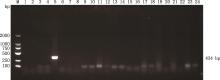
Fig.1
PCR amplification results of clinical samplesM,DL2000 DNA Marker;1, 3, 5, 7, 9, 11, 13, 15, 17, 19, 21 and 23, PCR amplification products of primers of DHAV1, DHAV3, AAstV, GAstV, DTMUV, NDV, AIV, DRV, DuCV, FAdV, NGPV and DPV, respectively; 2, 4, 6, 8, 10, 12, 14, 16, 18, 20, 22 and 24,Negative control"
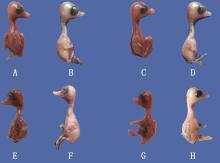
Fig.2
Pathological changes of SPF duck embryosA, C, E and G, The 1st to 4th passage experimental duck embryos, respectively; B, D, F and H, Control duck embryos"
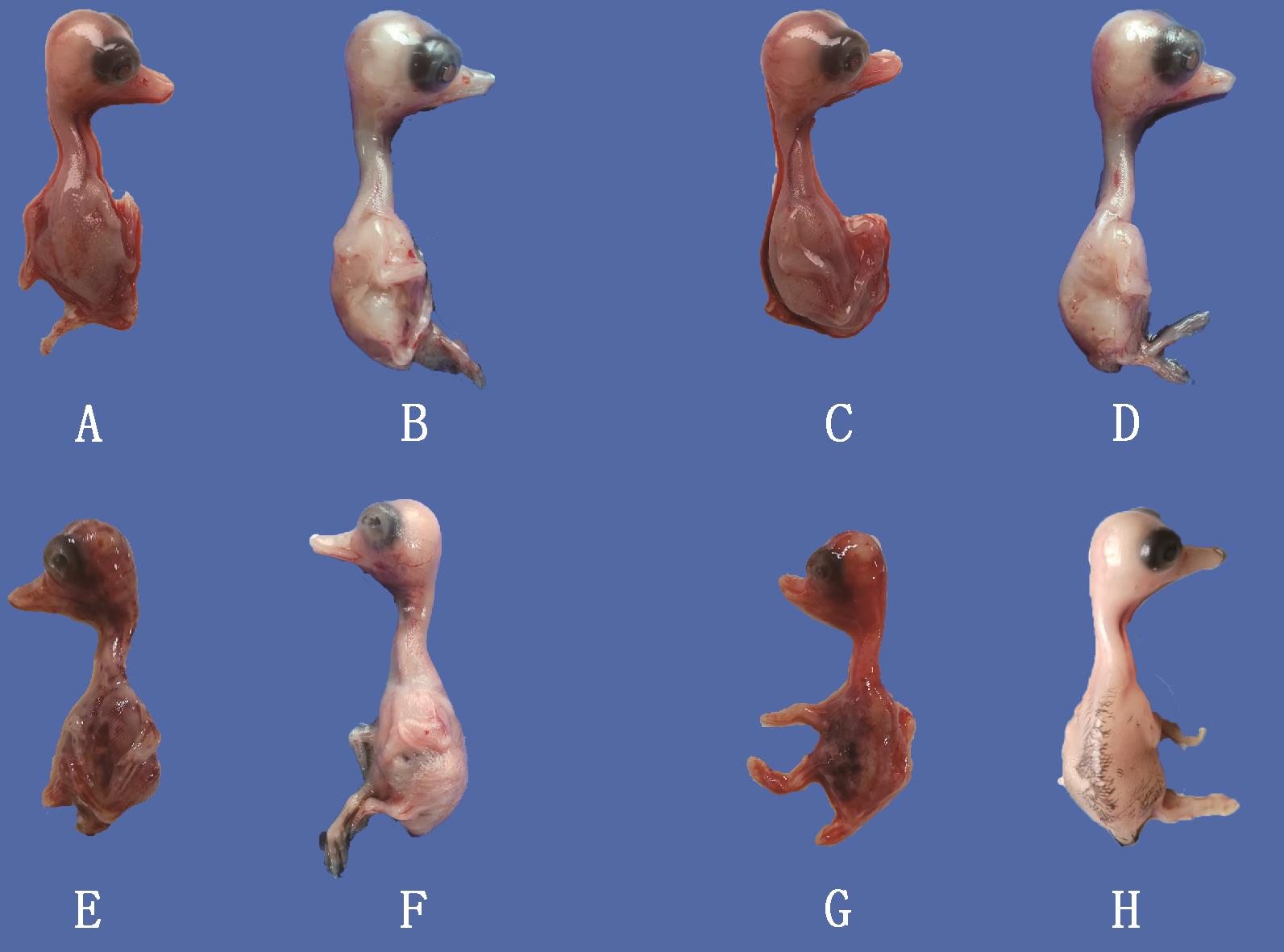
Fig.3
PCR results of allantoic fluidM,DL2000 DNA Marker;1, 3, 5, 7 and 9, PCR amplification products of allantoic fluid by primers of DAstV1, DAstV2, DAstV3, DAstV4 and DAstV5, respectively;2, 4, 6, 8 and 10, Negative control of allantoic fluid"
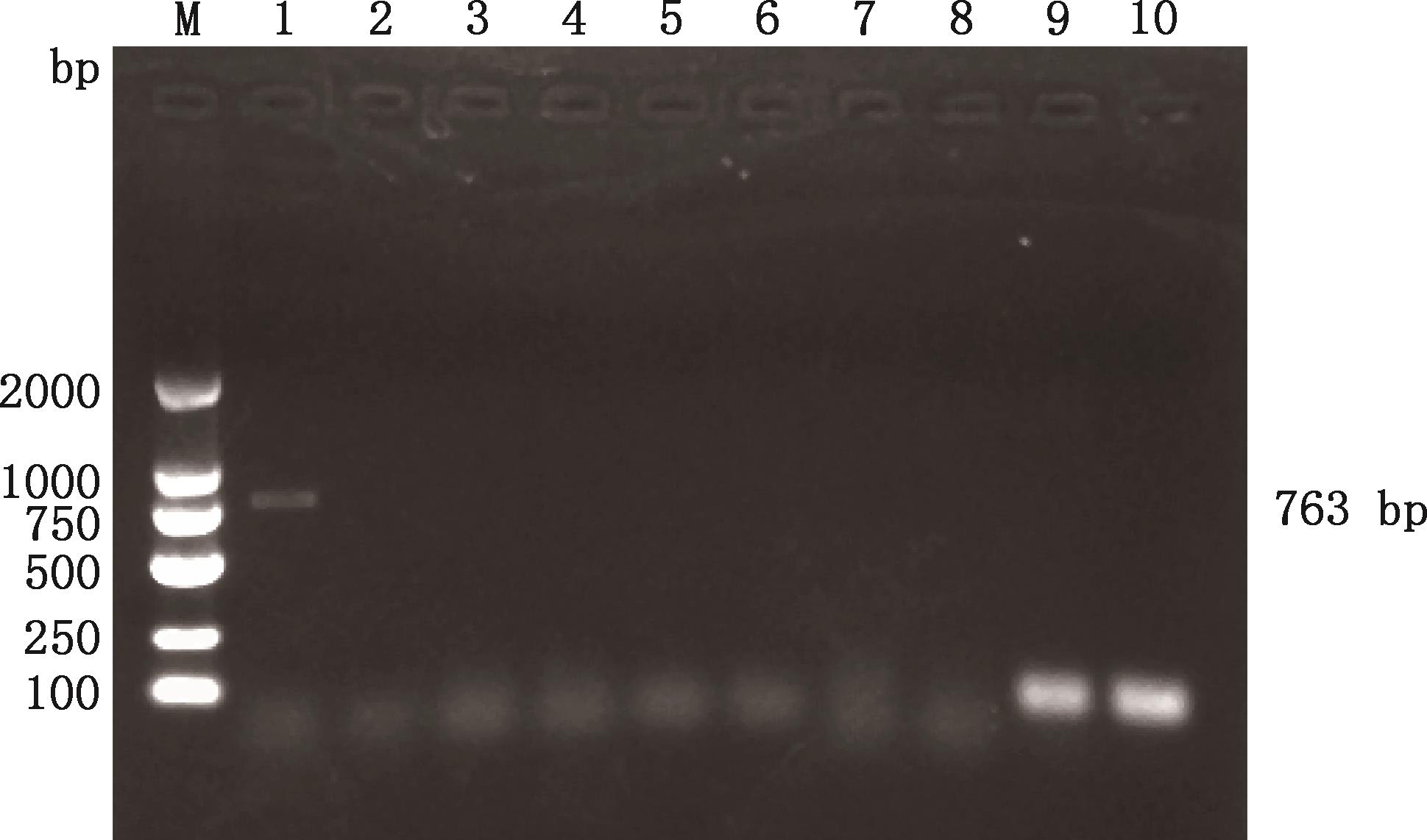
Fig.4
PCR results of DAstV1 in allantoic fluid from passage 1 to 4M, DL2000 DNA Marker; 1, DAstV1 positive control; 2, 4, 6 and 8, Allantoic fluids from passage 1 to 4, respectively; 3, 5, 7 and 9, Negative control of allantoic fluid"
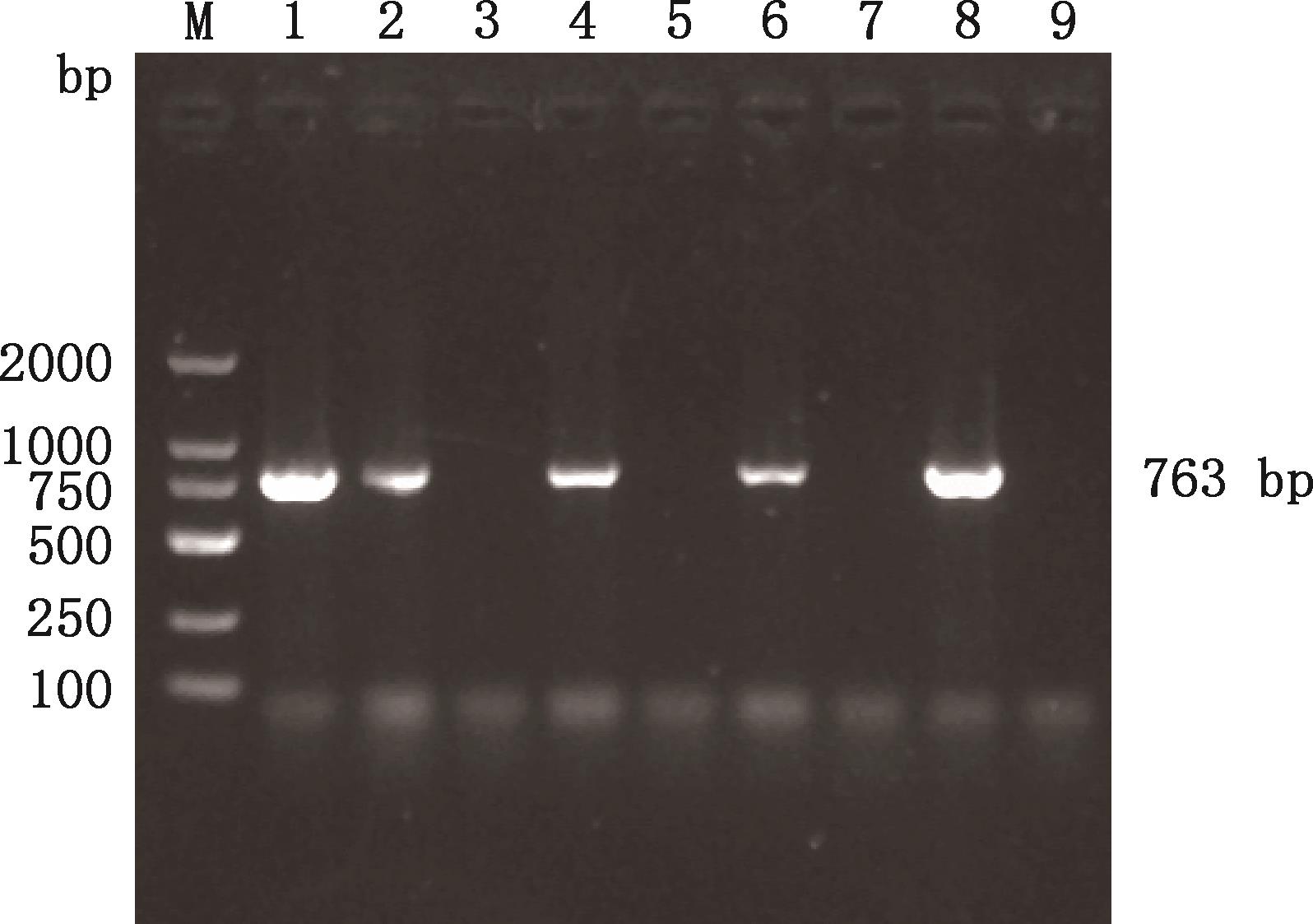
Fig.5
Segmented amplification results of the whole genome of HN24XY06 strainM, DL2000 DNA Marker; 1-10, Segmented genes of P1 to P10; 11, 3'-Race P2"
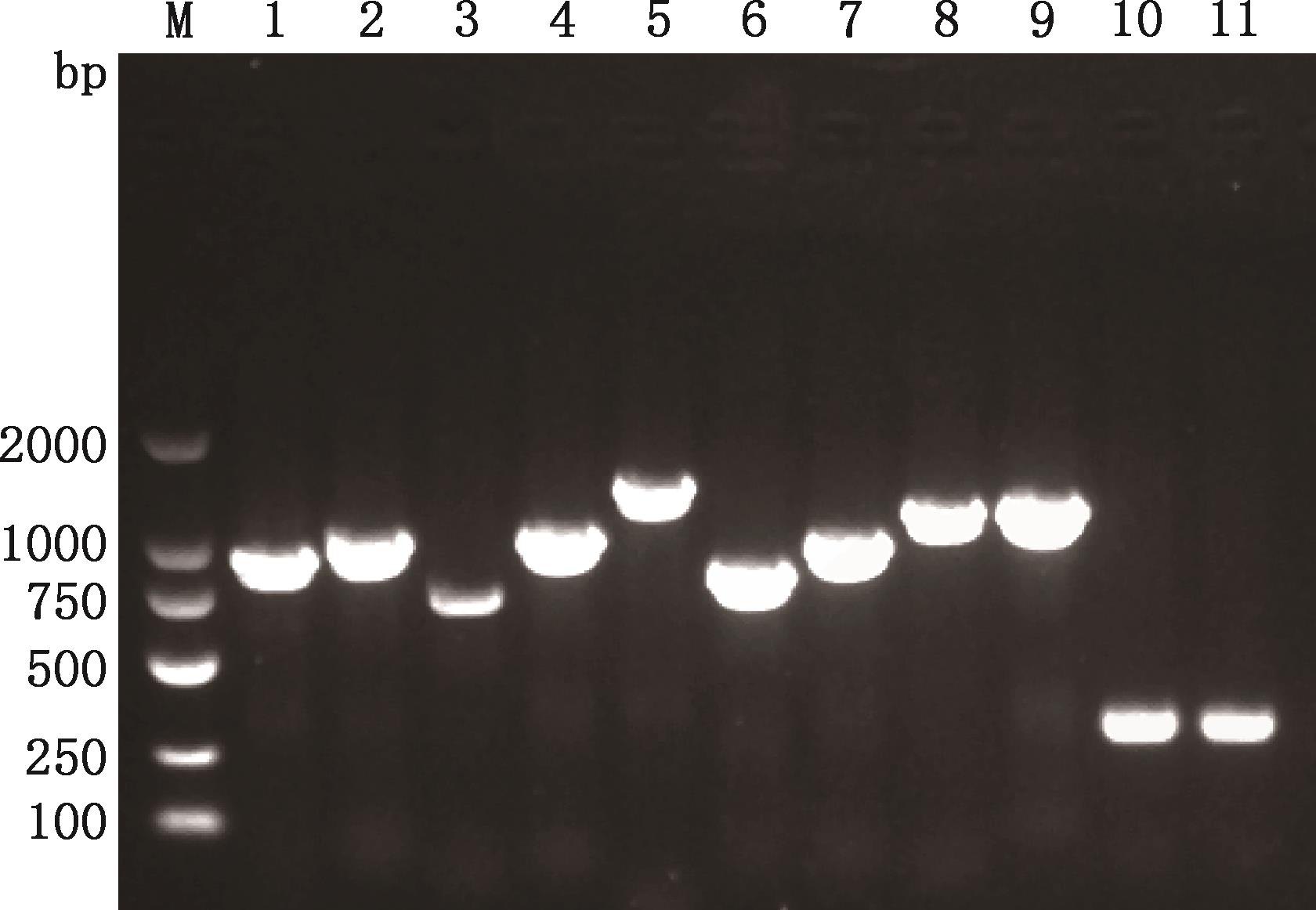

Fig.6
Schematic diagram of the whole genome structure of HN24XY06 strain"

Table 4
Nucleotide sequence similarities between HN24XY06 strain and Astrovirus reference strains"
毒株 Strains | 类型 Type | 相似性 Similarities /% | 毒株 Strains | 类型 Type | 相似性 Similarities /% |
|---|---|---|---|---|---|
| DAstV-SDZZ | DAstV1 | 97.8 | X1257 | DAstV | 54.4 |
| DAstV-SDWF | DAstV1 | 97.8 | C1365 | DAstV | 54.4 |
| HB2015 | DAstV1 | 97.6 | C1388 | DAstV | 54.5 |
| DA08 | DAstV1 | 96.0 | X2250 | DAstV | 54.2 |
| DA07 | DAstV1 | 95.4 | CPH NM1002 | DAstV3 | 57.3 |
| D51 | DAstV1 | 91.2 | CPH | DAstV3 | 57.3 |
| WF1201 | DAstV1 | 91.2 | JM | DAstV5 | 54.3 |
| D390 | DAstV1 | 91.2 | SL1 | DAstV2 | 56.6 |
| D120 | DAstV1 | 91.2 | SL5 | DAstV2 | 56.9 |
| D17 | DAstV1 | 91.1 | Du/Egy/Gharbia/2021/DAstVs | DAstV | 57.4 |
| C-NGB | DAstV1 | 91.0 | JSHA | GAstV | 57.4 |
| AAstV/Chicken/CHN/2018/CZ1801 | AAstV | 57.2 | GD | GAstV | 57.6 |
| TAstV/VA/99 | TAstV | 61.1 | GAstV-SDHZ | GAstV | 57.6 |
| TAstV/CA/00 | TAstV | 60.9 | AstV/Goose/2018/HLJ01 | GAstV | 57.5 |
| YP2 | DAstV4 | 54.5 | Astv/Goose/Guangdong/1812LMG/2018 | GAstV | 56.7 |
| TAstV/AK/98 | TAstV | 61.3 |
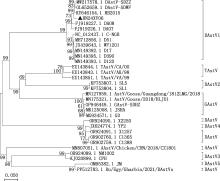
Fig.7
Phylogenetic tree based on whole genome sequence▲,The strain isolated in this study. The same as below"
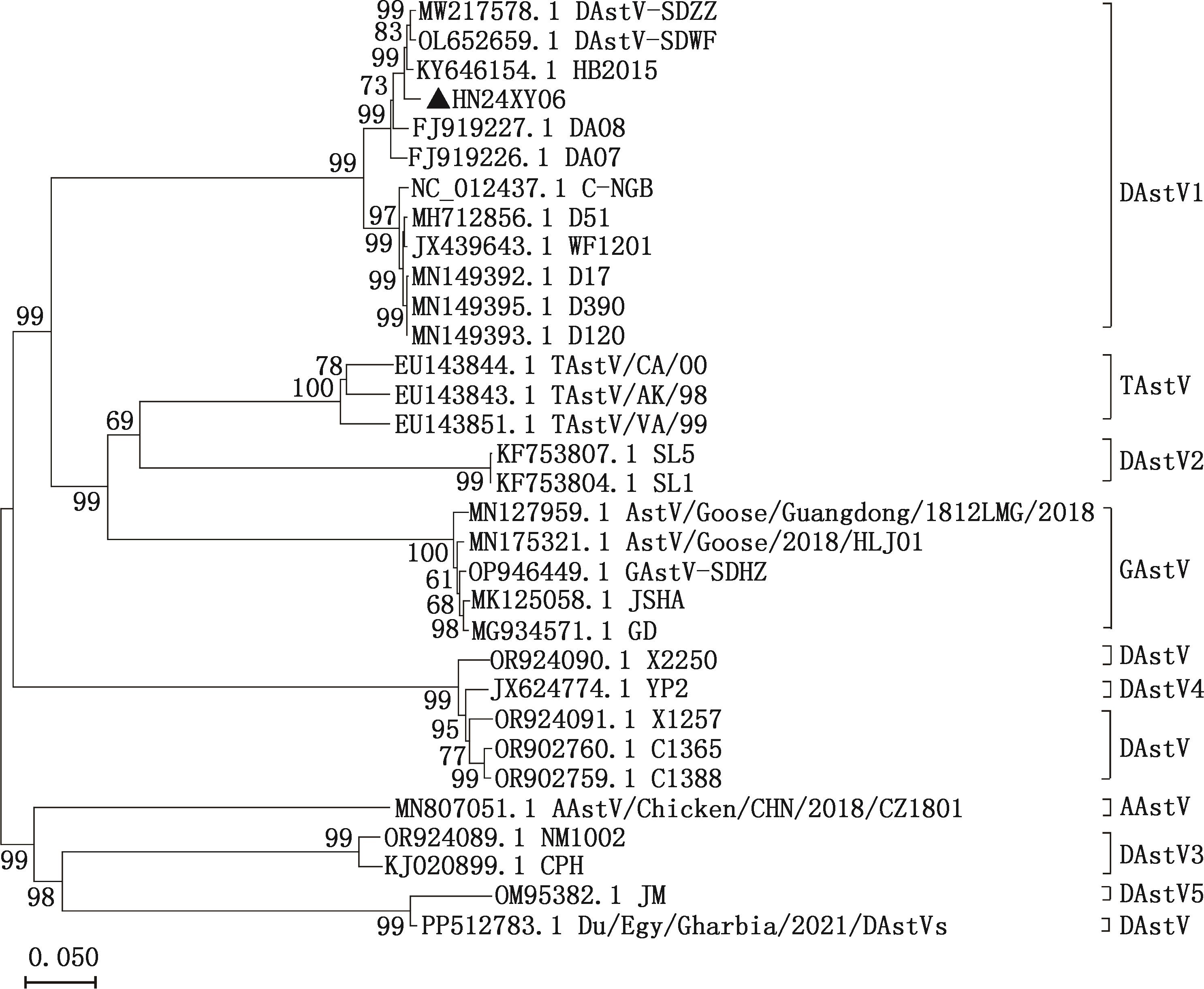
Fig.8
Phylogenetic tree based on the amino acid sequence of ORF1a"

Fig.9
Phylogenetic tree based on the amino acid sequence of ORF1b"

Fig.10
Phylogenetic tree based on the amino acid sequence of ORF2"
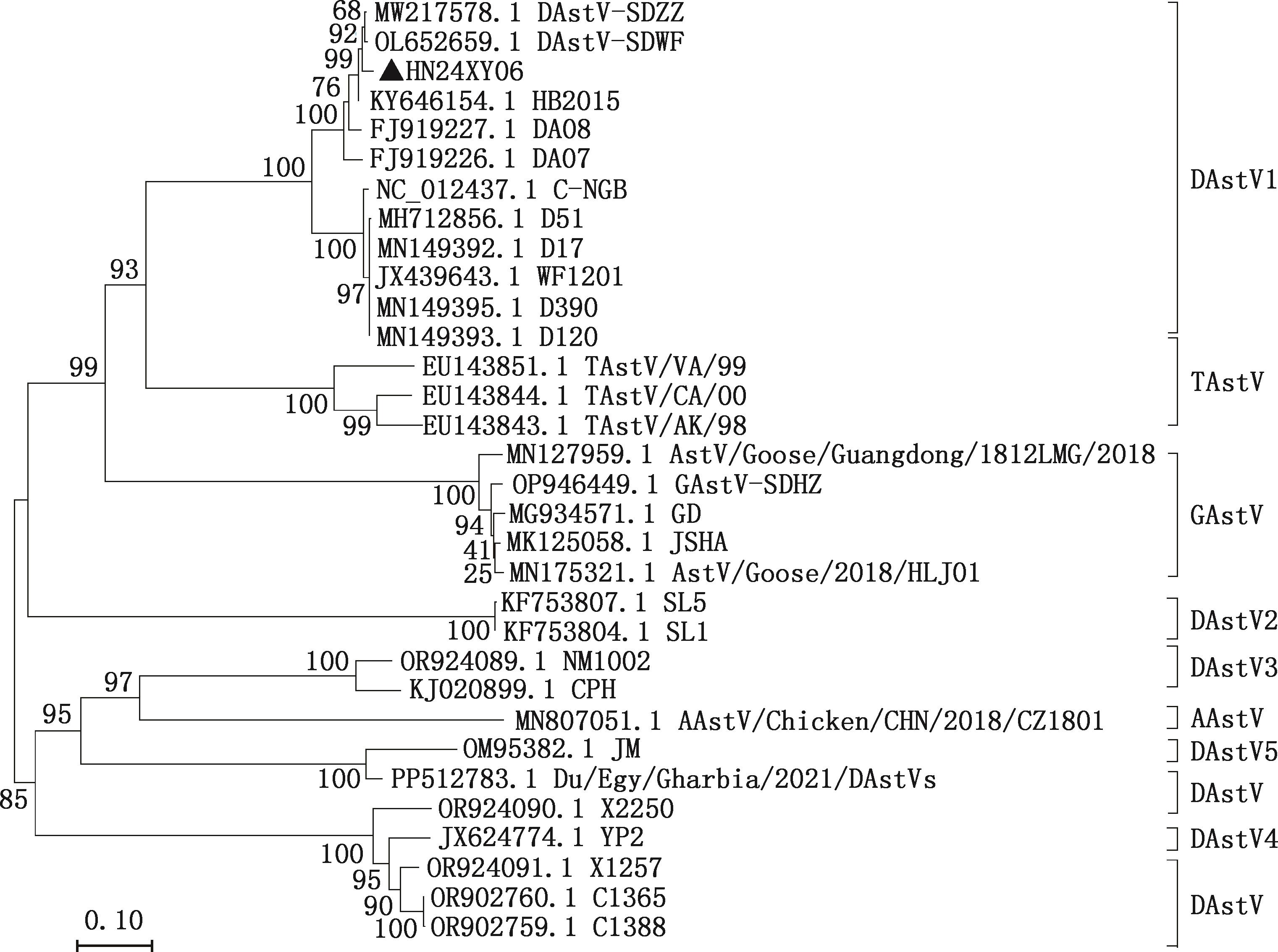
Table 5
Analysis of amino acid mutation sites in ORF1a, ORF1b and ORF2 of HN24XY06 strain"
毒株 Strains | 开放阅读框 Open reading frame | 突变位点 Mutational site |
|---|---|---|
| C-NGB | ORF1a | Q11E、E17Q*、S25P、P26F、G50D、D50N、S103A、I104L、I143F、M148V、A185V、H192Q、F198Y*、M230I、L230I、E266D*、P283S、K306N、Q346K、H346Y、A361V*、S379T、I381F、I385M、T421K、L423I、T449I、M465I、S493K*、S501F、M504F、I528V、I545V、V565I、V595I、A624V、A651V、S677A、I700V、R747Q、L751P、T752I、V753A*、K757R、D761T、R766K、I817T、T831I、E833K*、I834T、R836G、A840T、A841T、K844N、S846C*、R856G*、E859K*、F862Y、T864A、A871T、T873A、T885A、K884R、E888G*、S971N、A1152V、L1156P、V1161A*、S1192N、I1217V、S1238P |
| ORF1b | E19K*、K60R、E108D*、I132M、N172S、K172R、F261Y、N303D、A324V、S3949、T396I、I397V、I437V | |
| ORF2 | P18L、K43R*、H60R、M113L、R137K、R140K、K280T、R307K、N373S、T392A、L427S、R4297P、P437S、S438P*、L461F、N471S、D487S、N488S、V514L、S516A、A520T、R529K、A597E、P602T、F604Y、N620D、S623T、D637E、N639V、V645E、V650G、L663F、E668D、L716P | |
| DAstV-SDWF | ORF1a | E17Q*、F198Y*、R223K、E266D*、A361V*、I385M、M465I、S493K*、V753A*、E833K*、A840T、S846C*、K854E、K856G*、E859K*、E888G*、T896A、F961S、V1161A*、A1233V |
| ORF1b | E19K*、E108D*、M324V | |
| ORF2 | K43R*、S438P*、K451Q | |
| DAstV-SDZZ | ORF1a | E17Q*、F198Y*、R223K、E266D*、A361V*、I385M、S387A、I428L、S493K*、V753A*、V808L、E833K*、V838M、A840T、S846C*、R856G*、E859K*、E888G*、I998M、V1161A*、A1233V |
| ORF1b | E19K*、R35G、K76Q、E108D*、K228Q、M324V | |
| ORF2 | K43R*、S438P*、N488S |
| [1] | 陶 禹,冯旭东,樊彦丽,等.鸭星状病毒1型SYBR Green Ⅰ荧光定量PCR检测方法的建立及其在病毒分离鉴定中的应用[J].中国兽医学报,2024,44(6):1127-1132. |
| TAO Y, FENG X D, FAN Y L, et al. Establishment of SYBR Green Ⅰ dye fluorescence quantitative PCR (qPCR) method for detection of duck Astrovirus type 1 and its application in virus isolation and identification[J]. Chinese Journal of Veterinary Science, 2024,44(6):1127-1132. (in Chinese) | |
| [2] | 封莹洁,孟鸽,蔡成杰,等.鸭星状病毒3型的分离鉴定及全基因组序列分析[J].中国动物检疫,2025,42(4):84-91. |
| FENG Y J, MENG G, CAI C J, et al. Isolation,identification and genomic sequence analysis of DAstV-3[J]. China Animal Health Inspection, 2025,42(4):84-91. (in Chinese) | |
| [3] | ZHANG J, HUANG Y, LI L, et al. First identification and genetic characterization of a novel Duck astrovirus in ducklings in China[J]. Frontiers in Veterinary Science, 2022, 9:873062. |
| [4] | LAN J, ZHANG R, LI P, et al. Identification of a type-specific epitope in the ORF2 protein of Duck astrovirus type 1[J]. Animals (Basel), 2019, 9(12):1069. |
| [5] | ASPLIN F D. Duck hepatitis[J]. Veterinary Record, 1965, 77(17):487. |
| [6] | HAIDER S A, CALNEK B W. In vitro isolation, propagation, and characterization of Duck hepatitis virus type Ⅲ[J]. Avian Diseases, 1979, 23(3):715-729. |
| [7] | TODD D, SMYTH V J, BALL N W, et al. Identification of Chicken enterovirus-like viruses, Duck hepatitis virus type 2 and Duck hepatitis virus type 3 as Astroviruses[J]. Avian Pathology, 2009, 38(1):21-30. |
| [8] | LIU N, WANG F, ZHANG D. Complete sequence of a novel Duck astrovirus[J]. Archives of Virology, 2014, 159(10):2823-2827. |
| [9] | LIAO Q, LIU N, WANG X, et al. Genetic characterization of a novel Astrovirus in Pekin ducks[J]. Infection, Genetics and Evolution, 2015, 32:60-67. |
| [10] | 刘 宁.鸭星状病毒的遗传变异性和抗原性及感染鸭肝脏的转录组分析[D].北京:中国农业大学,2017. |
| LIU N. Genetic variability and antigenicity of Duck astrovirus (DAstV) and transcriptome analysis on livers of DAstV-infected ducklings[D]. Beijing: China Agricultural University, 2017. (in Chinese) | |
| [11] | LI Y, LUO J, SHANG J, et al. Epidemiological investigation and pathogenicity analysis of waterfowl Astroviruses in some areas of China[J]. Frontiers in Microbiology, 2024, 15:1375826. |
| [12] | FU Y, PAN M, WANG X, et al. Complete sequence of a Duck astrovirus associated with fatal hepatitis in ducklings[J]. Journal of General Virology, 2009, 90(5):1104-1108. |
| [13] | 张富友.我国部分地区禽星状病毒分子流行病学调查及其基因组特性研究[D].泰安:山东农业大学,2021. |
| ZHANG F Y. Molecular epidemiology and genomic characteristics of Avian astrovirus in some areas of China[D]. Tai’an: Shandong Agricultural University,2021.(in Chinese) | |
| [14] | WEI F, WANG Y, WANG Q, et al. The isolation and characterization of Duck astrovirus type-1 remerging in China[J]. Transboundary and Emerging Diseases, 2022, 69(5):2890-2897. |
| [15] | XU J, YIN L, GUO Y, et al. The biological characteristics of DAstV molecular epidemiology and pathogenicity of Duck astrovirus causing hepatitis in ducks and chickens in Southeast China[J]. Poultry Science, 2024, 103(10):104076. |
| [16] | CHEN X, CHEN Y, LIU C, et al. Improved one-tube RT-PCR method for simultaneous detection and genotyping of Duck hepatitis A virus subtypes 1 and 3[J]. PLoS One, 2019, 14(8):e0219750. |
| [17] | 杨 晶,张日腾,王振忠,等.我国部分地区鸭病毒性疫病共感染的流行病学调查[J].中国兽医学报,2018,38(10):1872-1877. |
| YANG J, ZHANG R T, WANG Z Z, et al. Epidemiological investigation on co-infection of ducks viral pathogens in some areas of China[J]. Chinese Journal of Veterinary Science, 2018,38(10):1872-1877. (in Chinese) | |
| [18] | LI Y, LUO J, ZHANG F, et al. Establishment and application of quadruple fluorescence quantitative RT-PCR method for the identification of waterfowl Astrovirus[J]. Frontiers in Microbiology, 2024, 15:1328243. |
| [19] | 郭翠平.鸭星状病毒1型WF1202株全基因组序列的测定与单因子血清的制备[D].泰安:山东农业大学,2014. |
| GUO C P. Analysis of the complete genome sequence and preparation of mono-specific serum of Duck astrovirus type 1 WF1202 strain[D]. Tai’an: Shandong Agricultural University,2014.(in Chinese) | |
| [20] | 张富友,邓春冉,王素春,等.禽星状病毒研究进展[J].中国动物检疫,2022,39(5):83-91. |
| ZHANG F Y, DENG C R, WANG S C, et al. Advances in the researches on Avian astrovirus[J]. China Animal Health Inspection, 2022,39(5):83-91. (in Chinese) | |
| [21] | XU J, YIN L, YAN Z, et al. Impact of Duck astrovirus on susceptibility to infection across duck ages[J]. Poultry Science, 2024, 103(5):103564. |
| [22] | 王笑言.鸭产蛋下降相关新病毒的分子鉴定与生物学特性研究[D].北京:中国农业大学,2015. |
| WANG X Y. Molecular identification and biological characterization of newly discovered viruses associated with egg drop of ducks[D]. Beijing: China Agricultural University, 2015. (in Chinese) | |
| [23] | LIU N, JIANG M, WANG M, et al. Isolation and detection of Duck astrovirus CPH: Implications for epidemiology and pathogenicity[J]. Avian Pathology, 2016, 45(2):221-227. |
| [24] | 邓春冉.我国部分地区水禽星状病毒的分子流行病学调查与DAstV-3快速检测方法的建立[D].邯郸:河北工程大学,2022. |
| DENG C R. Molecular epidemiological investigation of Avian astrovirus from waterfowl in some regions of China and the establishment of a rapid detection method for DAstV-3[D]. Handan: Hebei University of Engineering, 2022. (in Chinese) | |
| [25] | 廖勤丰. 新发现的水禽星状病毒、微RNA病毒和嵌杯病毒的分子检测与鉴定[D].北京:中国农业大学,2014. |
| LIAO Q F. Molecular detection and characterization of newly discovered Astrovirus, Picornavirus and Calicivirus of waterfowl[D]. Beijing: China Agricultural University, 2014. (in Chinese) | |
| [26] | 于天浩.一株鸭源星状病毒生物学特性鉴定及其卵黄抗体对雏鸭保护性的研究[D].哈尔滨:东北林业大学, 2024. |
| YU T H. Identification of biological characteristics of a duck-derived Astrovirus and study on the protective effect of egg yolk antibody on ducklings[D]. Harbin: Northeast Forestry University, 2024. (in Chinese) | |
| [27] | DE NOVA-OCAMPO M, SOLIMAN M C, EPINOSA-HERNÁNDEZ W, et al. Human astroviruses: In silico analysis of the untranslated region and putative binding sites of cellular proteins[J]. Molecular Biology Reports, 2019, 46(1):1413-1424. |
| [28] | PANTIN-JACKWOOD M J, STROTHER K O, MUNDT E, et al. Molecular characterization of Avian astroviruses[J]. Archives of Virology, 2011, 156(2):235-244. |
| [29] | ARIAS C F, DUBOIS R M. The Astrovirus capsid: A review[J]. Viruses, 2017, 9(1):15. |
| [30] | DUBOIS R M, FREIDEN P, MARVIN S, et al. Crystal structure of the Avian astrovirus capsid spike[J]. Journal of Virology, 2013, 87(14):7853-7863. |
| [31] | 张思远,卢秀娴,梁昭平,等.我国部分地区新型鹅星状病毒ORF2基因序列及遗传变异分析[J].中国动物检疫,2021,38(6):1-5. |
| ZHANG S Y, LU X X, LIANG Z P, et al. ORF2 gene sequence of novel Goose astroviruses isolated in China and genetic variation analysis[J]. China Animal Health Inspection, 2021, 38(6):1-5. (in Chinese) | |
| [32] | WOHLGEMUTH N, HONCE R, SCHULTZ-CHERRY S. Astrovirus evolution and emergence[J]. Infection, Genetics and Evolution, 2019, 69:30-37. |
| [1] | Ya WANG, Zhiguo LI, Rongyan LUO, Ruiguo LIU, Zhicai ZUO, Xiaoping MA. Isolation, Identification, Phylogenetic Analysis and Drug Sensitivity Test of Trichophyton verrucosum from Beef Cattle in Sichuan [J]. China Animal Husbandry & Veterinary Medicine, 2026, 53(1): 459-468. |
| [2] | LIU Jian, ZHOU Jinping, XU Weibing, BAI Yilan, YANG Xianchao, GUI Yaping, XIA Qiqi, XU Feng, SHEN Liping, LIU Peihong, WANG Jian. Phylogenetic and Bioinformatics Analysis of HN Gene of Pigeon Paramyxovirus Type Ⅰ Epidemic Strains in Shanghai [J]. China Animal Husbandry & Veterinary Medicine, 2025, 52(11): 5371-5380. |
| [3] | BIJunming, DONG Yaqin, CUIJin, SHA Zhou, GU Congcong, ZHENG Hui, WEI Rong, SUN Fuliang, ZHANG Feng, ZHANG Zhihong. Isolation,Identification and Genetic Evolution Analysis of a Strain of Bovine Viral Diarrhea Virus in Shandong Province [J]. China Animal Husbandry & Veterinary Medicine, 2024, 51(10): 4485-4499. |
| [4] | LI Zhongbo, HOU Qianghong, DUAN Deyong. Haplotypes Diversity,Genetic Differentiation and Phylogenetic Analysis of Aedes albopictus [J]. China Animal Husbandry & Veterinary Medicine, 2023, 50(4): 1452-1460. |
| [5] | LIU Yutong, YAO Yanting, LI Ruiling, HAN Wenqi, SHI Ting, WANG Yidan, REN Yupeng. Analysis of Genetic Variation of Porcine Epidemic Diarrhea Virus in Parts of Southwest China from 2020 to 2021 [J]. China Animal Husbandry & Veterinary Medicine, 2022, 49(6): 2279-2290. |
| [6] | XU Minsheng, KE Haiyi, YANG Dongxia, SHI Keda, SUN Zeyi, NIU Jiawei, CHANG Xin, ZHAI Shaolun, ZANG Yingan, LI Chunling. Whole Genome Sequencing and Biological Characteristics Analysis of Multidrug-resistant Actinobacillus pleuropneumoniae GD2107 Strain [J]. China Animal Husbandry & Veterinary Medicine, 2022, 49(10): 4019-4031. |
| [7] | QI Yuzhuo, LIANG Lin, HAN Kun, LIANG Ruiying, JIA Yaxiong, CUI Shangjin. Genome Determination and Genetic Evolution Analysis of a Pigeon Circovirus Strain in Beijing [J]. China Animal Husbandry & Veterinary Medicine, 2022, 49(1): 32-42. |
| [8] | XU Ning, GE Guiyang, LI Dongli, LIU Yi, GONG Qinglong, MA Baoyi, SHENG Chenyan, SHI Kun, LI Jianming, LENG Xue, DU Rui. Isolation and Identification of Porcine Pseudorabies Virus and Genetic Variation Analysis of Partial Virulence Gene [J]. China Animal Husbandry & Veterinary Medicine, 2021, 48(5): 1794-1803. |
| [9] | TANG Ye, CHEN Yi, TIAN Xiaoyan, LYU Haifeng, GAN Junji. Molecular Characterization of 3'-terminal Genome of Canine Coronavirus Strains JS1706 and JS1712 [J]. China Animal Husbandry & Veterinary Medicine, 2021, 48(11): 4231-4241. |
| [10] | ZHANG Li, REN Weike, LU Chao, LI Xiuli, LI Fuqiang, TIAN Xiangxue, CHI Jingjing, WANG Lili, JIANG Shan, DONG Zhimin, YAN Minghua. Genetic Variation Analysis of gB, gC and gE Genes of Porcine Pseudorabies Viruses Isolated in Tianjin During 2015-2020 [J]. China Animal Husbandry & Veterinary Medicine, 2021, 48(10): 3741-3751. |
| [11] | LI Mingyang, FANG Qingli, HUANG Weijian. Molecular Epidemiology of Bovine Astrovirus in Buffalo from Guangxi [J]. China Animal Husbandry & Veterinary Medicine, 2020, 47(9): 2926-2934. |
| [12] | YANG Zhenxing, KOU Meiling, LIAO Defang, GAO Xiang, HU Zhongyan, LI Zhanhong, XIE Jiarui, LI Huachun, YANG Heng. Isolation and Identification of Arbovirus from the Sentinel Herds in Jinghong City,Yunnan Province,China in 2019 [J]. China Animal Husbandry & Veterinary Medicine, 2020, 47(12): 4127-4137. |
| [13] | LI Jiajia, SONG Jianling. Identification and Complete Genomic Analysis of a Newcastle Disease Virus from a Laying Hen [J]. China Animal Husbandry & Veterinary Medicine, 2020, 47(1): 221-228. |
| [14] | HU Lili, SUN Yan, LIU Yingying, WANG Chen, BU Yanzhen. Morphological and Molecular Characteristics Analysis of Cylicocyclus leptostomum [J]. China Animal Husbandry & Veterinary Medicine, 2019, 46(1): 271-278. |
| [15] | WU Kainian, WANG Li, LI Chenyang. Cloning and Bioinformatics Analysis of BCL2A Gene in Jinchuan Yak [J]. China Animal Husbandry & Veterinary Medicine, 2018, 45(6): 1463-1470. |
| Viewed | ||||||
|
Full text |
|
|||||
|
Abstract |
|
|||||
