
China Animal Husbandry & Veterinary Medicine ›› 2026, Vol. 53 ›› Issue (1): 448-458.doi: 10.16431/j.cnki.1671-7236.2026.01.040
• Basic Veterinary Medicine • Previous Articles Next Articles
LIAN Kaiqi1,2( ), WANG Yuhang1,2, MENG Xiangfeng1,2, ZHANG Mingliang1,2, ZHOU Lingling1,2()
Received:2025-04-03
Online:2026-01-05
Published:2025-12-26
Contact:
ZHOU Lingling
E-mail:liankaiqi616@163.com;13700719135@163.com
CLC Number:
LIAN Kaiqi, WANG Yuhang, MENG Xiangfeng, ZHANG Mingliang, ZHOU Lingling. Isolation, Identification and Drug Resistance Analysis of Pathogenic Escherichia coli from Pavo cristatus[J]. China Animal Husbandry & Veterinary Medicine, 2026, 53(1): 448-458.
Table 1
Primer information of drug resistance genes"
药物类别 Drug category | 目的基因 Target genes | 引物序列 Primer sequences (5′→3′) | 退火温度 Annealing temperature/℃ | 产物大小 Product size/bp |
|---|---|---|---|---|
四环素类 Tetracyclines | tetA | F:GTAATTCTGAGCACTGTCGC | 54 | 957 |
| R:CTGCCTGGACAACATTGCTT | ||||
| tetB | F:TTGGTTAGGGGCAAGTTTTG | 54 | 659 | |
| R:GTAATGGGCCAATAACACCG | ||||
β-内酰胺类 β-lactams | ampC | F:TTCTATCAAMACTGGCARCC | 55 | 530 |
| R:CCYTTTTATGTACCCAYGA | ||||
| blaTEM | F:ATGAGTATTCAACATTTCCG | 57 | 859 | |
| R:CAATGCTTAATCAGTGAGG | ||||
| blaNDM | F:TGACGCGGCGTAGTGCTCAGTGT | 60 | 297 | |
| R:GCGGCGGGGATTGCGACTTAT | ||||
| 磺胺类Sulfonamides | sul1 | F:GGTTCTGAAATCCATCCCTG | 56 | 251 |
| R:CTCTCATCGAAGAAGGAGTC | ||||
| sul2 | F:CGGCATCGTCAACATAACC | 57 | 369 | |
| R:CCGAATGCATAACGACGAG | ||||
| Sul3 | F:AAACGAATCCGGAAGAGGT | 57 | 279 | |
| R:CAAGAGTTGGTGCTAAACGA | ||||
氨基糖苷类 Aminoglycosides | ant(3′)-Ⅰa | F:ATCTGGCTATCTTGCTGACA | 49 | 284 |
| R:TATGACGGGCTGATACTGG | ||||
| aph(3′)-Ⅱa | F:TGACTGGGCACAACAGACT | 50 | 717 | |
| R:TCAAGAAGGCGATAGAAGGC | ||||
| aac(3′)-Ⅱ | F:TGAAACGCTGACGGAGCCTC | 54 | 370 | |
| R:GTCGAACAGGTAGCACTGAG | ||||
| rmtB | F:ATGAACATCAACGATGCCCTC | 49 | 756 | |
| R:TTATCCATTCTTTTTTATCAAGTATAT | ||||
| strA-strB | F:TATCTGCGATTGGACCCTCTG | 54 | 538 | |
| R:CATTGCTCATCATTTGATCGGCT | ||||
| aadA1 | F:GCAGCGCAATGACATTCTTG | 54 | 282 | |
| R:ATCCTCGGCGCGATTTTG |
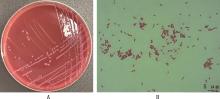
Fig.1
Growth of the isolated bacteria on MacConkey medium (A) and the microscopic examination of Gram staining (B, 1 000×)"

Table 2
Biochemical identification results"
项目 Items | 结果 Results | 项目 Items | 结果 Results |
|---|---|---|---|
| 吲哚 Indole | + | 磷酶 Phosphase | - |
| 尿素 Urea | - | V-P | - |
| 棉子糖 Raffinose | - | 苯丙氨酸脱氨酶 Phenylalanine deaminase | - |
| 戊糖 Pentose | + | 鸟氨酸脱羧酶 Ornithine decarboxylase | + |
| 山梨醇 Sorbitol | + | 赖氨酸脱羧酶 Lysine decarboxylase | + |
| ONPG | + | 二磷酶 Diphosphase | - |
| 硫化氢 Hydrogen sulfide | - | 侧金盏花醇 Adonitol | - |
| 西蒙氏枸橼酸盐 Simonsons citrate | - | MR | + |
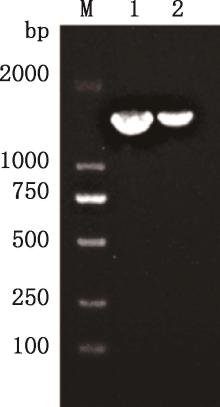
Fig.2
PCR identification results of 16S rRNA gene of the isolateM, DL2000 DNA Marker; 1 and 2, PCR products of 16S rRNA gene of the isolate"
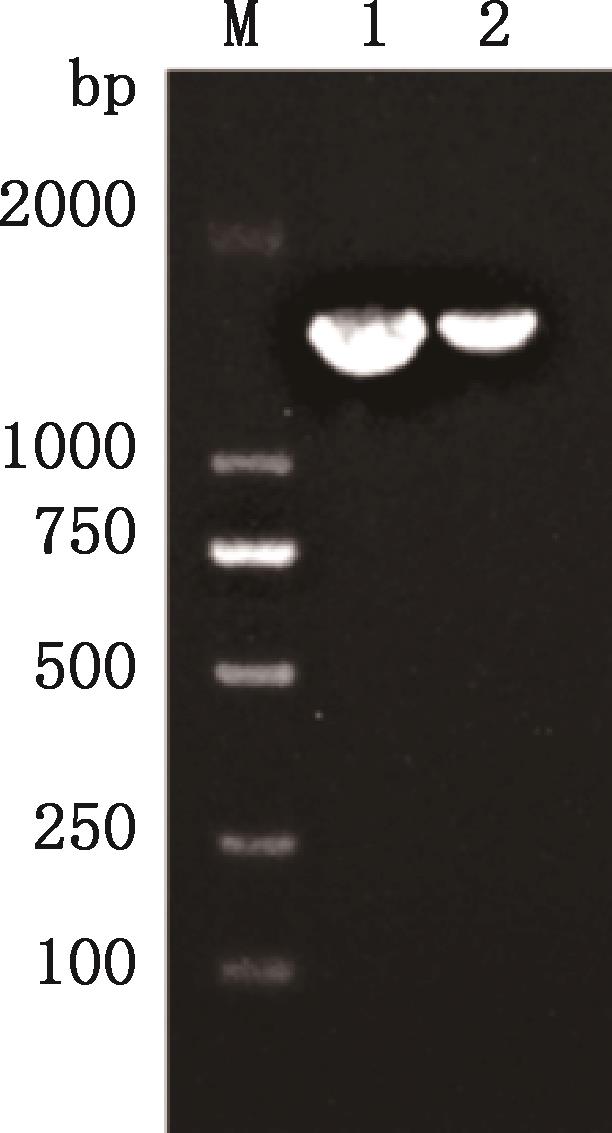
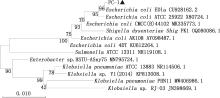
Fig.3
Phylogenetic tree of the isolated strain PC-1 based on 16S rRNA gene▲,The isolate in this study"

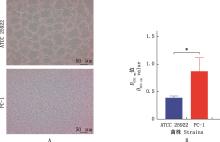
Fig.4
Biofilm-forming ability of the isolate①A, Observation results under inverted microscope (400×);B, Results of absorbance detection.②*, Significant difference (P<0.05)"
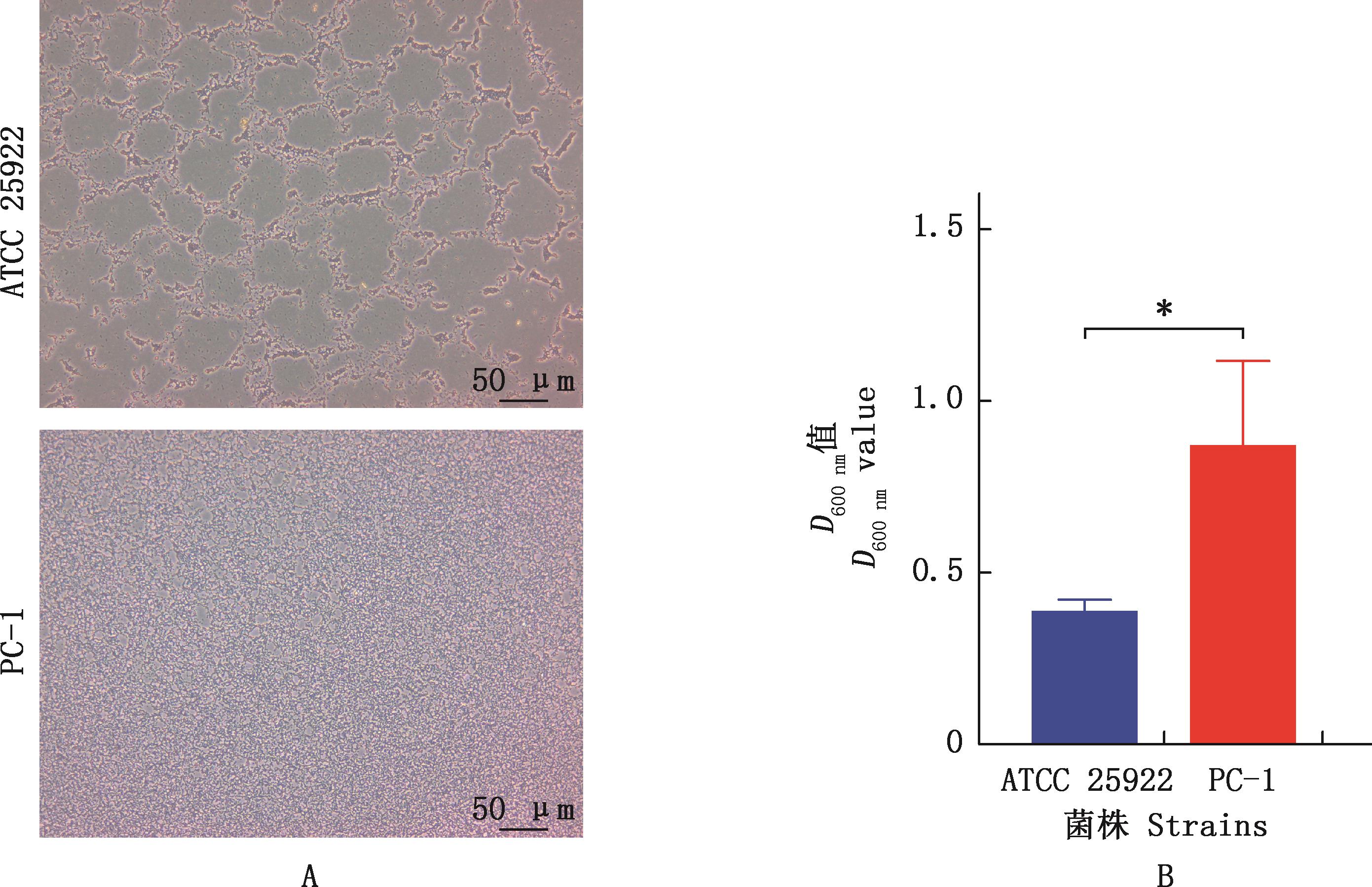
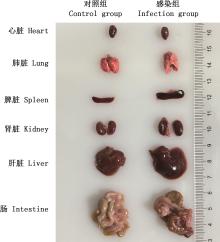
Fig.5
Necropsy results of mice in each group"
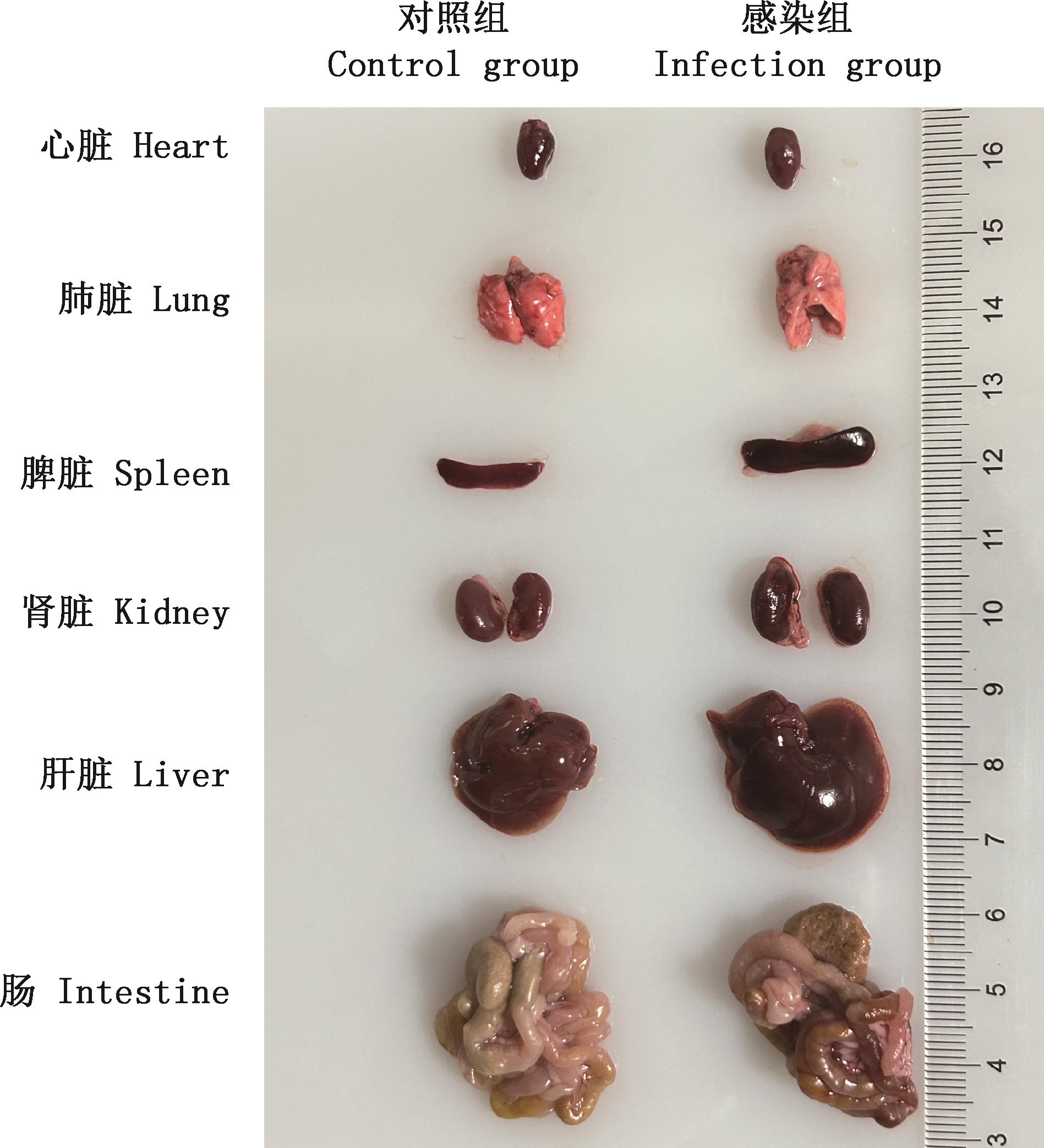
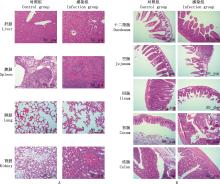
Fig.6
HE staining results of organs (A) and intestine (B) of mice in each group (400×)"

Table 3
Drug susceptibility test results of E. coli isolate"
药物 Drugs | 抑菌圈直径 IZD/mm | 结果 Results | 药物 Drugs | 抑菌圈直径 IZD/mm | 结果 Results |
|---|---|---|---|---|---|
| 左氧氟沙星 LEV | 30.5 | S | 头孢他啶 CAZ | 14.0 | R |
| 诺氟沙星 NOR | 23.0 | S | 卡那霉素 KAN | 11.5 | R |
| 氯霉素 CHL | 23.0 | S | 庆大霉素 GEN | 11.0 | R |
| 环丙沙星 CIP | 22.5 | S | 强力霉素 Dox | 9.5 | R |
| 亚胺培南 IPM | 22.0 | S | 氨苄西林 AMP | 6.0 | R |
| 头孢曲松 CTR | 22.0 | S | 青霉素 PEN | 6.0 | R |
| 头孢哌酮 CPZ | 21.0 | S | 链霉素 S | 6.0 | R |
| 氟苯尼考 FFC | 20.0 | S | 阿奇霉素 AZI | 6.0 | R |
| 阿米卡星 AMK | 18.0 | S | 哌拉西林 PIP | 6.0 | R |
| 头孢呋辛呐 CXM | 16.5 | I | 红霉素 E | 6.0 | R |
| 米诺环素 MH | 15.0 | I | 林可霉素 MY | 6.0 | R |
| 头孢唑啉 CZ | 15.0 | I | 苯唑西林 OX | 6.0 | R |
| 头孢氨苄 CN | 14.5 | I | 克林霉素 CC | 6.0 | R |
| 多黏菌素B PB | 14.5 | S | 四环素 TET | 6.0 | R |
| 复方新诺明 SXT | 6.0 | R | 万古霉素 VAN | 6.0 | R |
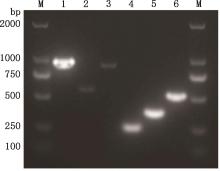
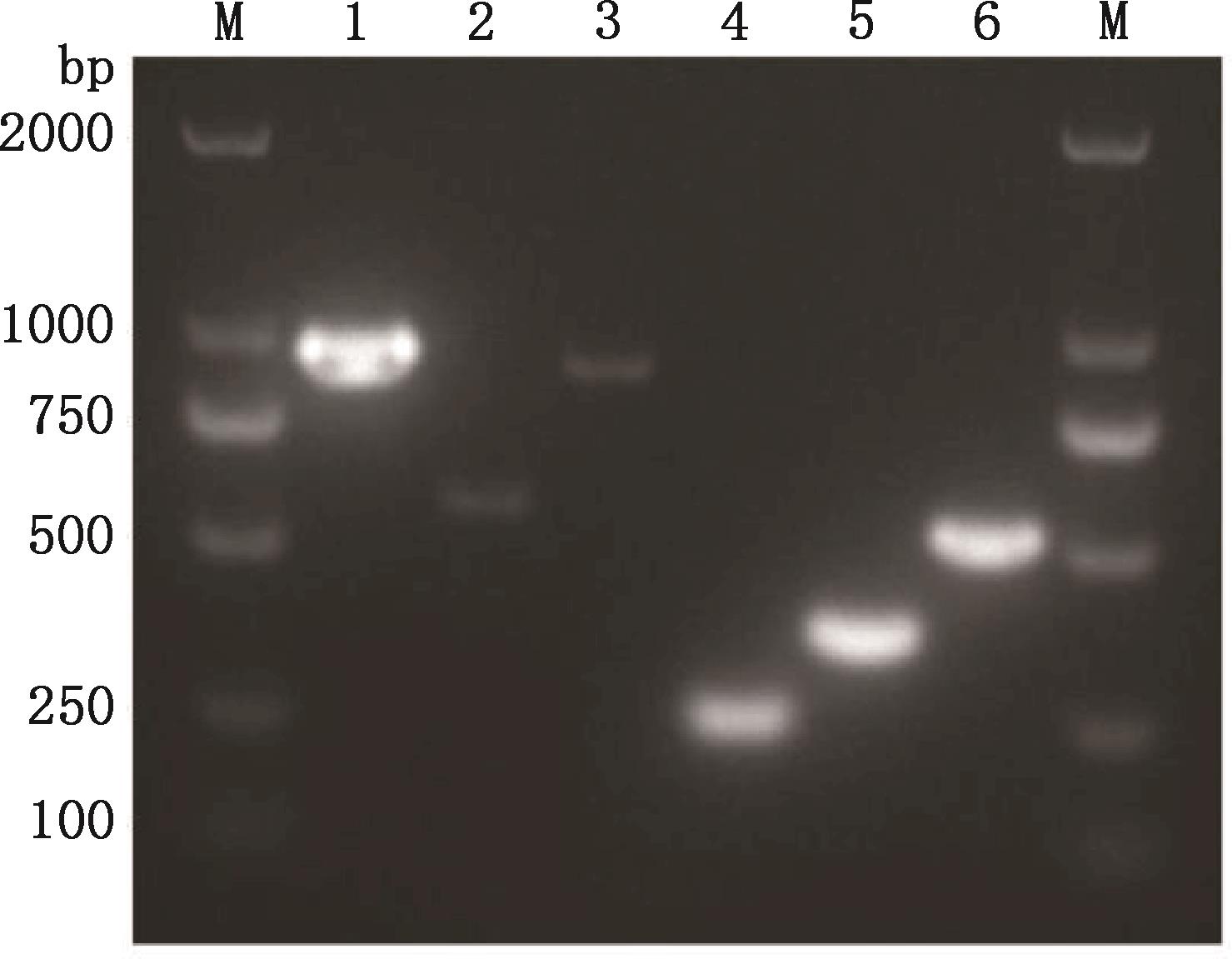
Fig.7
PCR amplification results of some drug resistance genesM, DL2000 DNA Marker; 1-6, tetA, ampC, blaTEM, sul1, sul2 and strA-strB genes, respectively"
| [1] | NASEER J, ANJUM K M. A study on indian peafowl (Pavo cristatus) emphasising breeding season and feeding behaviour in captivity[J]. Indian Journal of Animal Research, 2018, 52:1664-1666. |
| [2] | ZHANG X, LIN C, LI H, et al. Chromosome-level genome assembly of the green peafowl (Pavo muticus)[J]. Genome Biology and Evolution, 2022, 14(2):evac015. |
| [3] | INTARAPAT S, SUKPARANGSI W, GUSEV O, et al. A bird’s-eye view of endangered species conservation: Avian genomics and stem cell approaches for green peafowl (Pavo muticus)[J]. Genes (Basel), 2023, 14(11):2040. |
| [4] | 吴海滨, 杨娟, 周杰珑, 等.昆明动物园孔雀源大肠埃希菌毒力基因及耐药基因检测[J]. 动物医学进展, 2017, 38(9):122-125. |
| WU H B, YANG J, ZHOU J L, et al. Detection of virulence genes and drug resistance genes of peacock Escherichia coli isolated from Kunming zoo[J]. Progress in Veterinary Medicine, 2017, 38(9):122-125. (in Chinese) | |
| [5] | 李颖, 胡清霞, 李超, 等.夜鹭布氏柠檬酸杆菌的分离鉴定与耐药性分析[J]. 畜牧与兽医, 2023, 55(7):53-57. |
| LI Y, HU Q X, LI C, et al. Isolation, identification and drug resistance analysis of Citrobacter braakii from night heron[J]. Animal Husbandry & Veterinary Medicine, 2023, 55(7):53-57. (in Chinese) | |
| [6] | VOUNBA P, ARSENAULTT J, BADA-ALAMBEDJI R, et al. Prevalence of antimicrobial resistance and potential pathogenicity, and possible spread of third generation cephalosporin resistance, in Escherichia coli isolated from healthy chicken farms in the region of Dakar, Senegal[J]. PLoS One, 2019, 14(3):e0214304. |
| [7] | 罗 干.鸭源致病性大肠杆菌分型鉴定、毒力基因检测及药敏试验[D].重庆:西南大学, 2022. |
| LUO G. Genotype identification, virulence genes detection and drug susceptibility test of pathogenic Escherichia coli from duck[D]. Chongqing: Southwest University, 2022. (in Chinese) | |
| [8] | DE SOUSA E S O, CORTEZ A C A, DE SOUSA C M M, et al. Factors influencing susceptibility testing of antifungal drugs: A critical review of document M27-A4 from the Clinical and Laboratory Standards Institute (CLSI)[J]. Brazilian Journal of Microbiology, 2020, 51(4):1791-1800. |
| [9] | 任子宁, 袁孝武, 张烨淳, 等.猪源大肠杆菌的耐药性与锌抗性相关性的研究[J].中国预防兽医学报, 2023, 45(12): 1223-1231. |
| REN Z N, YUAN X W, ZHANG Y C, et al. Study on the correlation between antimicrobial resistance and zinc resistance of porcine Escherichia coli [J]. Chinese Journal of Preventive Veterinary Medicine, 2023, 45 (12): 1223-1231. (in Chinese) | |
| [10] | 薛舒文.广西某猪场猪大肠杆菌分离鉴定、耐药性分析及联合用药方案筛选[D]. 武汉: 华中农业大学, 2023. |
| XUE S W. Isolation,identification, drug resistance analysis and selection of drug combination of swine Escherichia coli from a pig farm in Guangxi[D]. Wuhan: Huazhong Agricultural University, 2023. (in Chinese) | |
| [11] | 车勇良, 陈秋勇, 陈如敬, 等.福建省猪源多黏菌素耐药基因mcr-1阳性细菌的耐药特性及分布特征[J].西北农林科技大学学报(自然科学版), 2022, 50(12):1-8. |
| CHE Y L, CHEN Q Y, CHEN R J, et al. Resistance characteristics and distribution of polymyxin-resistant mcr-1 gene positive bacteria from swine in Fujian[J]. Journal of Northwest A&F University (Natural Science Edition), 2022, 50(12): 1-8. (in Chinese) | |
| [12] | 韩平, 邵明珠, 杜建慧, 等.河北省奶牛源大肠杆菌耐药性与中草药体外抑菌效果[J].饲料研究, 2025, 48(11):78-84. |
| HAN P, SHAO M Z, DU J H, et al. Drug resistance of Escherichia coli in Hebei province dairy cows and in vitro antibacterial effect of Chinese herbal medicine[J]. Feed Research, 2025, 48(11): 78-84. (in Chinese) | |
| [13] | SHAHZAD A, ULLAH F, IRSHAD H, et al. Molecular detection of Shiga toxin-producing Escherichia coli (STEC) O157 in sheep, goats, cows and buffaloes[J]. Molecular Biology Reports, 2021, 48(8):6113-6121. |
| [14] | BAMUNUSINGHAGE N P D, NEELAWALA R G, MAGEDARA H P, et al. Antimicrobial resistance patterns of fecal Escherichia coli in wildlife, urban wildlife, and livestock in the eastern region of Sri Lanka, and differences between carnivores, omnivores, and herbivores[J]. Journal of Wildlife Diseases, 2022, 58(2):380-383. |
| [15] | MUNIR A, LU X, HUMAK F, et al. Emergence of plasmid-mediated fosfomycin resistance among Escherichia coli harboring fosA4, tet(X4), and mcr-1 genes in wild birds[J].mSystems, 2025,10(4):e0167324. |
| [16] | 谢常红, 刘桂兰, 王颖, 等.鸡源金黄色葡萄球菌、大肠杆菌、奇异变形杆菌的分离鉴定及生物学特性研究[J].中国畜牧兽医, 2024, 51(12):5549-5559. |
| XIE C H, LIU G L, WANG Y, et al. Isolation, identification and biological characteristics of Staphylococcus aureus, Escherichia coli and Proteus mirabilis from chickens[J]. China Animal Husbandry & Veterinary Medicine, 2024, 51(12): 5549-5559. (in Chinese) | |
| [17] | MALIK M, KUMAR M, BHALLA G S, et al. Extended spectrum beta-lactamase and aminoglycoside modifying enzyme genes in multi drug resistant Gram-negative bacteria: A snapshot from a tertiary care centre[J]. Medical Journal, Armed Forces India, 2024, 80(1):S223-S231. |
| [18] | ZHANG S, SHU Y, YANG Z, et al. Decoding the enigma: Unveiling the transmission characteristics of waterfowl-associated blaNDM-5-positive Escherichia coli in select regions of China[J]. Frontiers in Microbiology, 2024, 15:1501594. |
| [19] | POIREL L, MADEC J Y, LUPO A, et al. Antimicrobial resistance in Escherichia coli [J]. Microbiology Spectrum, 2018, 6(4):10. |
| [20] | WU B, QI Q, ZHANG X, et al. Dissemination of Escherichia coli carrying plasmid-mediated quinolone resistance (PMQR) genes from swine farms to surroundings[J]. The Science of the Total Environment, 2019, 665:33-40. |
| [21] | 周艳, 万启旸, 朱树娇, 等.一株猪源肠出血性大肠杆菌O157∶H7的全基因组测序及毒力和耐药基因分析[J].广东农业科学, 2025, 52(2):58-70. |
| ZHOU Y, WAN Q Y, ZHU S J, et al. Whole genome sequencing reveals the distribution of resistance and virulence genes of an enterohemorrhagic Escherichia coli O157∶H7 strain from swine[J]. Guangdong Agricultural Sciences, 2025, 52(2):58-70. (in Chinese) | |
| [22] | 戴婷婷, 陈海玉, 段楚楚, 等.鸡源携带多黏菌素耐药基因mcr-1大肠杆菌耐药性与毒力基因相关性分析[J].中国畜牧兽医, 2025, 52(3):1393-1404. |
| DAI T T, CHEN H Y, DUAN C C, et al. Correlation analysis of drug resistance and virulence genes of Escherichia coli with polycolistin resistance gene mcr-1 from chickens[J]. China Animal Husbandry & Veterinary Medicine, 2025, 52(3):1393-1404. (in Chinese) | |
| [23] | 苗睿, 刘垒成, 姜玉莎, 等.绿孔雀肠道菌群基因组特征和耐药性的宏基因组测序分析[J].西南林业大学学报(自然科学), 2024, 44(5):112-119. |
| MIAO R, LIU L C, JIANG Y S, et al. Metagenomic sequencing analysis of genomic characteristics and drug resistance of intestinal flora of Pavo muticus were analyzed by metagenomic sequencing[J]. Journal of Southwest Forestry University (Natural Sciences), 2024, 44(5): 112-119. (in Chinese) | |
| [24] | HONG S, LU H, TIAN D, et al. Discovery of triazole derivatives for biofilm disruption, anti-inflammation and metal ion chelation[J].Frontiers in Chemistry, 2025, 13:1545259. |
| [25] | GROSS N, MUHVICH J, CHING C, et al. Effects of microplastic concentration, composition, and size on Escherichia coli biofilm-associated antimicrobial resistance[J]. Applied and Environmental Microbiology, 2025, 91(4):e0228224. |
| [26] | MAITY A, DAS A, ROY R, et al. Development of novel strategies against the threats of drug-resistant Escherichia coli: An in silico and in vitro investigation[J]. 3 Biotech, 2025, 15(4):77. |
| [27] | AYDIN E, KOCAAGA M, TEMEL A. Association of antibiotic resistance and biofilm formation in Escherichia coli ST131/O25b[J]. Acta Microbiologica et Immunologica Hungarica, 2024, 71(3):197-205. |
| [28] | QIAN W, LI X, YANG M, et al. Relationship between antibiotic resistance, biofilm formation, and biofilm-specific resistance in Escherichia coli isolates from Ningbo, China[J].Infection and Drug Resistance, 2022, 15:2865-2878. |
| [1] | ZHANG Sui, CHENG Chunjie, YANG Chun, CHEN Mengjiao, CHENG Jing, ZHOU Linyi, LI Yongqing, WANG Xiaoying, LIU Wenxiao. Isolation, Identification and Pathogenicity Analysis of Dairy Cow-derived Klebsiella pneumoniae and Mannheimia haemolytica [J]. China Animal Husbandry & Veterinary Medicine, 2026, 53(2): 903-915. |
| [2] | ZHANG Min, LI Yingxiao, ZHANG Lulu, HE Shuhai, QU Zhehui, QIN Dongsheng, LIU Jicheng, JIAO Fengchao. Whole Genome Amplification and Phylogenetic Analysis of Duck Astrovirus Type 1 Xinyang Strain [J]. China Animal Husbandry & Veterinary Medicine, 2026, 53(2): 959-972. |
| [3] | ZHANG Xinxin, ZHANG Yue, CUI An, LI Jinru, ZHANG Yunjing, HE Lixia, YANG Guijun, REN Yudong, LI Guangxing. Isolation, Identification and Genetic Evolution Analysis of PEDV Epidemic Strains in Heilongjiang Province [J]. China Animal Husbandry & Veterinary Medicine, 2026, 53(1): 378-389. |
| [4] | WANG Ya, LI Zhiguo, LUO Rongyan, LIU Ruiguo, ZUO Zhicai, MA Xiaoping. Isolation, Identification, Phylogenetic Analysis and Drug Sensitivity Test of Trichophyton verrucosum from Beef Cattle in Sichuan [J]. China Animal Husbandry & Veterinary Medicine, 2026, 53(1): 459-468. |
| [5] | WANG Qilin, CAO Runlai, LIU Peiwen, LIU Ziyu, XUE Zhuqing, DU Haixia, ZHANG Yue, ZHANG Minjing, LI Yacong, WANG Weiyang, CONG Yanfang, WANG Xiaoxu, LIU Zhijie. Isolation, Identification and Biological Characteristics Analysis of Bordetella bronchiseptica from Raccoon dog(Nyctereutes procyonoides) [J]. China Animal Husbandry & Veterinary Medicine, 2026, 53(1): 489-498. |
| [6] | LI Fuxiang, SONG Jianling, LI Zhanhong. Isolation, Identification and Biological Characterization of Actinobacillus pleuropneumoniae Serotype 7 from Pigs in Yunnan [J]. China Animal Husbandry & Veterinary Medicine, 2026, 53(1): 499-508. |
| [7] | ZHOU Lingling, WANG Yuhang, ZHANG Yuanchen, ZHANG Mingliang, LIAN Kaiqi. Study on Antimicrobial Effects of Terpinen-4-ol Against Escherichia coli [J]. China Animal Husbandry & Veterinary Medicine, 2025, 52(9): 4497-4504. |
| [8] | LI Zihao, GUO Xingyang, LU Junxia, WEI Zhiguo, DING Jiabo, QIN Tong, LI Ruiwen. Antibacterial Effect and Mechanism of Plant Extracts on Canine Escherichia coli in vitro [J]. China Animal Husbandry & Veterinary Medicine, 2025, 52(8): 3888-3895. |
| [9] | ZHAO Xuejian, CHEN Xiaoliang, FENG Xiaowei, ZHANG Kang, MA Xiaojun, LI Jianxi. Investigation of the Pathogen of Calf Diarrhea in Gansu Region and Isolation, Identification and Drug Resistance Analysis of Clostridium perfringens [J]. China Animal Husbandry & Veterinary Medicine, 2025, 52(8): 3927-3938. |
| [10] | TANG Qidong, WA Renlele, LIANG Mingjun, LUO Xiaohong, DU Shuhao, DING Yuexia. Isolation,Identification and Drug Resistance of Salmonella from Goat and the Bacteriostatic Effects of Chinese Herbal Medicines [J]. China Animal Husbandry & Veterinary Medicine, 2025, 52(8): 3965-3975. |
| [11] | GUO Jing, HUANG Meixue, GUO Linfeng, FENG Wanli, JIA Yanyan, LIAO Chengshui, YU Zuhua. In vitro Safety Evaluation of Bacillus subtilis ZJ20 Based on Whole Genome Sequencing [J]. China Animal Husbandry & Veterinary Medicine, 2025, 52(8): 3987-3998. |
| [12] | DAI Lin, HUAI Zhifang, WANG Baowei, ZHANG Ming'ai, FAN Wenlei, ZHANG Jing, WANG Binghan, QI Guofeng. Isolation, Identification and Biological Properties and Safety of A Lactiplantibacillus plantarum Strain [J]. China Animal Husbandry & Veterinary Medicine, 2025, 52(7): 3070-3083. |
| [13] | LU Chong, WANG Yuyan, FU Han, LI Tongyang, MIAO Ronghao, LU Yabin, LI Jianlong, LIU Jianhua, GUO Qingyong, MAI Zhanhai, KUANG Ling. Isolation and Identification of the Main Pathogenic Bacteria of Aborted Yili Foals and Their Pathogenicity [J]. China Animal Husbandry & Veterinary Medicine, 2025, 52(7): 3344-3358. |
| [14] | ZHAO Yilong, TANG Na, JING Changhua, XU Qingqing, YIN Xiusheng, WANG Haiming, SUN Jing, LIN Panpan, DONG Lin, LIU Jishan, CAO Rongfeng. Isolation,Identification and Biological Characteristics of a Strain of Lumpy Skin Disease Virus [J]. China Animal Husbandry & Veterinary Medicine, 2025, 52(6): 2790-2799. |
| [15] | YANG Qinhong, YANG Jia, DUAN Wenjie, ZHANG Yongxian, ZHU Youshuai, YANG Shaohong, HE Cheng, YIN Hongbin, LI Suhua. Isolation and Identification of a High-temperature Tolerant Bacillus thermoamylovorans and Optimization of Its Enzyme Production Conditions [J]. China Animal Husbandry & Veterinary Medicine, 2025, 52(6): 2839-2850. |
| Viewed | ||||||
|
Full text |
|
|||||
|
Abstract |
|
|||||
