
China Animal Husbandry & Veterinary Medicine ›› 2026, Vol. 53 ›› Issue (1): 165-178.doi: 10.16431/j.cnki.1671-7236.2026.01.015
• Nutrition and Feed • Previous Articles Next Articles
CHEN Ping( ), XIE Jianpeng, HE Zhenfu, WANG Fei()
Received:2025-03-28
Online:2026-01-05
Published:2025-12-26
Contact:
WANG Fei
E-mail:gaaschenping@163.com;wangfei@gsagr.ac.cn
CLC Number:
CHEN Ping, XIE Jianpeng, HE Zhenfu, WANG Fei. Effects of Diets with Different Protein Levels on Rumen Metabolism in Yaks[J]. China Animal Husbandry & Veterinary Medicine, 2026, 53(1): 165-178.
Table 1
Composition and nutrient levels of diets (DM basis)"
| 项目 Items | 组别 Groups | |
|---|---|---|
| S4 | S6 | |
| 原料 Ingredients | ||
| 全株玉米青贮 Whole corn silage | 9.52 | 9.00 |
| 玉米秸秆揉丝草 Corn straw kneading grass | 17.00 | 14.52 |
| 酒糟 Distillers’ grains | 10.00 | 13.00 |
| 玉米 Corn | 41.93 | 27.93 |
| 麸皮 Wheat bran | 5.00 | 5.00 |
| 棉饼 Cottonseed meal | 5.00 | 6.00 |
| 豆粕 Soybean meal | 5.00 | 18.00 |
| 菜籽油 Rapeseed oil | 2.50 | 2.50 |
| 食盐 NaCl | 0.40 | 0.40 |
| 小苏打 NaHCO3 | 1.00 | 1.00 |
| 预混料 Premix① | 2.65 | 2.65 |
| 合计 Total | 100.00 | 100.00 |
| 营养成分 Nutrient components | ||
| 综合净能 NEmf/(MJ/kg)② | 7.73 | 7.65 |
| 粗蛋白质 CP | 12.77 | 18.88 |
| 中性洗涤纤维 NDF | 29.72 | 31.33 |
| 酸性洗涤纤维 ADF | 18.81 | 20.86 |
| 钙 Ca | 5.20 | 5.50 |
| 磷 P | 4.30 | 4.70 |
Table 2
Effects of diets with different protein levels on the growth performance in yaks"
| 项目 | 组别 Groups | |
|---|---|---|
| Items | S4 | S6 |
| 初始体重 IBW/kg | 208.80±6.09 | 210.80±6.74 |
| 终末体重 FBW/kg | 266.40±10.86 | 291.20±10.20 |
| 总增重 TWG/kg | 57.60±4.77B | 80.40±3.46A |
| 平均日增重 ADG/kg | 0.64±0.05B | 0.89±0.04A |
| 平均干物质采食量 ADMI/(kg/d) | 5.89±0.09 | 5.98±0.10 |
| 料重比 F/G | 8.74±1.15 | 7.58±0.56 |
Table 3
Effects of diets with different protein levels on the digestive efficiency in yaks"
项目 Items | 组别 Groups | |
|---|---|---|
| S4 | S6 | |
| 干物质 DM | 74.13±2.59 | 79.16±4.09 |
| 粗蛋白质 CP | 41.99±1.60b | 63.82±5.66a |
| 酸性洗涤纤维 ADF | 63.67±7.31 | 77.45±2.97 |
| 中性洗涤纤维 NDF | 68.41±7.32 | 79.39±2.56 |
| 粗纤维 CF | 63.48±9.38 | 79.76±1.94 |
| 粗灰分 ASH | 62.46±1.81B | 72.43±0.73A |
| 粗脂肪 EE | 70.78±3.28 | 84.30±4.99 |
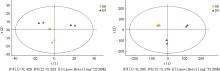
Fig.1
PCA results of rumen fluid metabolism in yaks between different protein level groupsA, GC-MS platform; B, LC-MS platform. The same as below"

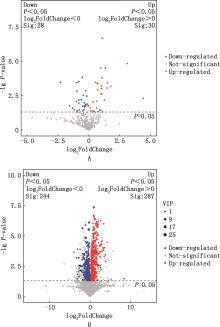
Fig.2
Volcano map of different metabolites in rumen fluid of yaks between different protein level groups"
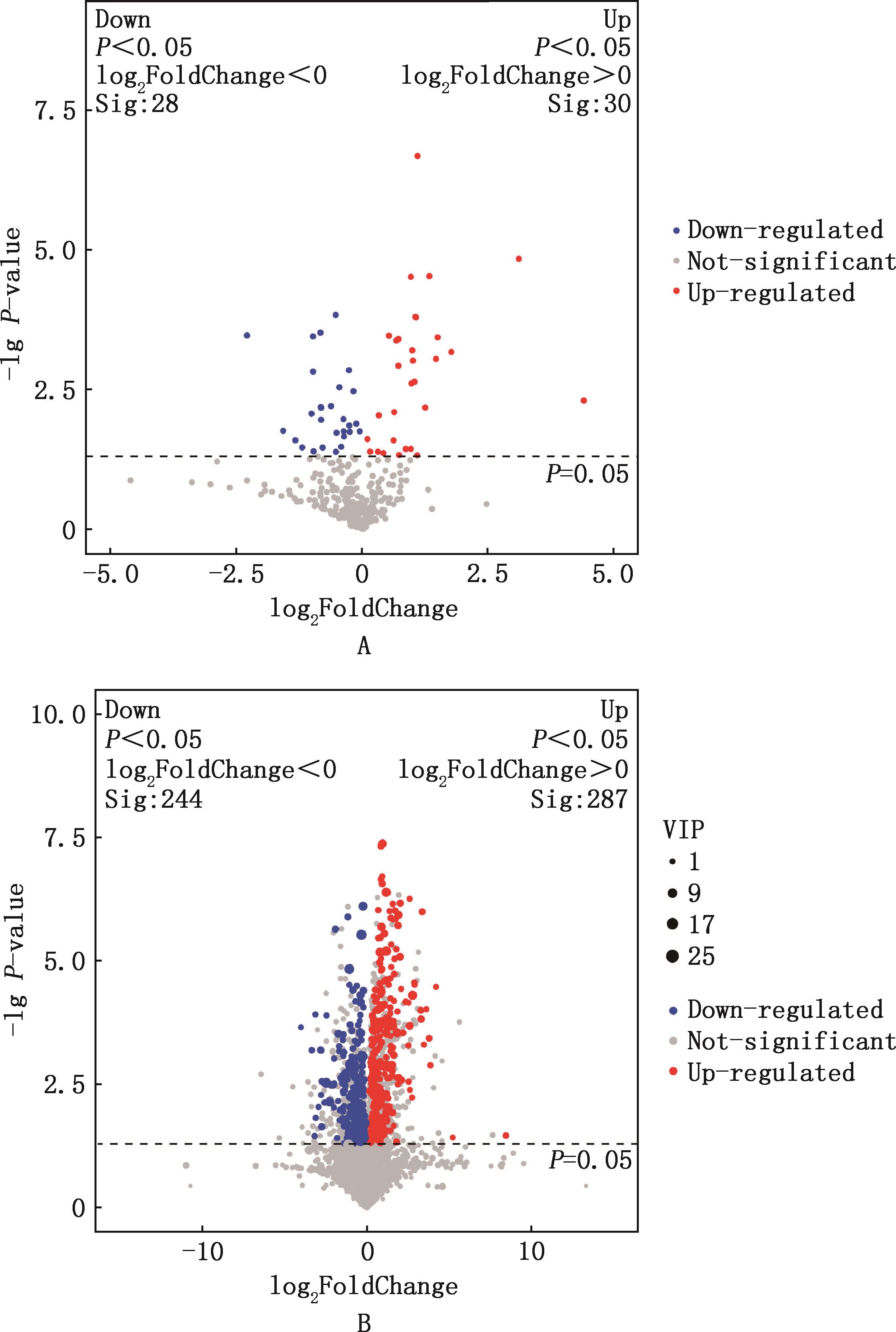
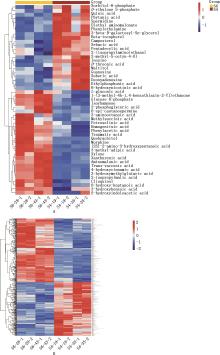
Fig.3
Heat map of different metabolites in rumen fluid of yaks between different protein level groups"

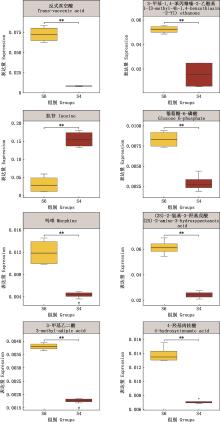
Fig.4
Expression distribution of differential metabolites in rumen fluid of yaks between different protein level groups**,Extremely significant difference (P<0.01)"

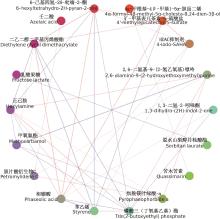
Fig.5
Correlation analysis of differential metabolites in rumen fluid of yaks between different protein level groups"
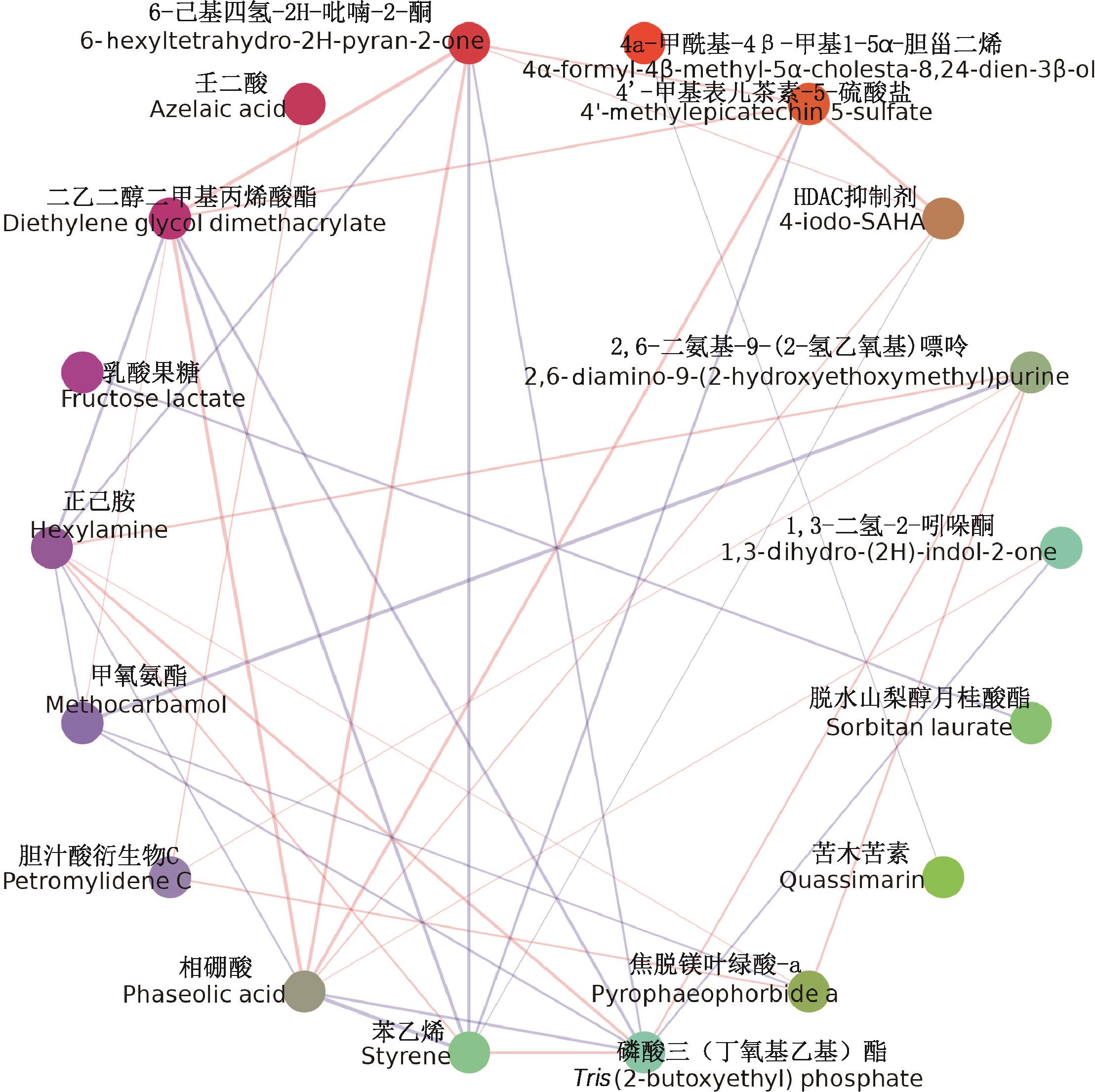
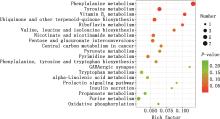
Fig.6
Pathway enrichment analysis of differential metabolites in rumen fluid of yaks between different protein level groups"

| [1] | 谢建鹏, 何振富, 张文鹏, 等. 基于血清代谢组学研究不同能量水平饲粮对育肥牦牛生产性能的影响[J]. 草业科学, 2025, 42(5): 1278-1290. |
| XIE J P, HE Z F, ZHANG W P, et al. Research on the effects of different energy levels of feed on growth traits and differential metabolites of fattening yaks based on metabolomics[J]. Pratacultural Science, 2025, 42(5): 1278-1290.(in Chinese) | |
| [2] | 黎凌铄. 不同蛋白水平饲粮中添加过瘤胃蛋氨酸对牦牛生长性能、血清指标、瘤胃发酵和菌群组成的影响[D].成都:西南民族大学, 2022. |
| LI L S. Effects of rumen protected methionine in diets with different protein levels on growth performance, serum indices, rumen fermentation and bacterial composition of yak[D]. Chengdu: Southwest Minzu University, 2022.(in Chinese) | |
| [3] | 李 婕, 郝力壮, 拜彬强, 等. 高精料舍饲条件下不同能量水平对生长期牦牛生长及血液生化指标的影响[J]. 饲料研究, 2021, 44(2):1-6. |
| LI J, HAO L Z, BAI B Q, et al. Effect of different energy levels on growth performance and blood biochemical indexes of feedlot yaks during growing period[J]. Feed Research, 2021, 44 (2): 1-6.(in Chinese) | |
| [4] | 张莉睿, 张 宇, 贺艳萍, 等. 基于非靶向代谢组学探究扁柏精油对赤拟谷盗的作用机制[J]. 河南工业大学学报(自然科学版), 2024, 45(2): 114-122. |
| ZHANG L R, ZHANG Y, HE Y P, et al. Exploring the mechanism of action of Chamaecyparis obtusa essential oil on Tribolium castaneum based on non-targeted metabolomics[J]. Journal of Henan University of Technology (Natural Science Edition), 2024, 45(2): 114-122.(in Chinese) | |
| [5] | WANG L Z, WANG Z S, XUE B, et al. Comparison of rumen archaeal diversity in adult and elderly yaks(Bos grunniens) using 16S rRNA gene high-throughput sequencing[J]. Journal of Integrative Agriculture, 2017,16(5):1130-1137. |
| [6] | 马丽娜, 李蕾蕾, 康晓冬, 等. 饲粮蛋白质水平对哺乳期犊牛生长性能、血清生化、免疫和抗氧化指标以及血清代谢物的影响[J]. 动物营养学报, 2024,36(9):5776-5792. |
| MA L N, LI L L, KANG X D, et al. Effects of dietary protein level on growth performance,serum biochemical,immune and antioxidant indices and serum metabolites of lactating calves[J]. Chinese Journal of Animal Nutrition, 2024,36(9):5776-5792.(in Chinese) | |
| [7] | 张晓玲, 徐田伟, 张 骞, 等. 饲粮蛋白水平对牦牛生长性能及瘤胃真菌菌群结构的影响[J]. 饲料研究, 2023,46(11):12-15. |
| ZHANG X L, XU T W, ZHANG Q, et al. Effect of dietary protein levels on growth performance and ruminal fungal community structure of yaks[J]. Feed Research, 2023, 46(11):12-15.(in Chinese) | |
| [8] | 来进成, 刘东花, 李润桦, 等. 饲粮粗蛋白质水平对育肥牦牛生产性能和瘤胃微生物多样性的影响[J]. 中国饲料, 2023, 21:105-112. |
| LAI J C, LIU D H, LI R H, et al. Effects of dietary crude protein levels on production performance and rumen microbial diversity in fattening yaks[J]. China Feed, 2023, 21:105-112.(in Chinese) | |
| [9] | 孙光明, 李 鑫, 索朗扎西, 等. 饲粮蛋白质水平对育肥期牦牛生长性能、血清生化与免疫指标及瘤胃发酵特征的影响[J]. 黑龙江畜牧兽医, 2023, 4:121-126. |
| SUN G M, LI X, SUO L Z X, et al. Effects of dietary protein levels on growth performance, serum biochemical and immune indexes, and rumen fermentation characteristics of fattening yaks[J]. Heilongjiang Animal Science and Veterinary Medicine, 2023, 4:121-126.(in Chinese) | |
| [10] | 李万栋, 郝力壮, 刘书杰, 等. 不同营养水平对生长期舍饲牦牛生长性能和营养物质表观消化率的影响[J]. 饲料工业, 2015,36(17):42-46. |
| LI W D, HAO L Z, LIU S J, et al. Effect of different nutrient diets on production performance and apparent digestibility of nutrients in three years old yaks by barn-feeding[J]. Feed Industry, 2015,36(17):42-46.(in Chinese) | |
| [11] | 田春丽. 不同能量和蛋白水平饲粮对滩羊生长性能、养分消化率和经济效益的影响[D]. 杨凌:西北农林科技大学, 2015. |
| TIAN C L. Effects of different energy and protein levels on growing performance, nutrients digestibility and economical benefits of Tan sheep[D]. Yangling: Northwest A&F University, 2015.(in Chinese) | |
| [12] | THIEX N, NOVOTNY L, CRAWFORD A. Determination of ash in animal feed: AOAC official method 942.05 revisited[J]. Journal of AOAC International, 2012, 95(5):12-129. |
| [13] | 张彩霞, 付文华, 李俊良, 等. 菌酶协同秸秆生物发酵饲料营养价值及瘤胃降解率研究[J]. 动物营养学报, 2024,36(9):6038-6048. |
| ZHANG C X, FU W H, LI J L, et al. A study of nutritional value and rumen degradation rate of fermented stover feed by fungus and enzyme[J]. Chinese Journal of Animal Nutrition, 2024,36(9):6038-6048.(in Chinese) | |
| [14] | 雷潇瑜, 涂 瑞, 彭忠利. 不同蛋白水平饲粮中添加过瘤胃赖氨酸对牦牛生长性能、养分消化、血清生化及瘤胃发酵参数的影响[J]. 中国饲料, 2024, 19:72-80. |
| LEI X Y, TU R, PENG Z L. Effects of rumen lysine supplementation in diets with different protein levels on growth performance, nutrient digestion,serum biochemistry and rumen fermentation parameters in yaks[J]. China Feed, 2024, 19:72-80.(in Chinese) | |
| [15] | 戴荣凤. 补饲日粮蛋白水平对娟犏牛生长、血液生化指标及瘤胃菌群的影响[D]. 北京:中国农业科学院, 2023. |
| DAI R F. Effects of dietary supplementary protein levels on growth, blood biochemical indexes, and rumen microflora of jersey-yak[D] .Beijing: Chinese Academy of Agricultural Sciences, 2023.(in Chinese) | |
| [16] | 任青苗. 牦牛瘤胃不同生态位微生物群落结构与功能研究[D]. 兰州:兰州大学, 2022. |
| REN Q M. Microbial communities in different niches of yak (Bos grunniens) rumen[D]. Lanzhou: Lanzhou University, 2022.(in Chinese) | |
| [17] | 王冰艺, 马弘财, 董海龙, 等. 牦牛胃肠道微生物影响因素的研究进展[J]. 动物营养学报, 2023, 35(4):2096-2104. |
| WANG B Y, MA H C, DONG H L, et al. Research progress on influencing factors of gastrointestinal microbiota in yaks[J]. Chinese Journal of Animal Nutrition, 2023,35(4):2096-2104.(in Chinese) | |
| [18] | KHAN MA, BACH A, WEARY DM, et al. Invited review: Transitioning from milk to solid feed in dairy heifers[J]. Journal of Dairy Science, 2016, 99(2):885-902. |
| [19] | GOULART R S, VIEIRA R A M, DANIEL J L P, et al. Effects of source and concentration of neutral detergent fiber from roughage in beef cattle diets on feed intake, ingestive behavior, and ruminal kinetics[J]. Journal of Animal Science, 2020,98(5):skaa107. |
| [20] | 郭 鑫, 刘 杰, 高巧仙, 等. 必需氨基酸营养对奶牛乳腺蛋白合成调控的研究进展[J]. 华北农学报, 2023,38(S1):393-399. |
| GUO X, LIU J, GAO Q X, et al. Research progress of essential amino acid nutrition on the regulation of mammary protein synthesis in dairy cows[J]. Acta Agriculturae Boreali-Sinica, 2023, 38(S1):393-399.(in Chinese) | |
| [21] | 李菊梅, 于佳俊, 文华英, 等. 西藏牦牛酸奶菌群结构与挥发性风味物质研究及相关性分析[J]. 食品与发酵工业, 2025, 51(11): 358-366. |
| LI J M, YU J J, WEN H Y, et al. Research and correlation analysis on the structure of yak yoghurt flora and volatile flavour substances in Xizang[J]. Food and Fermentation Industries, 2025, 51(11): 358-366.(in Chinese) | |
| [22] | 张 翀, 金海振, 周 纯, 等. 癸酸通过活化CD8+ T细胞促进小鼠黑色素瘤B16F10细胞皮下荷瘤模型的抗肿瘤免疫反应[J]. 中国肿瘤生物治疗杂志,2024(网络首发). |
| ZHANG C, JIN H Z, ZHOU C, et al. Caprie acid promotes anti-tumor immune response in a subeutaneous tumor-bearing model of mouse melanoma B16F10 cells by activating[J]. Chinese Journal of Cancer Biotherapy, 2024. Epub ahead of print.(in Chinese) | |
| [23] | RUSSO M, GUIDA F, PAPARO L, et al. The novel butyrate derivative phenylalanine-butyramide protects from doxorubicin induced cardiotoxicity[J]. European Journal of Heart Failure, 2020, 21(4):519-528. |
| [24] | FIORUCCI S, DISTRUTTI E. Bile acid-activated receptors, intestinal microbiota, and the treatment of metabolic disorders[J]. Trends in Molecular Medicine, 2015, 21(11):702-714. |
| [25] | 靳思玉, 李苗苗, 曹 阳. 牧草叶绿素衍生物植烷酸对动物机体的影响[J]. 中国饲料, 2019, 5:8-13. |
| JIN S Y, LI M M, CAO Y. The effects of phytanic acid from chlorophyll derivatives in forage grass on animal organism[J]. China Feed, 2019, 5:8-13.(in Chinese) | |
| [26] | 余 静, 余 黄. 不同能量水平饲粮对牦牛生长性能、瘤胃代谢参数和经济效益的影响[J]. 中国饲料, 2024, 16:45-48. |
| YU J, YU H. Effects of different energy levels diets on growth performance, rumenmetabolic parameters and economic benefits of yaks[J]. China Feed, 2024, 16:45-48.(in Chinese) | |
| [27] | 肖 浩. 牦牛瘤胃代谢研究进展[J]. 草业与畜牧, 2008,7:48-50. |
| XIAO H. Research progress of rumen metabolism in yak[J]. Journal of Grassland and Forage Science, 2008, 7:48-50.(in Chinese) |
| [1] | ZHAO Chen, ZHU Shuang, LI Jiping, HU Pengfei, LI Chunyi. Screening Key Factor of Deer Antler in Promoting Chondrocyte Proliferation Through Preparative Liquid Chromatography and Untargeted Metabolomics [J]. China Animal Husbandry & Veterinary Medicine, 2026, 53(1): 509-519. |
| [2] | LIU Xiaotong, GE Bingjie, QIU Qian, LIU Xinman, YU Minghong, ZHANG Xuemei. Application of Bioinformatics in Toxicity Mechanism of Aflatoxin B1 [J]. China Animal Husbandry & Veterinary Medicine, 2025, 52(4): 1639-1650. |
| [3] | AN Zhaoxiang, XUN Wenjuan, ZHOU Hanlin, SHI Liguang. Effects of Heat Stress on Semen Antioxidant Capacity and Seminal Plasma Metabolomics in Hainan Black Goats [J]. China Animal Husbandry & Veterinary Medicine, 2025, 52(3): 1191-1201. |
| [4] | LUO Qin, LIU Dingyu, LIU Baoling, QIAO Changhong, CHEN Xiangyu, HE Zhenwen, WANG Xiaohu, CHEN Jing, ZHANG Pian, HUANG Yuan, WANG Gang, LIU Hao, CAI Rujian. Research Progress on Antiviral Effect of Traditional Chinese Medicine Analyzed from Different Omics Perspectives [J]. China Animal Husbandry & Veterinary Medicine, 2025, 52(2): 554-561. |
| [5] | DUAN Yali, CHEN Qian, YANG Wanlu, GAO Pengfei, CAO Riliang, HU Guangying. Effects of Compound Chinese Herbal Medicine Feed Additives on the Intestinal Microbiota and Muscle Metabolism in Pigs [J]. China Animal Husbandry & Veterinary Medicine, 2025, 52(12): 5560-5574. |
| [6] | ZHI Li, DAI Sifan, LIU Xueqin, CHEN Quanzhen, YU Ying, MAO Huaming. Application of Transcriptomics and Metabolomics Technologies in Beef Quality Traits Research [J]. China Animal Husbandry & Veterinary Medicine, 2025, 52(12): 5600-5613. |
| [7] | QIAN Shiyu, YAO Ruyu, ZHANG Hetong, XING Wenhui, WU Jiahui, LI Yuanyuan, ZHAO Chunjiang. Advances in Equine Exercise Metabolome and Its Associated Metabolic Pathways [J]. China Animal Husbandry & Veterinary Medicine, 2025, 52(11): 5053-5062. |
| [8] | MA Qingling, BAO Gaoliang, WANG Zhiyou, GUI Linsheng, HOU Shengzhen, YANG Chao. Effects of Dietary Ammonium Chloride Addition Levels on Hepatic Histomorphology and Metabolome of Tibetan Sheep [J]. China Animal Husbandry & Veterinary Medicine, 2025, 52(10): 4697-4708. |
| [9] | QIAO Changhong, CHEN Xiangyu, LIU Baoling, LUO Qin, LIU Dingyu, HE Zhenwen, WANG Xiaohu, CHEN Jing, ZHANG Pian, HUANG Yuan, BAI Aiquan, WANG Gang, CAI Rujian. Research Progress on the Antimicrobial Mechanism of Traditional Chinese Medicine Through a Multi-omics Perspective [J]. China Animal Husbandry & Veterinary Medicine, 2025, 52(1): 52-59. |
| [10] | FENG Yi, YANG Yunyun, LUO Yongrong, WU Peng, WANG Yan, YANG Ying, CHEN Jiangfeng, JIANG Haibo, WEN Ming. Effect of Dietary Addition of Rosa roxburghii Tratt. Residue on Intestinal Histomorphology,Antioxidant Capacity,Immunity and Metabolomics in Common Carp (Cyprinus carpio) [J]. China Animal Husbandry & Veterinary Medicine, 2025, 52(1): 80-93. |
| [11] | HE Jianjian, GAO Huixia, SUN Chenxu, YAO Haibo, XIE Yaodi, YU Aihuan, HU Jinsheng, WANG He, DUAN Yueyan, TANG Defu, LIU Wangjing. Effect of Allium mongolicum Regel Powder on Nutrient Apparent Digestibility and Plasma Metabolomics in Angus Calves [J]. China Animal Husbandry & Veterinary Medicine, 2024, 51(9): 3780-3793. |
| [12] | WANG Jing, SONG Lirong, LIU Zhen, FU Rui, WANG Zi, ZANG Changjiang, LI Fengming. Effects of Dietary Protein Levels on Reproductive Performance,Digestion and Metabolism and Plasma Biochemical Indicators of Tarim Pigeons During Breeding Period [J]. China Animal Husbandry & Veterinary Medicine, 2024, 51(8): 3301-3310. |
| [13] | JING Kemin, ZHANG Peng, LI Yuqian, TIAN Yuan, DONG Wenjing, CHAI Zhixin, WANG Jikun, ZHONG Jincheng, CAI Xin. Cloning, Bioinformatic and Expression Analysis of SERPINE1 Gene in Longissimus Dorsi Muscle of Yaks with Different Tenderness [J]. China Animal Husbandry & Veterinary Medicine, 2024, 51(6): 2308-2318. |
| [14] | ZHANG Xingyan, LAN Haien, YI Xianfeng, YANG Kai, ZHU Wen, LAN Xi, ZHOU Junhua, CHEN Zhonghua. Metabolomics Analysis of Fermented Elephant Grass and It’s Effects on the Growth Performance and Serum Biochemical Indicators of Pigs [J]. China Animal Husbandry & Veterinary Medicine, 2024, 51(11): 4802-4811. |
| [15] | LI Rui, ZHANG Yiyang, LUO Xuehui, ZHOU Manlin, WU Shaomi, YANG Kun, QIAO Zilin. Effect of Hypoxia on Proliferation and Oxidative Stress Injury of Pulmonary Artery Smooth Muscle Cells in Yaks [J]. China Animal Husbandry & Veterinary Medicine, 2023, 50(6): 2245-2254. |
| Viewed | ||||||
|
Full text |
|
|||||
|
Abstract |
|
|||||
