
China Animal Husbandry & Veterinary Medicine ›› 2026, Vol. 53 ›› Issue (1): 333-342.doi: 10.16431/j.cnki.1671-7236.2026.01.030
• Genetics and Breeding • Previous Articles Next Articles
LI Yanyan1,2( ), HUANG Yuechuan2, ZHANG Hailiang2, MEI Cheng3, YANG Minglu3, ZHANG Menghua1, XU Lei1, FENG Yan1,2, HUANG Xixia1(), WANG Yachun2()
Revised:2025-09-02
Online:2026-01-05
Published:2025-12-26
Contact:
HUANG Xixia, WANG Yachun
E-mail:1072087203@qq.com;au-huangxixia@163.com;wangyachun@cau.edu.cn
CLC Number:
LI Yanyan, HUANG Yuechuan, ZHANG Hailiang, MEI Cheng, YANG Minglu, ZHANG Menghua, XU Lei, FENG Yan, HUANG Xixia, WANG Yachun. Population Characteristics and Influencing Factors of Pregnancy Rates for in vitro Embryo Transfer in Holstein Cattle[J]. China Animal Husbandry & Veterinary Medicine, 2026, 53(1): 333-342.
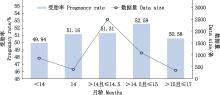
Fig.1
Average pregnancy rate of in vitro embryo transferred to recipient cattle at different ages"
Table 1
Descriptive statistics for pregnancy rate of IVP embryo transfer in Holstein cattle"
性状 Traits | 水平 Levels | 数据量 Data size/条 | 受胎率 Pregnancy rate/% |
|---|---|---|---|
受体牛发情天数 Days post-estrus in recipient cows | 6~7 | 4 098 | 51.54 |
| 8 | 1 057 | 50.33 | |
黄体等级 Corpus luteum grade | 1 | 2 477 | 51.15 |
| 2 | 2 078 | 51.78 | |
| 3 | 600 | 50.17 | |
移植次数 Number of embryo transfer for the recipient | 首次移植 | 3 986 | 51.66 |
| 非首次移植 | 1 169 | 50.04 | |
胚胎父本 Embryo sire | A001 | 25 | 60.00 |
| A002 | 196 | 59.18 | |
| A003 | 167 | 58.68 | |
| A004 | 14 | 57.14 | |
| A005 | 173 | 56.07 | |
| A006 | 339 | 55.75 | |
| A007 | 36 | 55.56 | |
| A008 | 22 | 54.55 | |
| A009 | 802 | 54.49 | |
| A010 | 193 | 54.40 | |
| A011 | 352 | 54.26 | |
| A012 | 1 018 | 51.18 | |
| A013 | 30 | 50.00 | |
| A014 | 768 | 48.70 | |
| A015 | 23 | 47.83 | |
| A016 | 71 | 46.48 | |
| A017 | 101 | 44.55 | |
| A018 | 580 | 44.31 | |
| A019 | 25 | 44.00 | |
| A020 | 49 | 42.86 | |
| A021 | 171 | 39.77 | |
胚胎保存状态 Embryo preservation status | 新鲜胚胎 | 742 | 67.12 |
| 冷冻胚胎 | 4 784 | 50.06 | |
胚胎发育阶段 Development stage of embryo | 囊胚 | 1 101 | 47.41 |
| 扩张囊胚 | 4 054 | 52.34 |
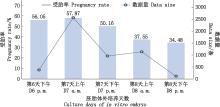
Fig.2
Effect of in vitro culture duration on pregnancy rates of transferred bovine IVP embryos"
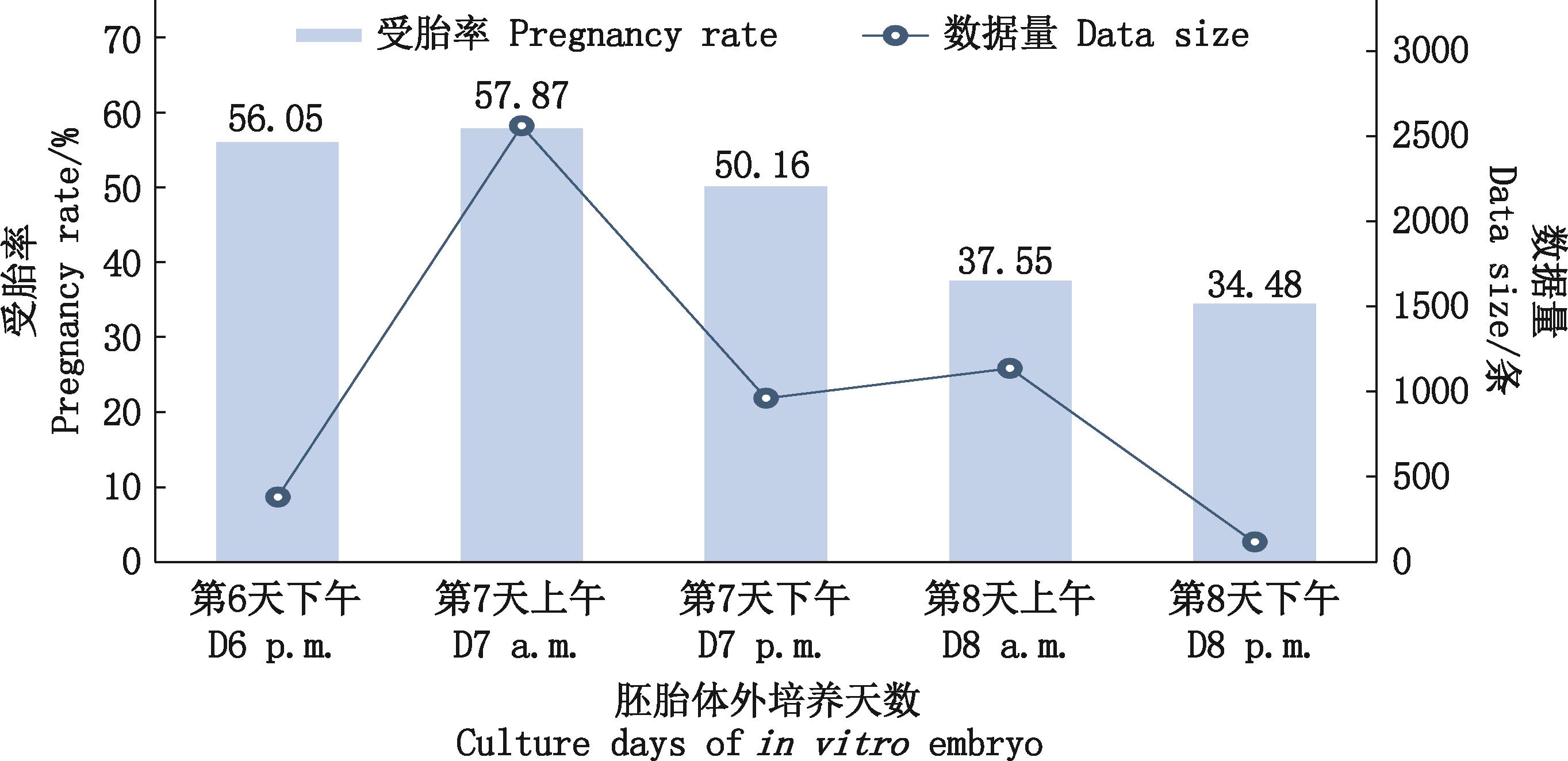
Table 2
Significance of factors influencing pregnancy rate from IVP embryo transfer in Holstein cattle"
| 效应 Factors | 自由度DF | 卡方 χ2 | P值 P-value |
|---|---|---|---|
| 胚胎保存状态 Embryo preservation status | 1 | 13.48 | <0.01** |
| 受体牛月龄 Age of recipient | 4 | 12.06 | 0.02* |
| 胚胎体外培养天数 Culture days of in vitro embryo | 4 | 114.30 | <0.01** |
| 胚胎发育阶段 Development stage of embryo | 1 | 12.28 | <0.01** |
| 移植次数 Number of embryo transfer for the recipient | 1 | 9.50 | <0.01** |
| 受体牛发情天数 Days post-estrus in recipient cows | 1 | 0.73 | 0.39 |
| 黄体等级 Corpus luteum grade | 2 | 0.85 | 0.65 |
| 胚胎父本 Embryo sire | 20 | 37.30 | 0.01* |
| 场-人 Farm-technician | 46 | 48.25 | 0.39 |
Table 3
Logistic regression analysis of factors affecting pregnancy rate in Holstein cattle following IVP embryo transfer"
效应 Factors | 水平 Levels | 估计值 Estimated value | 标准误 SEM | 卡方 χ2 | P值 P-value | 优势比 Odds ratio | 95%置信区间 95% confidence interval |
|---|---|---|---|---|---|---|---|
胚胎保存状态 Embryo preservation status | 新鲜胚胎 | 0.62 | 0.17 | 13.48 | <0.01 | 1.86 | 1.33~2.58 |
受体牛月龄 Age of recipient | 14 | 0.06 | 0.13 | 0.25 | 0.61 | 1.06 | 0.83~1.37 |
| >14且≤14.5 | 0.07 | 0.08 | 0.80 | 0.37 | 1.07 | 0.92~1.27 | |
| >14.5且≤15 | 0.46 | 0.14 | 11.30 | <0.01 | 1.59 | 1.21~2.08 | |
| >15且≤17 | 0.42 | 0.17 | 5.94 | 0.02 | 1.52 | 1.09~2.13 | |
胚胎体外培养天数 Culture days of in vitro embryo | 第6天下午 | 0.86 | 0.23 | 14.24 | <0.01 | 2.35 | 1.51~3.67 |
| 第7天上午 | 0.85 | 0.20 | 17.24 | <0.01 | 2.34 | 1.56~3.50 | |
| 第7天下午 | 0.62 | 0.21 | 8.68 | <0.01 | 1.86 | 1.23~2.81 | |
| 第8天上午 | 0.08 | 0.21 | 0.13 | 0.71 | 1.08 | 0.72~1.62 | |
胚胎发育阶段 Development stage of embryo | 扩张囊胚 | 0.25 | 0.07 | 12.30 | <0.01 | 1.28 | 1.12~1.48 |
移植次数 Number of embryo transfer for the recipient | 首次移植 | 0.39 | 0.13 | 9.50 | <0.01 | 1.48 | 1.16~1.90 |
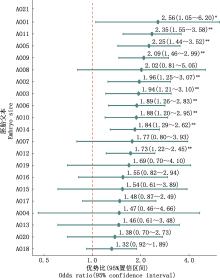
Fig.3
Difference comparison of pregnancy rates following the transfer of in vitro embryos from different siresCompared with reference level A021,*,Significant difference (P<0.05);**,Extremely significant difference (P<0.01)"

| [1] | 王志成,苏昶祺,陈仕毅,等. 体外受精和胚胎移植技术在肉牛双胎生产中的应用研究进展[J]. 中国畜牧杂志,2022,58(7):8-14. |
| WANG Z C, SU C Q, CHEN S Y,et al. Research progress on the application of in vitro fertilization and embryo transfer technology to production of beef cattle twins[J]. Chinese Journal of Animal Science,2022,58(7):8-14.(in Chinese) | |
| [2] | BRACKETT B G, BOUSQUET D, BOICE M L, et al. Normal development following in vitro fertilization in the cow[J]. Biology of Reproduction, 1982, 27(1):147-158. |
| [3] | PIETERSE M C, KAPPEN K A, KRUIP T A M, et al. Aspiration of bovine oocytes during transvaginal ultrasound scanning of the ovaries[J]. Theriogenology, 1988, 30(4):751-762. |
| [4] | KIDIE H A. Review on growth and development of multiple ovulation and embryo transfer technology in cattle[J]. World Scientific News, 2019,127:199-211. |
| [5] | 刘自营,郑 卓,高汉婷,等. 牛体外胚胎生产技术研究进展[J].中国畜禽种业,2023,19(7):170-175. |
| LIU Z Y, ZHENG Z, GAO H T,et al. Research progress on bovine in vitro embryo production technology[J]. The Chinese Livestock and Poultry Breeding,2023,19(7):170-175.(in Chinese) | |
| [6] | SASAKI O, TAKEDA H, NISHIURA A. Estimation of the economic value of herd-life length based on simulated changes in survival rate[J]. Animal Science Journal, 2019, 90(3):323-332. |
| [7] | STEWART B M, BLOCK J, MORELLI P, et al. Efficacy of embryo transfer in lactating dairy cows during summer using fresh or vitrified embryos produced in vitro with sex-sorted semen[J]. Journal of Dairy Science, 2011, 94(7):3437-3445. |
| [8] | DEMETRIO D G B, SANTOS R M, DEMETRIO C G B,et al. Factors affecting conception rates following artificial insemination or embryo transfer in lactating Holstein cows[J]. Journal of Dairy Science,2007,90(11):5073-5082. |
| [9] | SARTORI R, GÜMEN A, GUENTHER J N,et al. Comparison of artificial insemination versus embryo transfer in lactating dairy cows[J]. Theriogenology,2006,65(7):1311-1321. |
| [10] | FERRAZ P A, BURNLEY C, KARANJA J,et al. Factors affecting the success of a large embryo transfer program in Holstein cattle in a commercial herd in the southeast region of the United States[J]. Theriogenology,2016,86(7):1834-1841. |
| [11] | ASHRY M, SMITH G W. Application of embryo transfer using in vitro produced embryos: Intrinsic factors affecting efficiency[J]. Cattle Practice,2015,23(Pt1):1-8. |
| [12] | AGCA Y, MONSON R L, NORTHEY D L,et al. Transfer of fresh and cryopreserved IVP bovine embryos: Normal calving,birth weight and gestation lengths[J]. Theriogenology,1998,50(1):147-162. |
| [13] | SANCHES B V, LUNARDELLI P A, TANNURA J H, et al. A new direct transfer protocol for cryopreserved IVF embryos[J]. Theriogenology, 2016, 85(6):1147-1151. |
| [14] | GÓMEZ E, CARROCERA S, MARTÍN D,et al. Efficient one-step direct transfer to recipients of thawed bovine embryos cultured in vitro and frozen in chemically defined medium[J]. Theriogenology,2020,146:39-47. |
| [15] | DO V H, CATT S, AMAYA G,et al. Comparison of pregnancy in cattle when non-vitrified and vitrified in vitro-derived embryos are transferred into recipients[J]. Theriogenology,2018,120:105-110. |
| [16] | XIE C, HUANG C, YAN L,et al. Recipients’and environmental factors affecting the pregnancy rates of a large,fresh in vitro fertilization-embryo transfer program for dairy cows in a commercial herd in China[J]. Veterinary Sciences,2024,11(9):410. |
| [17] | CROWE A D, SÁNCHEZ J M, MOORE S G,et al.Incidence and timing of pregnancy loss following timed artificial insemination or timed embryo transfer with a fresh or frozen in vitro-produced embryo[J]. Journal of Dairy Science,2025,108(1):1022-1038. |
| [18] | HASLER J F. Factors affecting frozen and fresh embryo transfer pregnancy rates in cattle[J]. Theriogenology,2001,56(9):1401-1415. |
| [19] | VAN WAGTENDONK-DE LEEUW A M, MULLAART E, DE ROOS A P W, et al. Ovum pick up and in vitro production in the bovine after use in several generations: A 2005 status[J]. Theriogenology,2006,65(5):914-925. |
| [20] | BRUYÈRE P, BAUDOT A, GUYADER-JOLY C,et al. Improved cryopreservation of in vitro-produced bovine embryos using a chemically defined freezing medium[J]. Theriogenology,2012,78(6):1294-1302. |
| [21] | FERRÉ L B, KJELLAND M E, STRØBECH L B,et al. Review: Recent advances in bovine in vitro embryo production:Reproductive biotechnology history and methods[J]. Animal,2020,14(5):991-1004. |
| [22] | BLOCK J, BONILLA L, HANSEN P J. Effect of addition of hyaluronan to embryo culture medium on survival of bovine embryos in vitro following vitrification and establishment of pregnancy after transfer to recipients[J]. Theriogenology,2009,71(7):1063-1071. |
| [23] | PASCHOAL D M, SUDANO M J, GUASTALI M D,et al. Forskolin effect on the cryosurvival of in vitro-produced bovine embryos in the presence or absence of fetal calf serum[J]. Zygote, 2014,22(2):146-157. |
| [24] | VIEIRA A D, FORELL F, FELTRIN C,et al. In-straw cryoprotectant dilution of IVP bovine blastocysts vitrified in hand-pulled glass micropipettes[J]. Animal Reproduction Science, 2007,99(3-4):377-383. |
| [25] | ESTRADA-CORTÉS E, ORTIZ W G, CHEBEL R C,et al. Embryo and cow factors affecting pregnancy per embryo transfer for multiple-service,lactating Holstein recipients[J]. Translational Animal Science,2019,3(1):60-65. |
| [26] | GIMENO I, GARCIA-MANRIQUE P, CARROCERA S, et al. The metabolic signature of in vitro produced bovine embryos helps predict pregnancy and birth after embryo transfer[J]. Metabolites, 2021, 11(8):484. |
| [27] | EALY A D, WOOLDRIDGE L K, MCCOSKI S R. Board invited review: Post-transfer consequences of in vitro-produced embryos in cattle[J]. Journal of Animal Science, 2019, 97(6):2555-2568. |
| [28] | GEBREYESUS G, SECHER J B, LUND M S, et al. Genetic parameters for bull effects on in vitro embryo production (IVP) and relationship between semen quality traits and IVP performance[J]. Animal Reproduction Science, 2024, 263:107436. |
| [29] | PARK J, BANG S, LEE W, et al. Sex ratio and conception rates of fresh/vitrified embryos at different developmental stages by ovum pick up in Hanwoo cows[J]. Journal of Animal Science and Technology, 2024, 66(5):920-935. |
| [30] | GALLI C, DUCHI R, CROTTI G, et al. Bovine embryo technologies[J]. Theriogenology, 2003, 59(2):599-616. |
| [31] | 徐光勇,刘振田,陈祥飞,等. 和牛OPU卵母细胞体外受精后胚胎发育潜能研究[J]. 中国畜牧兽医,2025,52(2):730-739. |
| XU G Y, LIU Z T, CHEN X F,et al. Study on embryonic developmental potential of embryos derived from ovum pickup oocytes and fertilization in vitro in Wagyu[J]. China Animal Husbandry & Veterinary Medicine,2025,52(2):730-739.(in Chinese) | |
| [32] | GEBREYESUS G, LUND M S, KUPISIEWICZ K, et al. Genetic parameters of semen quality traits and genetic correlations with service sire nonreturn rate in Nordic Holstein bulls[J]. Journal of Dairy Science, 2021, 104(9):10010-10019. |
| [33] | ORTEGA M S, LOCKHART K N, SPENCER T E. Impact of sire on embryo development and pregnancy[J]. Veterinary Clinics of North America: Food Animal Practice, 2024, 40(1):131-140. |
| [34] | WEAVER L D, GALLAND J, SOSNIK U, et al. Factors affecting embryo transfer success in recipient heifers under field conditions[J]. Journal of Dairy Science, 1986, 69(10):2711-2717. |
| [35] | 陈江凌,汪聪勇,王现军,等. 河南省荷斯坦牛冷冻胚胎移植效果分析[J].中国奶牛,2016,2:12-14. |
| CHEN J L, WANG C Y, WANG X J,et al. The analysis of Holstein on transfer efficiency of frozen-thawed embryos in Henan[J]. China Dairy Cattle,2016, 2:12-14.(in Chinese) | |
| [36] | MADUREIRA A M L, BURNETT T A, MARQUES J C S, et al. Occurrence and greater intensity of estrus in recipient lactating dairy cows improve pregnancy per embryo transfer[J]. Journal of Dairy Science, 2022, 105(1):877-888. |
| [37] | BENYEI B, KOMLOSI I, PECSI A, et al. The effect of internal and external factors on bovine embryo transfer results in a tropical environment[J]. Animal Reproduction Science, 2006, 93(3-4):268-279. |
| [38] | THOMSON S P, HOLMES R J, LANDES P T, et al. Assessment and selection of the recipient cows’ corpus luteum at the time of embryo transfer, and its influence on conception rate[J]. Australian Veterinary Journal, 2021, 99(7):288-292. |
| [39] | RODRIGUES M, BONOTTO A, ACOSTA D, et al. Effect of oestrous synchrony between embryo donors and recipients, embryo quality and state on the pregnancy rate in beef cattle[J]. Reproduction in Domestic Animals, 2018, 53(1):152-156. |
| [1] | ANG Song, LI Hui, SUN Fang, WEI Ziheng, BU Ye, SUI Xinxin, LUO Li, LIU Chundong, WU Wenbin, BAO Xiaoping, XU Shanshan, HOU Jintao. Comparison of Slaughter Performance and Meat Quality Between Holstein and Angus-Holstein F1 Cattle [J]. China Animal Husbandry & Veterinary Medicine, 2025, 52(3): 1211-1221. |
| [2] | XU Guangyong, LIU Zhentian, CHEN Xiangfei, ZHANG Meijie, DU Tao, ZHANG Junbo, LIU Zhihui, XING Xuesong, DU Fuliang. Study on Embryonic Developmental Potential of Embryos Derived from Ovum Pickup Oocytes and Fertilization in vitro in Wagyu [J]. China Animal Husbandry & Veterinary Medicine, 2025, 52(2): 730-739. |
| [3] | YANG Jiazi, HUANG Yuechuan, ZHANG Hailiang, GAO Zimeng, ZHAO Xuelian, WANG Sijia, LI Bin, WEN Dongxu, YU Ying, WANG Yachun. Population Characteristics and Influencing Factors of Conformation Traits and Milk Production Traits of Holstein Cattle in Tibetan [J]. China Animal Husbandry & Veterinary Medicine, 2025, 52(1): 258-267. |
| [4] | HUANG Yuechuan, ZHANG Hailiang, LIU Zhanpeng, ZHAO Shanjiang, SUN Wei, LI Xihe, WANG Lin, ZHU Huabin, HUANG Xixia, WANG Yachun. Analysis of the Population Characteristics and Influencing Factors of Superovulation Response Traits in Northern Chinese Holstein Cattle [J]. China Animal Husbandry & Veterinary Medicine, 2024, 51(11): 4851-4859. |
| [5] | CHEN Shaokan, LUO Hanpeng, MA Yehua, LIU Gang, WANG Di, HAO Kebi, WANG Yachun, GUO Gang. Selection and Influencing Factors Analysis of Key Milking Flow Rate Indicators of Holstein Cattle [J]. China Animal Husbandry & Veterinary Medicine, 2024, 51(1): 212-219. |
| [6] | WANG Yaqin, ZONG Junlin, ZHANG Tao, GUAN Weijun. Isolation,Culture and Differentiation Potential of Bovine Adipose Mesenchymal Stem Cells [J]. China Animal Husbandry & Veterinary Medicine, 2023, 50(9): 3530-3540. |
| [7] | AN Songyan, CHANG Yao, CHEN Qun, JI Hongjin, DU Ze, YANG Ruoyu, XU Jingyi, MA Yehua, YU Ying, WANG Yachun. Comparative Study on Growth Curve of Body Measurements Between Holstein and Jersey Cattle [J]. China Animal Husbandry & Veterinary Medicine, 2023, 50(12): 4947-4957. |
| [8] | ZHANG Haobo, ZHAO Shanjiang, WANG Huan, XU Xi, FENG Zhiqiang, WANG Wanjie, GONG Jianfei, PANG Yunwei, DU Weihua, ZHU Huabin. Effects of Addition of Insulin-Transferrin-Sodium Selenite on Effect of Production, Hypothermic Storage and Routine Freezing of Bovine in vitro Embryos [J]. China Animal Husbandry & Veterinary Medicine, 2023, 50(10): 4077-4084. |
| [9] | ZANG Changjiang, LIU Baoxuan, YUAN Dong, LI Xiaobin, LI Fengming, CHEN Kaixu, MIREGULI·Yimamu, YANG Kailun. Effect of Supplementation with L-arginine on Pregnancy Rate and Plasma Parameters of Re-service Thoroughbred Horses [J]. China Animal Husbandry & Veterinary Medicine, 2023, 50(1): 125-133. |
| [10] | XU Haoqi, XU Jingyi, HU Lirong, ZHANG Fan, LUO Hanpeng, ZHANG Hailiang, SHI Rui, LI Xiang, LIU Lin, LIU Qiaoxiang, GUO Gang, WANG Yachun. Polymorphism of PIK3CB Gene and Its Association Analysis with Reproductive and Milk Production Traits in Chinese Holstein Cattle [J]. China Animal Husbandry & Veterinary Medicine, 2022, 49(9): 3438-3452. |
| [11] | WU Hao, YAO Songyang, SONG Yukun, MA Hui, GUO Gang, WANG Tiankun, LI Xiubo, LU Yongqiang, ZHANG Lu, LIU Guoshi. Effects of Melatonin on Pregnancy Rate and Reproductive Hormone in Holstein Dairy Cows [J]. China Animal Husbandry & Veterinary Medicine, 2021, 48(7): 2523-2529. |
| [12] | WANG Tengfei, ZHANG Yan, WANG Yanping, ZHAO Shanjiang, ZHU Huabin, WANG Lingling, MA Zhu, DAI Yunping, PANG Yunwei. Study on the Influencing Factors of in vitro Fertilization Efficiency in Dairy Cows [J]. China Animal Husbandry & Veterinary Medicine, 2021, 48(2): 574-580. |
| [13] | ZHAO Fanfan, WANG Dan, MA Yanjun, MA Xinbing, GE Jianjun, ZHANG Xiaoxue, ZHANG Menghua, XU Lei, JIANG Hui, SANG Zhagen, HUANG Xixia. Effect of Non-Genetic Factors on Population Life of Holstein Dairy Cows in Xinjiang [J]. China Animal Husbandry & Veterinary Medicine, 2020, 47(3): 822-827. |
| [14] | ZHAO Fanfan, GE Janju, LI Hongyan, ZHANG Menghua, WEI Chen, WANG Dan, DU Jianwen, XU Lei, JIANG Hui, SANG Zhagen, HUANG Xixia, TAN Shixin. Effects of Somatic Cell Score on Milk Yield and Milk Composition in Holstein Milk in Xinjiang [J]. China Animal Husbandry & Veterinary Medicine, 2019, 46(11): 3323-3331. |
| [15] | WANG Dan, LIU Kui-guo, MANATI·Hashan, ZHANG Meng-hua, WEI Chen, XIAILI·Yiming, ZHANG Chao, JI Peng-fei, HUANG Xi-xia. Analysis of Factors Influencing the Mortality Rates of Xinjiang Brown Cattle and Holstein Cattle Calves [J]. China Animal Husbandry & Veterinary Medicine, 2017, 44(5): 1363-1368. |
| Viewed | ||||||
|
Full text |
|
|||||
|
Abstract |
|
|||||
