
China Animal Husbandry & Veterinary Medicine ›› 2026, Vol. 53 ›› Issue (1): 212-223.doi: 10.16431/j.cnki.1671-7236.2026.01.019
• Nutrition and Feed • Previous Articles Next Articles
YANG Jiayu1,2( ), HE Keke2,3, JIAO Kerui1,2, LIANG Yunyi2, CHEN Yakun2, YIN Shuangshuang2, YANG Pengbiao4, BU Dengpan2, ZHANG Yuanqing1(), ZHAO Liansheng2()
Received:2025-05-19
Online:2026-01-05
Published:2025-12-26
Contact:
ZHANG Yuanqing, ZHAO Liansheng
E-mail:yjy990407@163.com;yuanqing_zhang@163.com;aaronann@163.com
CLC Number:
YANG Jiayu, HE Keke, JIAO Kerui, LIANG Yunyi, CHEN Yakun, YIN Shuangshuang, YANG Pengbiao, BU Dengpan, ZHANG Yuanqing, ZHAO Liansheng. Study of Fermentation Quality and in vitro Ruminal Fermentation Characteristics of Mixed Silage with Different Ratios of Fresh Alfalfa and Oat Hay[J]. China Animal Husbandry & Veterinary Medicine, 2026, 53(1): 212-223.
Table 1
Raw material nutrient composition (DM basis)"
项目 Items | 苜蓿 Alfalfa | 燕麦干草 Oat hay |
|---|---|---|
| 干物质 DM | 18.85 | 88.75 |
| 粗蛋白质 CP | 17.44 | 8.60 |
| 中性洗涤纤维 NDF | 45.77 | 53.63 |
| 酸性洗涤纤维 ADF | 36.47 | 37.18 |
| 粗灰分 Ash | 8.81 | 6.11 |
| 可溶性碳水化合物 WSC | 2.53 | 17.51 |
| 粗脂肪 EE | 1.19 | 1.04 |
Table 2
Nutritional components of blended raw material (DM basis)"
| 项目 Items | 处理 Treatment | 标准误 SEM | P值 P-value | ||
|---|---|---|---|---|---|
| AO1 | AO2 | AO3 | |||
| 干物质 DM | 35.26c | 40.23b | 45.30a | 1.456 | <0.01 |
| 粗蛋白质 CP | 13.01a | 12.84b | 11.39b | 0.273 | <0.01 |
| 中性洗涤纤维 NDF | 52.19c | 55.31b | 60.19a | 1.228 | <0.01 |
| 酸性洗涤纤维 ADF | 34.99a | 30.92b | 32.93ab | 0.691 | 0.02 |
| 粗灰分 Ash | 8.99c | 10.58a | 9.55b | 0.253 | <0.01 |
| 可溶性碳水化合物 WSC | 7.80b | 12.05ab | 15.02a | 0.392 | 0.04 |
Table 3
The sensory evaluation standard for silage"
| 项目Items | 评估标准Evaluation standards | 得分Scores |
|---|---|---|
| 质地 Texture | 茎叶结构保持良好 | 4 |
| 茎叶结构保持较差 | 2 | |
| 茎叶结构保持极差或发现有轻度霉菌或轻度污染 | 1 | |
| 茎叶腐烂或污染严重 | 0 | |
| 色泽 Color | 与原料相似,烘干后呈淡褐色 | 2 |
| 略有变色,呈淡黄色或淡褐色 | 1 | |
| 变色严重,墨绿色或褐色,呈较强的霉味 | 0 | |
| 气味 Odor | 无丁酸臭味,有芳香果味或明显的面包香味 | 14 |
| 有微弱的丁酸臭味,或较强的酸味、芳香味弱 | 10 | |
| 丁酸味颇重,或者具有刺鼻的焦糊臭或霉味 | 4 | |
| 有很强的丁酸臭或者氨味,或者几乎无酸味 | 2 |
Table 4
The sensory quality rating of silage"
| 得分Scores | 等级Grades | 评语Comments |
|---|---|---|
| 16~20 | 1-优 | 优良 |
| 10~15 | 2-中 | 尚好 |
| 5~9 | 3-可 | 中等 |
| 0~4 | 4-下 | 腐败 |
Table 5
Results of sensory quality of mixed silage"
项目 Items | 处理Treatments | ||
|---|---|---|---|
| AO1 | AO2 | AO3 | |
| 质地 Texture | 4.00 | 4.00 | 2.94 |
| 色泽 Color | 2.00 | 2.00 | 1.19 |
| 气味 Odor | 10.00 | 12.87 | 9.00 |
| 评分 Score | 16.00 | 18.87 | 13.13 |
| 等级 Rating | 优良 | 优良 | 尚好 |
Table 6
Results of nutritional quality of mixed silage (DM basis)"
| 项目 Items | 处理Treatments | 标准误 SEM | P值 P-value | ||
|---|---|---|---|---|---|
| AO1 | AO2 | AO3 | |||
| 干物质 DM/% | 32.96a | 36.82b | 43.59a | 1.556 | <0.01 |
| 粗蛋白质 CP/% | 14.08a | 12.79b | 12.05c | 0.316 | <0.01 |
| 中性洗涤纤维 NDF/% | 50.90 | 50.03 | 51.85 | 0.443 | 0.26 |
| 酸性洗涤纤维 ADF/% | 32.21b | 32.76a | 32.24b | 0.106 | 0.02 |
| 粗灰分 Ash/% | 9.20c | 10.55a | 9.83b | 0.212 | <0.01 |
| 可溶性碳水化合物 WSC/% | 2.60b | 2.89b | 5.06a | 0.867 | <0.01 |
| 粗脂肪 EE/% | 1.74a | 1.72a | 1.53b | 0.045 | 0.02 |
| 饲草质量分值 FQS | 60.39a | 57.58a | 47.71b | 2.256 | 0.02 |
Table 7
Results of fermentation quality of mixed silage"
| 项目 Items | 处理Treatments | 标准误 SEM | P值 P-value | ||
|---|---|---|---|---|---|
| AO1 | AO2 | AO3 | |||
| pH | 4.14 | 4.11 | 4.09 | 0.009 | 0.08 |
| 氨态氮/总氮NH3-N/TN | 5.36a | 5.30a | 4.08b | 0.390 | <0.01 |
| 乳酸 LA/%DM | 5.53a | 5.12a | 3.74b | 0.304 | 0.02 |
| 乙酸 AA/%DM | 1.61 | 1.37 | 1.12 | 0.126 | 0.30 |
| 丙酸 PA/%DM | 0.71 | 0.62 | 0.47 | 0.048 | 0.09 |
| 丁酸 BA/%DM | ND | ND | ND | ||
Table 8
Results of aerobic stabilization time of mixed silage"
| 项目 Item | 处理Treatments | 标准误 SEM | P值 P-value | ||
|---|---|---|---|---|---|
| AO1 | AO2 | AO3 | |||
| 有氧稳定时间 Aerobic stabilization time | 133.17c | 204.50a | 166.45b | 9.18 | <0.01 |
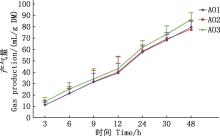
Fig 1
In vitro gas production of mixed silage"
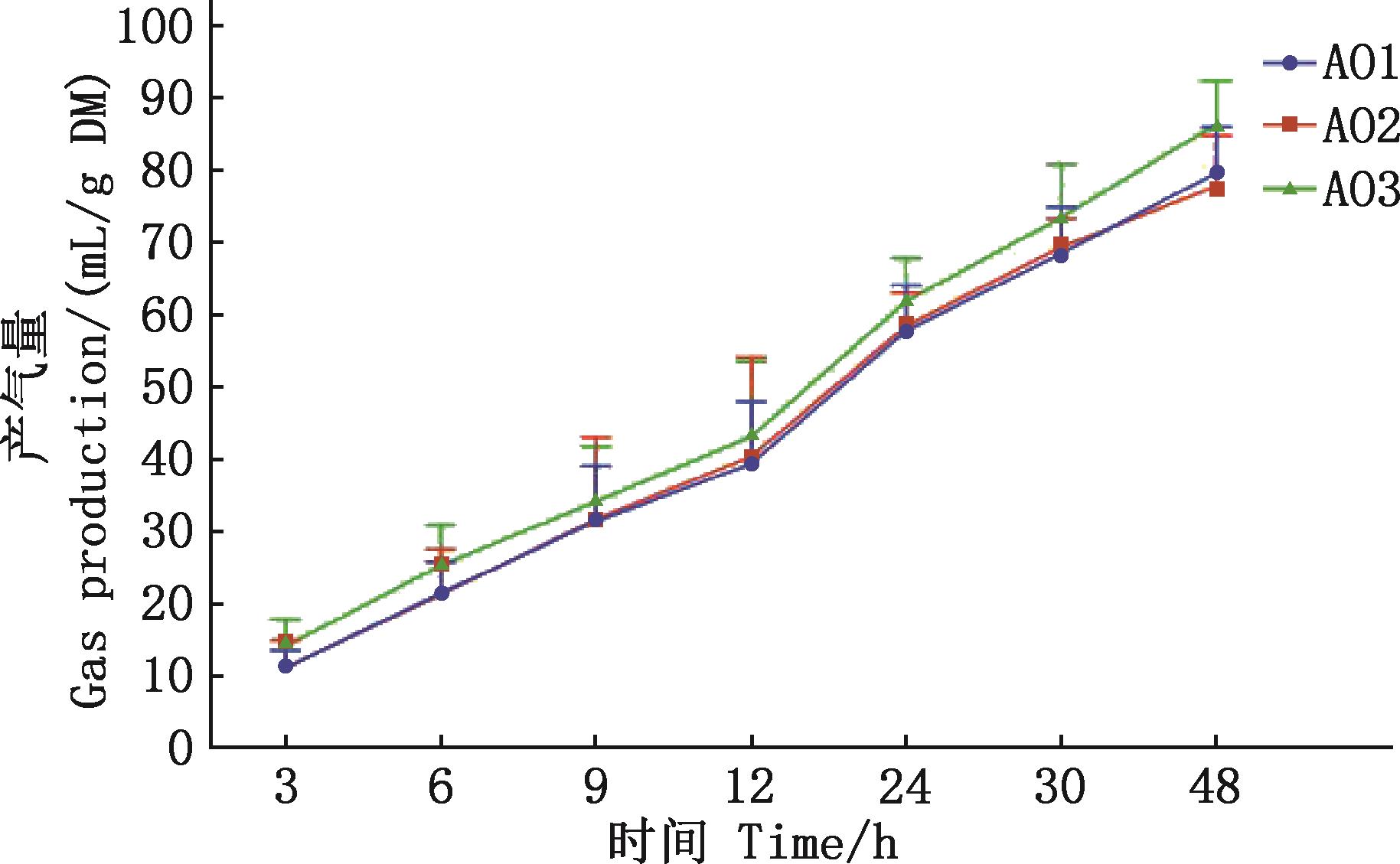
Table 9
Results of in vitro fermentation parameters of mixed silage"
项目 Items | 处理Treatments | 标准误 SEM | P值 P-value | ||
|---|---|---|---|---|---|
| AO1 | AO2 | AO3 | |||
| pH | 6.82 | 6.81 | 6.79 | 0.005 | 0.34 |
| 总挥发性脂肪 TVFA/(mmol/L) | 68.59a | 67.28b | 67.04b | 0.945 | <0.01 |
| 乙酸 AA/(mmol/L) | 43.52 | 41.98 | 42.57 | 0.911 | 0.11 |
| 丙酸 PA/(mmol/L) | 12.04 | 12.06 | 12.05 | 0.153 | 0.99 |
| 丁酸 BA/(mmol/L) | 10.49a | 9.45b | 9.48b | 0.348 | <0.01 |
| 戊酸 Valerate/(mmol/L) | 0.99 | 1.01 | 1.04 | 0.032 | 0.89 |
| 异丁酸Isobutyrate/(mmol/L) | 0.87 | 0.91 | 0.91 | 0.090 | 0.96 |
| 异戊酸Isovalerate/(mmol/L) | 1.63 | 1.73 | 1.62 | 0.052 | 0.90 |
| 乙丙比 A/P | 3.15b | 3.46a | 3.48a | 0.056 | <0.01 |
| 氨态氮 NH3-N/(mg/dL) | 40.45a | 35.20b | 33.24b | 1.191 | <0.01 |
| 微生物蛋白MCP/(g/L) | 0.15 | 0.14 | 0.18 | 0.008 | 0.13 |
Table 10
Results of in vitro nutrient degradation rate of mixeds ilage"
| 项目Items | 处理Treatments | 标准误 SEM | P值 P-value | ||
|---|---|---|---|---|---|
| AO1 | AO2 | AO3 | |||
| 干物质降解率 IVDMD | 62.30a | 58.07b | 57.30b | 0.913 | <0.01 |
| 粗蛋白质降解率 IVCPD | 73.41a | 71.61b | 70.44b | 0.472 | <0.01 |
| 中性洗涤纤维降解率 IVNDFD | 58.98 | 57.26 | 48.31 | 2.174 | 0.07 |
| 酸性洗涤纤维降解率 IVADFD | 56.11 | 49.56 | 48.92 | 2.767 | 0.57 |
| [1] | COBLENT Z. Unique interrelationships between fiber composition, water-soluble carbohydrates, and in vitro gas production for fall-grown oat forages[J]. Journal of Dairy Science, 2013, 96(11): 7195-7209. |
| [2] | THIAGO DA S, EDSON MAURO S.Advances in Silage Production and Utilization[M]. ExLiEvA,2016. |
| [3] | WANG Y, KE W, LU Q, et al. Effects of Bacillus coagulans and Lactobacillus plantarum on the fermentation characteristics, microbial community, and functional shifts during alfalfa silage fermentation[J]. Animals, 2023, 13(5): 932. |
| [4] | XU R, ZHAO H, YANG Y, et al. Effects of intercropping, nitrogen fertilization and corn plant density on yield, crude protein accumulation and ensiling characteristics of silage corn interseeded into alfalfa stand[J]. Agriculture, 2022, 12(3): 357. |
| [5] | 陈雅坤, 杨嘉宇, 梁韵仪, 等. 样品前处理方法和试验条件优化对全株玉米青贮中氨态氮含量的影响[J]. 中国饲料, 2024,21: 32-37. |
| CHEN Y K, YANG J Y, LIANG Y Y, et al. Effect of sample preparation methods and experimental condition optimization on ammonium nitrogen content in whole plant corn silage [J]. China Feed, 2024,21: 32-37.(in Chinese) | |
| [6] | 张丽英, 隋连敏, 杨文军. 滤袋法快速测定饲料中粗脂肪和总脂肪[J]. 饲料工业, 2010, 31(5): 35-36. |
| ZHANG L Y, SUI L M, YANG W J. Rapid determination of crude fat and total fat in feeds by filter bag method[J]. Feed Industry, 2010, 31(5): 35-36.(in Chinese) | |
| [7] | 丁雪梅, 张晓君, 赵 云, 等. 蒽酮比色法测定可溶性糖含量的试验方法改进[J]. 黑龙江畜牧兽医, 2014,23: 230-233. |
| DING X M, ZHANG X J, ZHAO Y, et al. Improvement of the anthrone colorimetric method for determining soluble sugar content[J]. Heilongjiang Animal Science and Veterinary Medicine, 2014,23: 230-233.(in Chinese) | |
| [8] | 梁韵仪, 赵连生, 卜登攀. 利用偏最小二乘法(PLS)构建饲草质量综合评价模型[A]. 中国畜牧兽医学会动物营养学分会第十四次动物营养学术研讨会论文集[C]. 2024. |
| LIANG Y Y, ZHAO L S, BU D P. Constructing a comprehensive evaluation model for forage quality using partial least squares (PLS) method[A]. Proceedings of the 14th Academic Seminar on Animal Nutrition by the Animal Nutrition Branch of the Chinese Society of Animal Husbandry and Veterinary Medicine[C]. 2024.(in Chinese) | |
| [9] | BRODERICK G A, KANG J H. Automated simultaneous determination of ammonia and total amino acids in ruminal fluid and in vitro media[J]. Journal of Dairy Science, 1980, 63(1): 64-75. |
| [10] | MENKE K H, RAAB L, SALEWSKI A, et al. The estimation of the digestibility and metabolizable energy content of ruminant feedingstuffs from the gas production when they are incubated with rumen liquor in vitro [J]. The Journal of Agricultural Science, 1979, 93(1): 217-222. |
| [11] | 郭 鑫, 姚瑞芬, 谭咏琪, 等. 硫胺素对体外瘤胃发酵参数及支链脂肪酸合成的影响[J]. 动物营养学报, 2024,36(8):5141-5151. |
| GUO X, YAO R F, TAN Y Q, et al. Effects of thiamine on in vitro rumen fermentation parameters and branched-chain fatty acid synthesis[J]. Chinese Journal of Animal Nutrition, 2024, 36(8): 5141-5151. (in Chinese) | |
| [12] | ABO-DONIA F M, ELSHIKH H A, ESH A M H, et al. Co-ensiled rice straw with whole sugar beet and its effect on the performance of lactating cows[J]. Tropical Animal Health and Production, 2024, 56(5): 173. |
| [13] | KUNG L, SHAVER R D, GRANT R J,et al. Silage review: Interpretation of chemical, microbial, and organoleptic components of silages[J]. Journal of Dairy Science, 2018, 101(5): 4020-4033. |
| [14] | ANNA S T, HIKAWCZUK T, JAMA-RODZENSKA A, et al. Determining the optimal harvesting moment of green forage from Guizotia abyssinica cultivated as a catch crop on silage and its quality form, fresh or wilted green material, in the two following years[J]. Animals, 2024, 14(17): 2455. |
| [15] | HEBA S A S, HALA H B. Influence of variable mixing rates and nitrogen fertilization levels on the fodder quality of Egyptian clover (Trifolium alexandrinum L.) and annual ryegrass (Lolium multiflorum Lam.)[J]. African Journal of Agricultural Research, 2015, 10(53): 4858-4864. |
| [16] | LI Y F, WANG L L, YU Y S, et al. Forage quality and fermentation dynamics of silages of Italian ryegrass (Lolium multiflorum Lam.) wilted for varying periods[J]. Animal Bioscience, 2024, 37(12): 2091-2100. |
| [17] | MERNAWATI M, MERYANDINI A, WIDYASTUTI Y. Selection of Lactiplantibacillus plantarum strains as inoculant of rice straw fermentation and its fermentation characteristics[J]. Livestock and Animal Research, 2023, 21(3): 153. |
| [18] | WEI S N, JEONG E C, LI Y F, et al. Evaluation of forage production, feed value, and ensilability of proso millet (Panicum miliaceum L.)[J]. Journal of Animal Science and Technology, 2022, 64(1): 38-51. |
| [19] | 周 雪, 龙忠富, 赵相勇. 不同收获期贵州地方玉米种质青贮前后营养变化规律比较[J]. 贵州畜牧兽医, 2016, 40(2): 62-66. |
| ZHOU X, LONG Z F, ZHAO X Y. Comparative study on nutritional changes of local corn silage in Guizhou at different harvest times[J]. Guizhou Animal Science and Veterinary Medicine, 2016, 40(2): 62-66.(in Chinese) | |
| [20] | THERDTATHA P, LA-ONGKHAM O, NAKPHAICHIT M, et al. Effect of lactic acid bacterial starter KUB-G2 on grass silage quality and its microbial community performed using 140-ton plastic bag silos: A large-scale study[J]. Quality Assurance and Safety of Crops & Foods, 2024, 15(SP1): 1-13. |
| [21] | 董志浩, 原现军, 闻爱友, 等. 添加乳酸菌和发酵底物对桑叶青贮发酵品质的影响[J]. 草业学报, 2016, 25(6): 167-174. |
| DONG Z H, YUAN X J, WEN A Y, et al. Effect of adding lactic acid bacteria and fermentation substrate on the fermentation quality of mulberry leaf silage[J]. Acta Prataculturae Sinica, 2016, 25(6): 167-174.(in Chinese) | |
| [22] | NKOSI B D, MEESKE R, LANGA T, et al. Effects of bacterial inoculation on the fermentation characteristics and aerobic stability of ensiled whole plant soybeans [J]. South African Journal of Animal Science, 2016, 46(2): 129-138. |
| [23] | ZHAO J, DONG Z, LI J, et al. Evaluation of Lactobacillus plantarum and waste molasses as fermentation modifier to increase silage quality and reduce ruminal greenhouse gas emissions of rice straw[J]. Science of the Total Environment, 2019, 688: 143-152. |
| [24] | SAHAR A K, CELEBI S Z, ERDOGAN S. Effects of harvesting stages and additives on the chemical composition, fermentation quality and relative feed value of soybean silages varieties [J]. Tarım Bilimleri Dergisi, 2024, 30(2):325-335. |
| [25] | DU Z, RISU N, GENTU G, et al. Dynamic changes and characterization of the protein and carbohydrate fractions of native grass grown in Inner Mongolia during ensiling and the aerobic stage[J]. Asian-Australasian Journal of Animal Sciences, 2020, 33(4): 556-567. |
| [26] | KIM J G, HAM J S, LI Y W, et al. Development of a new lactic acid bacterial inoculant for fresh rice straw silage[J]. Asian-Australasian Journal of Animal Sciences, 2017, 30(7): 950-956. |
| [27] | WANG W, CAI X, SHAO T, et al. Effects of bacterial inoculants on the microbial community, mycotoxin contamination, and aerobic stability of corn silage infected in the field by toxigenic fungi[J]. Chemical and Biological Technologies in Agriculture, 2022, 9(1): 93. |
| [28] | 尹 祥, 王咏琪, 李鑫琴, 等. 不同水分吸附材料对象草青贮发酵品质及好氧稳定性的影响[J]. 草业学报, 2021, 30(7): 133-138. |
| YIN X, WANG Y Q, LI X Q, et al. Effect of different water absorbent materials on fermentation quality and aerobic stability of elephant grass silage[J]. Acta Prataculturae Sinica, 2021, 30(7): 133-138.(in Chinese) | |
| [29] | CALABRÒ S, MONIELLO G, PICCOLO V, et al. Rumen fermentation and degradability in buffalo and cattle using the in vitro gas production technique[J]. Journal of Animal Physiology and Animal Nutrition, 2008, 92(3): 356-362. |
| [30] | XU Z, YING C, BAI P, et al. Microbial dynamics, metabolite profiles, and chemical composition in Saccharomyces cerevisiae and Kluyveromyces marxianus co-culture during solid-state fermentation[J]. Food Bioscience, 2025, 64: 105849. |
| [31] | SALEM A Z M, BUENDÍA-RODRÍGUEZ G, ELGHANDOUR M M M, et al. Effects of cellulase and xylanase enzymes mixed with increasing doses of Salix babylonica extract on in vitro rumen gas production kinetics of a mixture of corn silage with concentrate[J]. Journal of Integrative Agriculture, 2015, 14(1): 131-139. |
| [32] | HILLION M L, MOSCOVIZ R, TRABLY E, et al. Co-ensiling as a new technique for long-term storage of agro-industrial waste with low sugar content prior to anaerobic digestion[J]. Waste Management, 2018, 71: 147-155. |
| [33] | SYAICHURROZI I, SARTO S, SEDIAWAN W B, et al. Effect of feed addition on anaerobic digestion process in treating vinasse: Experimental and kinetic studies[J]. Periodica Polytechnica Chemical Engineering, 2023, 67(1): 127-140. |
| [34] | XIA C, RAHMAN M A U, YANG H, et al. Effect of increased dietary crude protein levels on production performance, nitrogen utilisation, blood metabolites and ruminal fermentation of Holstein bulls[J]. Asian-Australasian Journal of Animal Sciences, 2018, 31(10): 1643-1653. |
| [35] | THAO N T, WANAPAT M, CHERDTHONG A. Effect of different types of forages, animal fat or marine oils in cow’s diet on milk fat secretion and composition, especially conjugated linoleic acid (CLA) and polyunsaturated fatty acids[J]. Livestock Production Science, 2001, 70(1/2): 31-48. |
| [36] | THAO N T, WANAPAT M, CHERDTHONG A, et al. Effects of eucalyptus crude oils supplementation on rumen fermentation, microorganism and nutrient digestibility in swamp buffaloes[J]. Asian-Australasian Journal of Animal Sciences, 2014, 27(1): 46-54. |
| [37] | FORMATO M, CIMMINO G, BRAHMI-CHENDOUH N, et al. Polyphenols for livestock feed: Sustainable perspectives for animal husbandry [J]. Molecules, 2022, 27(22): 7752. |
| [38] | LA S, LI H, ZHANG Y, et al. Different sources of alfalfa hay alter the composition of rumen microbiota in mid-lactation Holstein cows without affecting production performance[J]. Frontiers in Veterinary Science, 2024, 11: 1433876. |
| [39] | SUN Z, ASCHALEW N D, CHENG L, et al. Dietary 5-hydroxytryptophan improves sheep growth performance by enhancing ruminal functions, antioxidant capacity, and tryptophan metabolism: In vitro and in vivo studies[J]. Frontiers in Immunology, 2024, 15: 1398310. |
| [40] | ELLIS J L, DIJKSTRA J, BANNINK A, et al. The effect of high-sugar grass on predicted nitrogen excretion and milk yield simulated using a dynamic model[J]. Journal of Dairy Science, 2011, 94(6): 3105-3118. |
| [41] | YANG C M J. Response of forage fiber degradation by ruminal microorganisms to branched-chain volatile fatty acids, amino acids, and dipeptides [J]. Journal of Dairy Science, 2002, 85(5): 1183-1190. |
| [42] | EBNALI A, KHORVASH M, GHORBANI G R, et al. Effects of forage offering method on performance, rumen fermentation, nutrient digestibility and nutritional behaviour in Holstein dairy calves[J]. Journal of Animal Physiology and Animal Nutrition, 2016, 100(5): 820-827. |
| [43] | 马淑梅, 张 兰, 宋 谦, 等. 饲用小黑麦与紫花苜蓿不同混合比例对其青贮营养成分和发酵品质的影响[J]. 黑龙江畜牧兽医, 2025,1: 115-122. |
| MA S M, ZHANG L, SONG Q, et al. Effect of different mixing ratios of feeding rye and alfalfa on silage nutritional components and fermentation quality[J]. Heilongjiang Animal Science and Veterinary Medicine, 2025,1: 115-122.(in Chinese) | |
| [44] | HRISTOV A N, BANNINK A, CROMPTON L A, et al. Nitrogen in ruminant nutrition: A review of measurement techniques [J]. Journal of Dairy Science, 2019, 102(7): 5811-5852. |
| [45] | 梁小玉, 季 杨, 易 军, 等. 混合比例和添加剂对菊苣与青贮玉米混合青贮品质的影响[J]. 草业学报, 2018, 27(2): 173-181. |
| LIANG X Y, JI Y, YI J, et al. Effect of mixing ratio and additives on the quality of chicory and corn silage mixtures[J]. Acta Prataculturae Sinica, 2018, 27(2): 173-181.(in Chinese) | |
| [46] | MU L, WANG Q, WANG Y, et al. Effects of cellulase and xylanase on fermentative profile, bacterial diversity, and in vitro degradation of mixed silage of agro-residue and alfalfa[J]. Chemical and Biological Technologies in Agriculture, 2023, 10(1): 40. |
| [1] | HE Keke, YANG Jiayu, CHEN Yakun, LIANG Yunyi, BU Dengpan, MA Hui, LUO Weizhen, CAO Xiaofeng, DENG Xian, TANG DING, ZANG Changjiang, ZHAO Liansheng. Effects of Different Proportions of Sesbania cannabina and Oat Hay Mixed Silage on the Quality and in vitro Fermentation Characteristics [J]. China Animal Husbandry & Veterinary Medicine, 2025, 52(11): 5122-5133. |
| [2] | CHEN Rongqiang, LEI Xiaowen, WU Lijuan, OU Xiang, LIAN Hai, ZHANG Qiang, QIU Jingyun, CAO Xianhong, YAN Lei, CAI Xiaofen. Effects of Different Compound Additives on Quality and Microbial Diversity of Mixed Silage of Forage Mulberry and King Grass [J]. China Animal Husbandry & Veterinary Medicine, 2024, 51(7): 2849-2859. |
| [3] | CHEN Yakun, YAN Weiming, BU Dengpan, ZHAO Liansheng, XU Jianchu, SHEN Yifan, ZHENG Airong, ZHANG Jianyong. Study on Mixed Silage Quality of Calotropis gigantea and Pennisetum sinese with Different Proportions [J]. China Animal Husbandry & Veterinary Medicine, 2023, 50(8): 3065-3072. |
| [4] | XU Jinyi, CHEN Chao, WANG Haijin, WANG Huanhuan, NA Binbin, ZHENG Yulong. Research Progress on Silage and Utilization of Woody Feed [J]. China Animal Husbandry & Veterinary Medicine, 2021, 48(8): 2838-2852. |
| [5] | LI Fu-hou, WANG Zhao-feng, HOU Fu-jiang, CHENG Yun-xiang. Research Progress on Characteristics of Oat Hay Supplementary Feeding on Tibetan Sheep in Cold Season [J]. China Animal Husbandry & Veterinary Medicine, 2016, 43(9): 2358-2365. |
| [6] | CUI Hai;;WANG Jia-qi;BU Deng-pan;LI Fa-di;Khas-Eedene. Application of Oat (Avena L.) in Animal Production [J]. China Animal Husbandry & Veterinary Medicine, 2010, 37(6): 214-216. |
| [7] | HONG Jinsuo;LIU Shujie;CHAI Shatuo;CUI Zhanhong;ZHANG Xiaowei;ZHAO Yueping. Assessing Nutritional Value of Qinghai Local Oat Hay with in vitroGas Production Method and Nylon Bags Method [J]. China Animal Husbandry & Veterinary Medicine, 2009, 36(3): 36-38. |
| Viewed | ||||||
|
Full text |
|
|||||
|
Abstract |
|
|||||
