
China Animal Husbandry & Veterinary Medicine ›› 2026, Vol. 53 ›› Issue (2): 916-925.doi: 10.16431/j.cnki.1671-7236.2026.02.036
• Preventive Veterinary Medicine • Previous Articles Next Articles
LYU Ran1( ), YANG Hongwei1, TU Min2, MENG Zhaoying1, JIN Huan2(), ZHANG Zhenhua2()
Revised:2025-06-30
Online:2026-02-20
Published:2026-01-27
Contact:
JIN Huan, ZHANG Zhenhua
E-mail:lr20240407@163.com;jinhuan0717@126.com;13401014936@163.com
CLC Number:
LYU Ran, YANG Hongwei, TU Min, MENG Zhaoying, JIN Huan, ZHANG Zhenhua. Construction of an Infectious Clone of Chicken Infectious Bursal Disease Virus Strain BJQ902[J]. China Animal Husbandry & Veterinary Medicine, 2026, 53(2): 916-925.
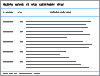
Table 1
Primers required for the construction of the IBDV infectious clone"
引物名称 Primer name | 片段Segment | 引物序列 Primer sequences (5'→3') | 退火温度 Annealing temperature/℃ | 用途 Purpose |
|---|---|---|---|---|
| IBDV-A-F | A | GGATACGATCGGTCTGACCC | 55 | 全基因组扩增 |
| IBDV-A-R | GGGGACCCGCGAACGGATCCA | |||
| pCAG-R-SeqA-F | A | GGCAAAGAATTCCTCGAG | 58 | 引入RiboJ核酶序列 |
| pCAG-R-SeqA-R | GTTGGGTTTGATCTTGCAGGTTTGT | |||
| SeqA-H-pCAG-F | A | AGGGCTGTCTCTGATGAGGACCTTG | 58 | 引入HDVrz核酶序列 |
| SeqA-H-pCAG-R | AGGAGTGAATTCCTCGAG | |||
| IBDV-B-F | B | GGATACGATGGGTCTGACCCT | 55 | 全基因组扩增 |
| IBDV-B-R | GGGGGCCCCCGCAGGCGAAGG | |||
| pCAG-R-SeqB-F | B | GGCAAAGAATTCCTCGAGAG | 58 | 引入RiboJ核酶序列 |
| pCAG-R-SeqB-R | CAGAGGGTCAGACCCATCGT | |||
| SeqB-H-pCAG-F | B | CCCGGCCTTCGCCTGCGGGG | 58 | 引入HDVrz核酶序列 |
| SeqB-H-pCAG-R | AGGAGTGAATTCCTCGAG | |||
| VP2-F | A | ATGACAAACCTGCAAGATCAA | 55 | 鉴定VP2 |
| VP2-R | CCTTATGGCCCGGATTATGTC |
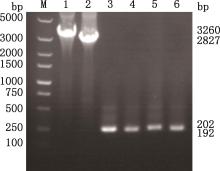
Fig.1
Electrophoresis of amplified fragments A and B, and the ribozyme sequenceM, DL5000 DNA Marker; 1, Fragment A; 2, Fragment B; 3, A-RiboJ; 4, A-HDVrz; 5, B-RiboJ; 6, B-HDVrz"

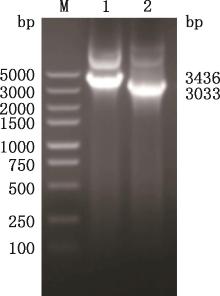
Fig.2
Identification of the recombinant plasmids"


Fig.3
Results of DF-1 cell lesion (100×)A, Blank control group; B, Cells infected with BJQ902 strain; C, Cells infected with rBJQ902 strain"

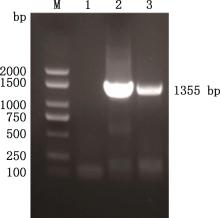
Fig.4
PCR identification results of VP2 gene of rBJQ902 strainM, DL2000 DNA Marker; 1, Control; 2, VP2 gene of BJQ902 strain; 3, VP2 gene of rBJQ902 strain"
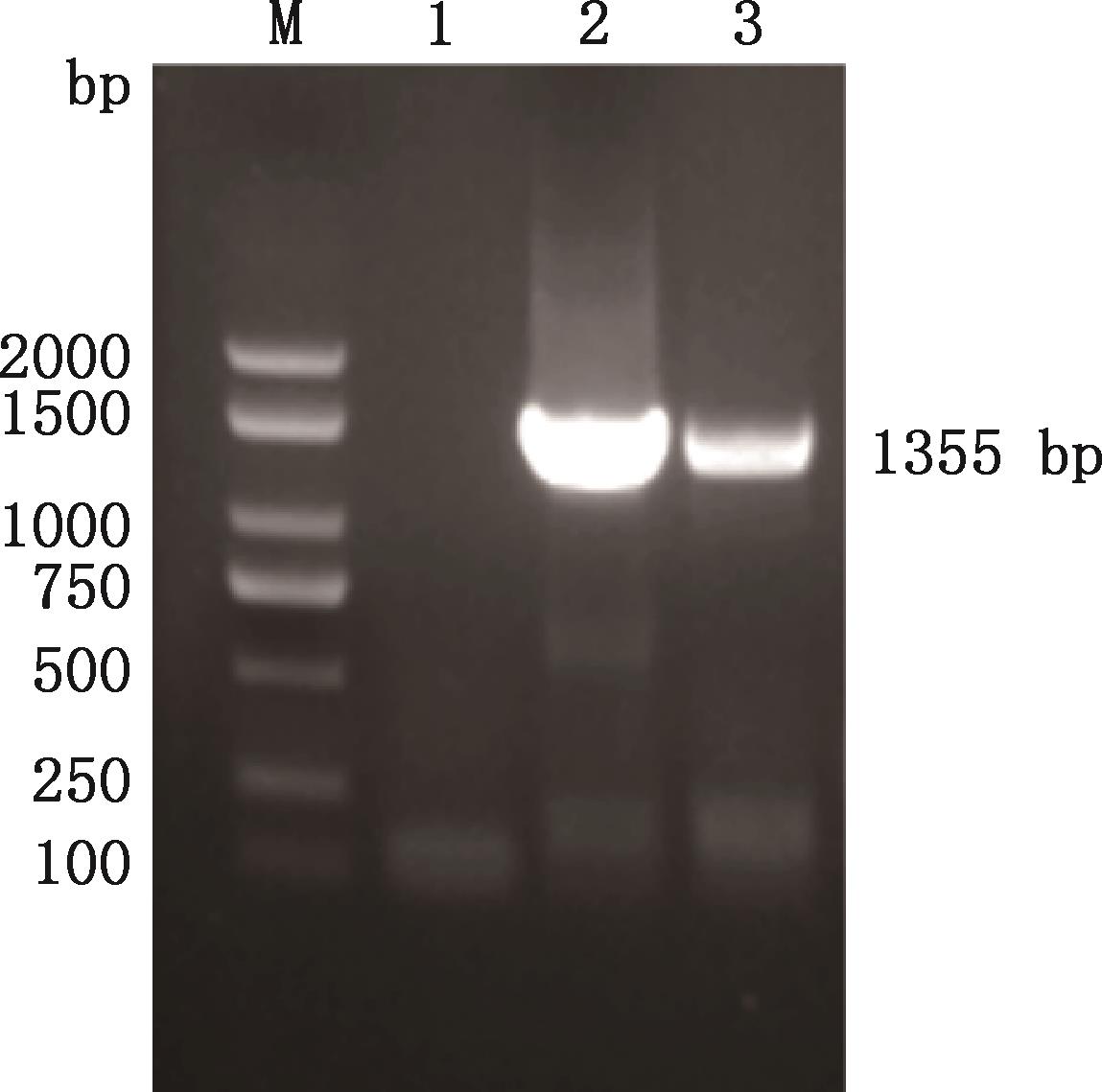
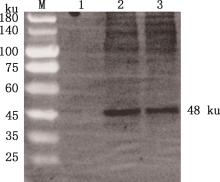
Fig.5
Western blotting identification results of VP2 protein of rBJQ902 strainM, Protein Marker; 1, Control; 2, VP2 protein of BJQ902 strain; 3, VP2 protein of rBJQ902 strain"
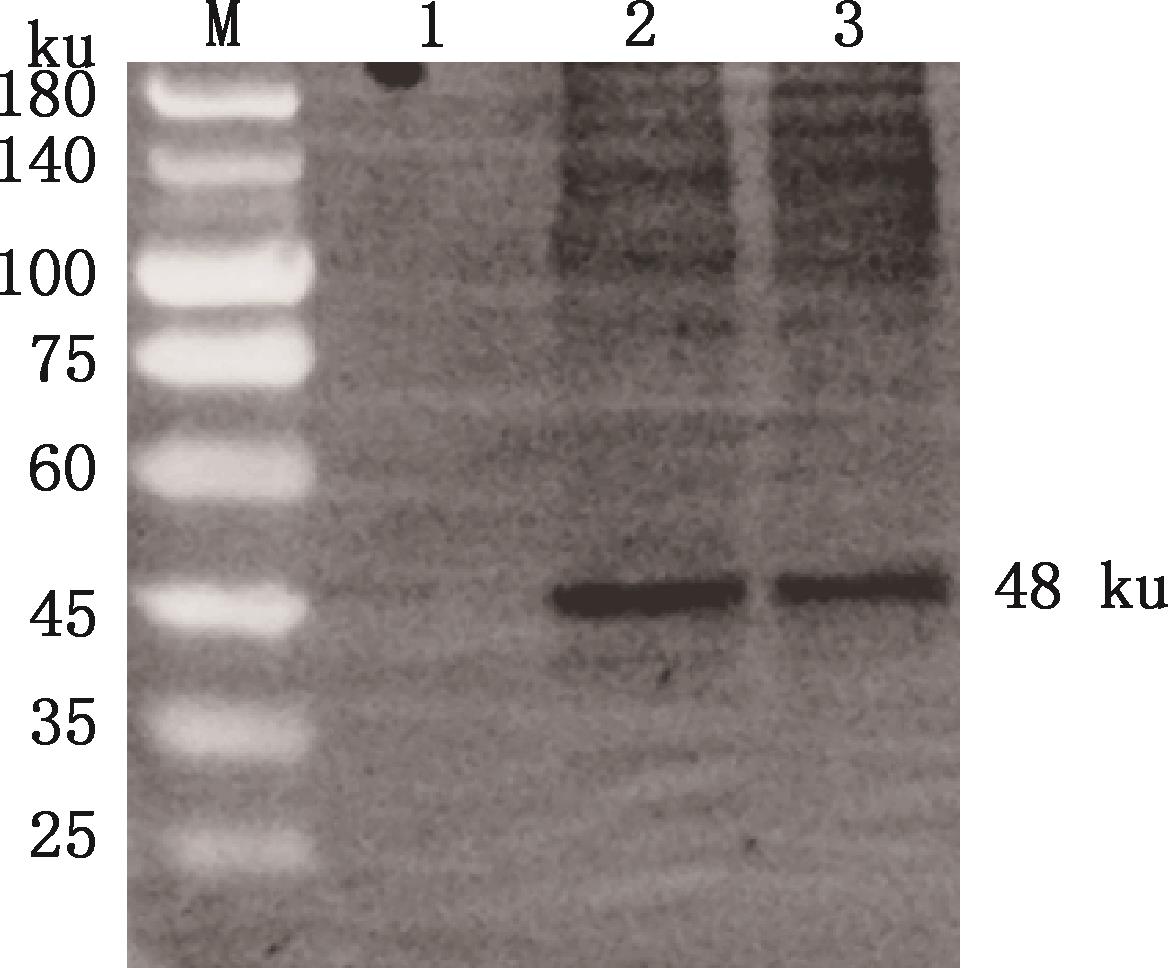
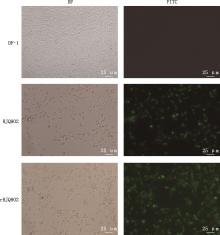
Fig.6
Identification result of VP2 protein by IFA (200×)BF, Bright field; FITC, Green fluorescence"

| [1] | WANG Y, JIANG N, FAN L, et al. Development of a viral-like particle candidate vaccine against novel variant Infectious bursal disease virus[J]. Vaccines (Basel), 2021, 9(2): 142. |
| [2] | LUQUE D, SAUGAR I, REJAS M T, et al. Infectious bursal disease virus: Ribonucleoprotein complexes of a double-stranded RNA virus[J]. Journal of Molecular Biology, 2009, 386(3): 891-901. |
| [3] | COULIBALY F, CHEVALIER C, GUTSCHE I, et al. The birnavirus crystal structure reveals structural relationships among Icosahedral viruses[J]. Cell, 2005, 120(6): 761-772. |
| [4] | WU H, SINGH N K, LOCY R D, et al. Expression of immunogenic VP2 protein of Infectious bursal disease virus in Arabidopsis thaliana [J]. Biotechnology Letters, 2004, 26(10): 787-792. |
| [5] | AZAD A A, BARRETT S A, FAHEY K J. The Characterization and molecular cloning of the double-stranded RNA genome of an Australian strain of Infectious bursal disease virus[J]. Virology, 1985, 143(1): 35-44. |
| [6] | BOOT H J, HUURNE A H TER, PEETERS B P. Generation of full-length cDNA of the two genomic dsRNA segments of Infectious bursal disease virus[J]. Journal of Virological Methods, 2000, 84(1): 49-58. |
| [7] | MUNDT E, BEYER J, MÜLLER H. Identification of a novel viral protein in Infectious bursal disease virus-infected cells[J]. Journal of General Virology, 1995, 76 (Pt 2): 437-443. |
| [8] | BOOT H J, HUURNE A A TER, HOEKMAN A J, et al. Rescue of very virulent and mosaic Infectious bursal disease virus from cloned cDNA: VP2 is not the Sole determinant of the very virulent phenotype[J]. Journal of Virology, 2000, 74(15): 6701-6711. |
| [9] | 高辉.IBDV VP5关键氨基酸致病力分析与免疫保护效果研究[D]. 北京: 中国农业大学, 2024. |
| GAO H.Analysis of pathogenicity and immunoprotective effects of critical amino acids of IBDV VP5[D]. Beijing: China Agricultural University, 2024. (in Chinese) | |
| [10] | 王小娥, 杨春晓, 朱彩霞, 等.利用噬菌体随机肽库筛选传染性法氏囊病病毒VP2模拟表位[J].农业生物技术学报, 2010, 18(3): 573-579. |
| WANG X E, YANG C X, ZHU C X, et al. Screening of mimic epitopes for Infectious bursal disease virus VP2 by phage display random peptide library[J].Journal of Agricultural Biotechnology, 2010, 18(3): 573-579.(in Chinese) | |
| [11] | BRANDT M, YAO K, LIU M, et al. Molecular determinants of virulence, cell tropism, and pathogenic phenotype of Infectious bursal disease virus[J]. Journal of Virology, 2001,75(24): 11974-1182. |
| [12] | COULIBALY F, CHEVALIER C, DELMAS B, et al. Crystal structure of an Aquabirnavirus particle: Insights into antigenic diversity and virulence determinism[J]. Journal of Virology, 2010,84(4): 1792-1799. . |
| [13] | 张子言, 杨冰欢, 谭磊, 等.传染性法氏囊病病毒变异株的分离鉴定与分析[J/OL].中国动物传染病学报, 1-13[2023-08-03]. |
| ZHANG Z Y, YANG B H, TAN L, et al. Isolation, identification and analysis of Infectious bursal disease virus variant[J/OL]. Chinese Journal of Animal Infectious Diseases, 1-13[2023-08-03].(in Chinese) | |
| [14] | 张晓宇.IBDV新型变异株的分离鉴定及其VP2蛋白表达与免疫原性分析[D]. 扬州: 扬州大学, 2023. |
| ZHANG X Y. Isolation and identification of novel variant IBDV and expression of VP2 protein and its immunogenicity analysis[D]. Yangzhou: Yangzhou University, 2023. (in Chinese) | |
| [15] | MUNDT E. Tissue culture infectivity of different strains of Infectious bursal disease virus is determined by distinct amino acids in VP2[J]. The Journal of General Virology, 1999,80: 2067-2076. |
| [16] | VAN LOON A A W M, DE HAAS N, ZEYDA I, et al. Alteration of amino acids in VP2 of very virulent Infectious bursal disease virus results in tissue culture adaptation and attenuation in chickens[J]. Journal of General Virology, 2002, 83(Pt 1): 121-129. |
| [17] | 孔子萌.鸡Ⅱ型补体受体的鉴定及其单克隆抗体的制备[D]. 南昌: 江西农业大学, 2020. |
| KONG Z M. Identification of chicken complement receptor type Ⅰ and preparation of its monoclonal antibody[D]. Nanchang: Jiangxi Agricultural University, 2020. (in Chinese) | |
| [18] | 孔子萌, 江波, 蔡云虹, 等.鸡补体受体2基因克隆、蛋白表达纯化及其多克隆抗体的制备和鉴定[J].中国畜牧兽医, 2020, 47(1): 201-208. |
| KONG Z M, JIANG B, CAI Y H, et al. Cloning, protein expression and purification of chicken complement receptor 2 gene and preparation and identification of its polyclonal antibody[J].China Animal Husbandry and Veterinary Medicine, 2020, 47(1): 201-208. (in Chinese) | |
| [19] | LIANG P, CAO M, LI J, et al. Expanding sugar alcohol industry: Microbial production of sugar alcohols and associated chemocatalytic derivatives[J]. Biotechnology Advances, 2023, 64: 108105. |
| [20] | MUND E, VAKHARIA V N. Synthetic transcripts of double-stranded Birnavirus genome are infectious[J]. Proceedings of the National Academy of Sciences of the United States of America, 1996, 93: 11131-11136. |
| [21] | YAO K, MARK A G, VIKRAM N V. Generation of mutant Infectious bursal disease virus that does not cause bursal lesions[J]. Journal of Virology, 1998, 72: 2647-2654. |
| [22] | 焦文强,殷相平,柳纪省.狂犬病病毒反向遗传学的研究进展[J].中国兽医科学,2011,41(9):979-984. |
| JIAO W Q, YIN X P, LIU J S. Advances in the reverse genetics of Rabies virus[J]. China Veterinary Science, 2011,41(9): 979-984. (in Chinese) | |
| [23] | BARLIC-MAGANJA D, ZORMAN-ROJS O, GROM J. Detection of Infectious bursal disease virus in different lymphoid organs by single-step reverse transcription polymerase chain reaction and microplate hybridization assay[J]. Journal of Veterinary Diagnostic Investigation, 2002, 14(3): 243-246. |
| [24] | KENICHI I, YOUKO S, ICHIRO K, et al. An improved method for recovering Rabies virus from cloned cDNA[J]. Journal of Virology Methods, 2003, 107: 229-236. |
| [25] | MARTIN A, STAEHELI P, SCHNEIDER U. RNA polymerase Ⅱ-controlled expression of antigenomic RNA enhances the rescue efficacies of two different members of the Mononegavirales independently of the site of viral genome replication[J]. Journal of Virology, 2006, 80: 5708-5715. |
| [26] | BEN A N, KHABOUCHI N, MARDASSI H. Efficient rescue of Infectious bursal disease virus using a simplified RNA polymerase Ⅱ-based reverse genetics strategy[J].Archives of Virology, 2008, 153(6): 1131-1137. |
| [27] | 祁小乐, 高宏雷, 高玉龙, 等.鸡传染性法氏囊病病毒Gt株感染性分子克隆的构建[J].中国农业科学, 2007, 40(10): 2343-2349. |
| QI X L, GAO H L, GAO Y L, et al. Development of infectious molecular clones in Infectious bursal disease virus Gt strain[J]. Scientia Agricultura Sinica, 2007, 40(10): 2343-2349. (in Chinese) | |
| [28] | YANG H, WANG Y, YE C. Rapid generation of attenuated Infectious bursal disease virus from dual-promoter plasmids by reduction of viral ribonucleoprotein activity[J].Journal of Virology, 2020, 94(7): e01569-19. |
| [1] | JIANG Yanping, SUN Jian, LIU Wei, LI Bolong, BAI Huitao, YANG Jing, LI Jiaxuan, CUI Wen, ZHOU Han, HAN Jianchun, TANG Lijie. Establishment of Direct Immunofluorescence Assay for IBDV and Its Preliminary Application [J]. China Animal Husbandry & Veterinary Medicine, 2025, 52(9): 4368-4378. |
| [2] | HE Xianming, REN Guangcai, YE Junxian, LAN Hong, LIU Yufu, XIONG Ting, YANG Zekun, XU Ting, CHEN Ruiai. Isolation and Identification of a Strain of Infectious Bursal Disease Virus and Sequence Analysis of VP2 Gene [J]. China Animal Husbandry & Veterinary Medicine, 2022, 49(3): 1005-1014. |
| [3] | WANG Miao, CHEN Xueyang, WANG Xingming, LIANG Xiongyan, YANG Yuying. Construction of Infectious Clones of Two ALV-K Recombinant Viruses and Virus Rescue [J]. China Animal Husbandry & Veterinary Medicine, 2022, 49(10): 3764-3770. |
| [4] | MENG Weijin, FAN Kuohai, CHANG Xiongxiong, YIN Wei, LI Hongquan, WANG Zhirui. Eukaryotic Expression and Immunogenicity Detection of Fusion Protein of Chicken Infectious Bursal Disease Virus VP2 and Truncated Diphtheria Toxin DT390 [J]. China Animal Husbandry & Veterinary Medicine, 2021, 48(12): 4652-4660. |
| [5] | WANG Yanwei, ZHANG Suling, WU Peng, GENG Xiaolin, HUANG Yuxin, LI Penghao, WANG Mengyue, LI Xiangdong, PANG Wenqiang, TIAN Kegong. Identification of Subviral Particles Efficiently Self-assembled by Infectious Bursal Disease Virus rVP2 Protein [J]. China Animal Husbandry & Veterinary Medicine, 2020, 47(6): 1677-1684. |
| [6] | GAO Xiang, LI Hui, ZHANG Li-zhou, LU Zhen, WANG Yong-qiang, GAO Li, WU Tian-tian, GAO Yu-long, LIU Chang-jun, WANG Xiao-mei, QI Xiao-le. Soluble Expression, Purification and Activity Analysis of Capsid Protein of Very Virulent Infectious Bursal Disease Virus [J]. China Animal Husbandry & Veterinary Medicine, 2017, 44(7): 2096-2102. |
| [7] | FENG Shu-tang, MA Yu-yuan, XIA Ying. Research Progress and Countermeasures of Porcine Endogenous Retrovirus in Chinese Miniature [J]. China Animal Husbandry & Veterinary Medicine, 2017, 44(4): 1244-1248. |
| [8] | WANG Jie-qiong, ZHAO Yu-jie, ZHOU Yun-fei, HUANG Zong-mei, CHEN Pan-pan, ZHOU Wei-fan, LIU Lin, LI Xin-sheng. Prokaryotic Expression and Bioinformatics Analysis of VP2 Gene of Infectious Bursal Disease Virus C4 Strain [J]. China Animal Husbandry & Veterinary Medicine, 2017, 44(12): 3585-3591. |
| [9] | HAN Tao, ZHOU Zhi, ZHAO Bo-lin, YUAN Lin, ZHAI Xin-yan. Effect of 5' Terminal Non Viral Nucleotide on the Rescue of PRRSV Infectious Clone [J]. China Animal Husbandry & Veterinary Medicine, 2016, 43(5): 1349-1354. |
| [10] | WANG Nian, CHEN Yu-ming, ZHANG Li-zhou, GAO Li, LU Zhen, GAO Yu-long, WANG Yong-qiang, GAO Hong-lei, LIU Chang-jun, CUI Hong-yu, WANG Xiao-mei, QI Xiao-le. Construction of Bait Vector of Infectious Bursal Disease Virus VP4 and Screening of the Interacted Proteins of Host Cell Using Yeast Two-hybrid System [J]. China Animal Husbandry & Veterinary Medicine, 2015, 42(2): 317-323. |
| [11] | CHEN Yu-ming, ZHANG Li-zhou, REN Xian-gang, GAO Li, QIN Li-ting, GAO Yu-long, WANG Yong-qiang, GAO Hong-lei, WANG Xiao-mei, QI Xiao-le. Construction and Identification of Yeast Two-hybrid Bait Vectors of Capsid Protein of IBDV Different Virulence Strains [J]. China Animal Husbandry & Veterinary Medicine, 2014, 41(1): 30-34. |
| [12] | CUI Li-fan;WU Guo-hua;ZHANG Qiang. Advance in Study on Gene Therapy of Diseases by Ribozymes [J]. China Animal Husbandry & Veterinary Medicine, 2011, 38(4): 217-220. |
| [13] | FAN Yun-feng;ZHAO Qi-zu;ZHAO Yun;ZOU Xing-qi;ZHANG Zhong-qiu;WANG Qin;NING Yi-bao. The Study of Recovered Infectious Classical Swine Fever Virus from Full-length cDNA Clone [J]. China Animal Husbandry & Veterinary Medicine, 2009, 36(6): 56-60. |
| Viewed | ||||||
|
Full text |
|
|||||
|
Abstract |
|
|||||
