
中国畜牧兽医 ›› 2026, Vol. 53 ›› Issue (2): 761-775.doi: 10.16431/j.cnki.1671-7236.2026.02.023
毕毅( ), 杨秋月, 谢瞰, 杨亚晋, 陈彦宏, 李青青, 郭爱伟()
收稿日期:2025-07-11
出版日期:2026-02-20
发布日期:2026-01-27
通讯作者:
郭爱伟
E-mail:1253395174@qq.com;g.aiwei.swfu@hotmail.com
作者简介:毕毅,E-mail:1253395174@qq.com
基金资助:
BI Yi(), YANG Qiuyue, XIE Kan, YANG Yajin, CHEN Yanhong, LI Qingqing, GUO Aiwei()
Received:2025-07-11
Online:2026-02-20
Published:2026-01-27
Contact:
GUO Aiwei
E-mail:1253395174@qq.com;g.aiwei.swfu@hotmail.com
摘要:
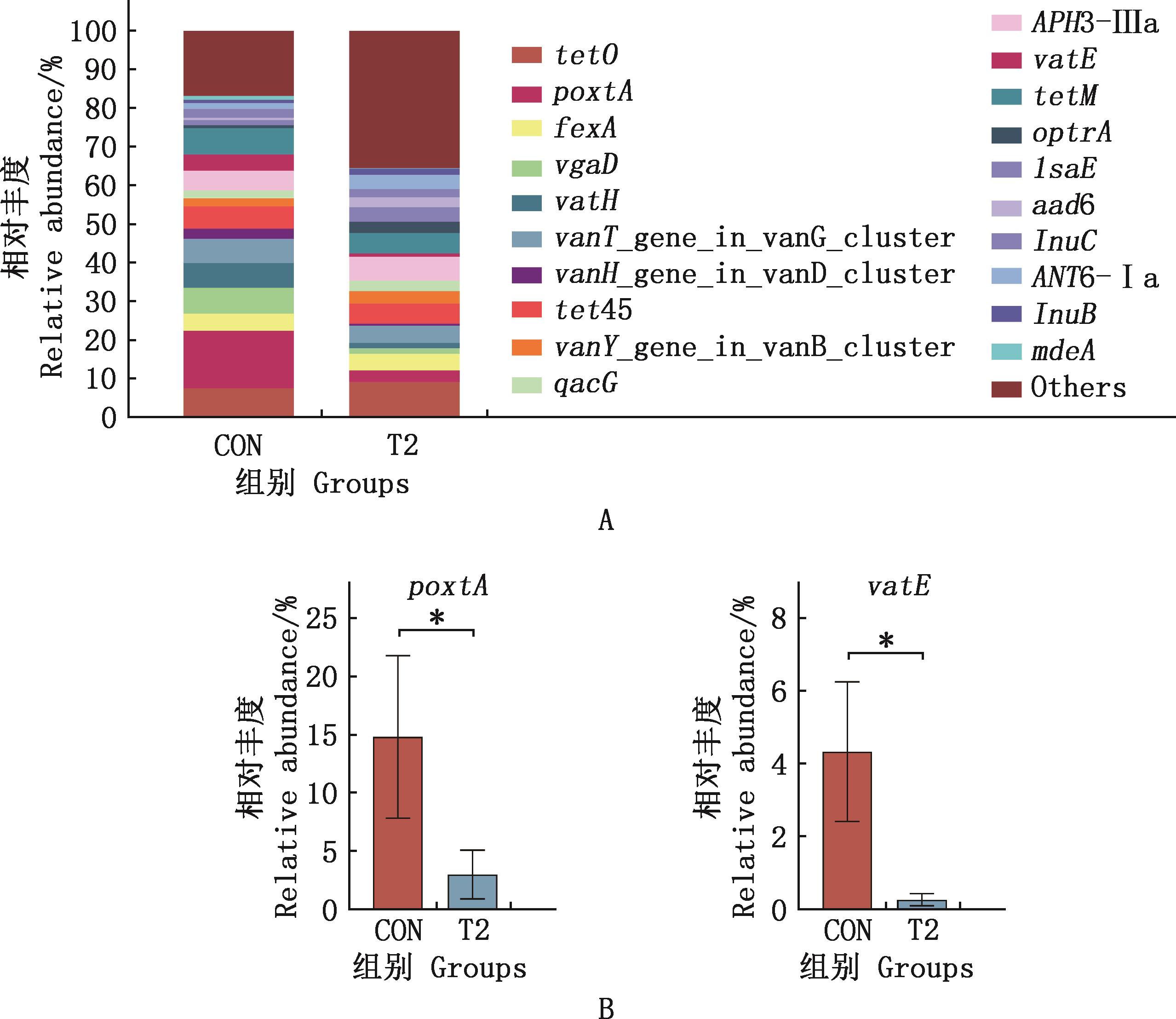
目的 研究不同饲喂方式下添加膳食纤维(DF)对黄羽肉鸡屠宰性能、胫骨发育、粪便微生物及耐药基因的影响。 方法 选取1日龄健康、体重接近(35 g±5 g)的雄性黄羽肉鸡250只,随机分为5组,每组5个重复,每重复10只鸡。对照组(CON)饲喂不添加DF的基础饲粮(FF);试验1组(T1)饲喂低纤维饲粮(LF,含1.5% DF);试验2组(T2)饲喂高纤维饲粮(HF,含3% DF);试验3组(T3)在0~4周龄饲喂FF,5~8周龄饲喂LF;试验4组(T4)在0~4周龄饲喂LF,5~8周龄饲喂HF。试验期为56 d。试验结束时翅静脉采血测定血钙、血磷;屠宰后测定屠宰性能、胫骨性能指标及胫骨灰分、钙、磷含量;采集CON与T2组新鲜粪便进行宏基因组学分析。 结果 ①屠宰性能:各试验组黄羽肉鸡的屠宰率、半净膛率、全净膛率、胸肌率及腿肌率均无显著差异(P>0.05)。②胫骨指标:各组黄羽肉鸡胫骨长、胫骨重、髓腔直径、体积、密度等均无显著变化(P>0.05);与T1组相比,T2和T3组黄羽肉鸡胫骨直径显著提高(P<0.05);与T3和T4组相比,T2组黄羽肉鸡的皮质骨厚度显著增加(P<0.05);与CON组相比,各试验组黄羽肉鸡的胫骨灰分、骨钙和磷含量均无显著差异(P>0.05)。③血清钙、磷含量显示,与CON组相比,T1、T3和T4组黄羽肉鸡的血钙含量显著增加(P<0.05),T1、T2、T3和T4组的黄羽肉鸡的血磷含量显著降低(P<0.05);④宏基因组测序表明,与CON组相比,T2组黄羽肉鸡粪便微生物中副拟杆菌属、拟杆菌属、梭菌属、粪杆菌属、链球菌属、肠球菌属、棒状杆菌属及罗氏菌属等微生物的相对丰度显著升高(P<0.05),同时T2组粪便中耐药基因poxtA和vatE相对丰度显著降低(P<0.05)。 结论 本试验条件下,全程在饲粮中添加3%的DF可改善黄羽肉鸡胫骨性能与粪便微生物组成,并降低粪便中特定耐药基因的丰度。
中图分类号:
毕毅, 杨秋月, 谢瞰, 杨亚晋, 陈彦宏, 李青青, 郭爱伟. 饲粮中添加膳食纤维对黄羽肉鸡屠宰性能、胫骨性能指标、粪便微生物和耐药基因的影响[J]. 中国畜牧兽医, 2026, 53(2): 761-775.
BI Yi, YANG Qiuyue, XIE Kan, YANG Yajin, CHEN Yanhong, LI Qingqing, GUO Aiwei. Effects of Dietary Fiber on Slaughter Performance, Tibia Performance Indicators, Fecal Microbiota, and Antibiotic Resistance Genes in Yellow-feathered Broilers[J]. China Animal Husbandry & Veterinary Medicine, 2026, 53(2): 761-775.

表1
饲粮组成与营养水平(风干基础) (%)"
项目 Items | 0~4周龄 0 to 4 weeks of age | 5~8周龄 5 to 8 weeks of age | ||||||||
|---|---|---|---|---|---|---|---|---|---|---|
| CON | T1 | T2 | T3 | T4 | CON | T1 | T2 | T3 | T4 | |
| 原料 Ingredients | ||||||||||
| 玉米 Corn | 57.06 | 55.19 | 53.32 | 57.06 | 55.19 | 64.48 | 62.62 | 60.93 | 62.62 | 60.93 |
| 豆粕 Soybean meal | 28.45 | 28.82 | 29.20 | 28.45 | 28.82 | 20.73 | 21.09 | 21.17 | 21.09 | 21.17 |
| 鱼粉 Fish meal | 5.10 | 5.10 | 5.10 | 5.10 | 5.10 | 5.20 | 5.20 | 5.31 | 5.20 | 5.31 |
玉米蛋白粉 Corn gluten meal | 2.00 | 2.00 | 2.00 | 2.00 | 2.00 | 2.00 | 2.00 | 2.00 | 2.00 | 2.00 |
微晶纤维素 Microcrystalline fiber | 0.00 | 1.00 | 2.00 | 0.00 | 1.00 | 0.00 | 1.00 | 2.00 | 1.00 | 2.00 |
| 菊粉 Inulin | 0.00 | 0.50 | 1.00 | 0.00 | 0.50 | 0.00 | 0.50 | 1.00 | 0.50 | 1.00 |
| 豆油 Soybean oil | 2.70 | 2.70 | 2.70 | 2.70 | 2.70 | 3.10 | 3.10 | 3.16 | 3.10 | 3.16 |
| L-赖氨酸 L-Lys | 0.14 | 0.14 | 0.13 | 0.14 | 0.14 | 0.15 | 0.15 | 0.15 | 0.15 | 0.15 |
| DL-蛋氨酸 DL-Met | 0.15 | 0.15 | 0.15 | 0.15 | 0.15 | 0.14 | 0.14 | 0.14 | 0.14 | 0.14 |
| 石粉 Limestone | 1.50 | 1.50 | 1.50 | 1.50 | 1.50 | 1.50 | 1.50 | 1.50 | 1.50 | 1.50 |
| 磷酸氢钙 CaHPO4 | 1.27 | 1.27 | 1.27 | 1.27 | 1.27 | 1.27 | 1.27 | 1.21 | 1.27 | 1.21 |
| 食盐 NaCl | 0.37 | 0.37 | 0.37 | 0.37 | 0.37 | 0.23 | 0.23 | 0.23 | 0.23 | 0.23 |
| 预混料 Premix① | 1.00 | 1.00 | 1.00 | 1.00 | 1.00 | 1.00 | 1.00 | 1.00 | 1.00 | 1.00 |
氯化胆碱 Choline chloride | 0.26 | 0.26 | 0.26 | 0.26 | 0.26 | 0.20 | 0.20 | 0.20 | 0.20 | 0.20 |
营养成分 Nutrient components② | ||||||||||
| 代谢能 ME/(MJ/kg) | 12.44 | 12.42 | 12.40 | 12.44 | 12.42 | 12.83 | 12.81 | 12.82 | 12.81 | 12.82 |
| 粗蛋白质 CP | 21.51 | 21.51 | 21.51 | 21.51 | 21.51 | 18.90 | 18.90 | 18.86 | 18.90 | 18.86 |
| 赖氨酸 Lys | 1.32 | 1.33 | 1.32 | 1.32 | 1.33 | 1.15 | 1.15 | 1.16 | 1.15 | 1.16 |
| 蛋氨酸 Met | 0.53 | 0.53 | 0.53 | 0.53 | 0.53 | 0.49 | 0.49 | 0.49 | 0.49 | 0.49 |
| 钙 Ca | 1.01 | 1.01 | 1.01 | 1.01 | 1.01 | 0.99 | 0.99 | 0.99 | 0.99 | 0.99 |
| 有效磷 AP | 0.48 | 0.48 | 0.48 | 0.48 | 0.48 | 0.48 | 0.48 | 0.47 | 0.48 | 0.47 |
表 2
饲粮中添加DF对黄羽肉鸡屠宰性能的影响 (%)"
项目 Items | 对照组 CON | 试验1组 T1 | 试验2组 T2 | 试验3组 T3 | 试验4组 T4 | P值 P-value |
|---|---|---|---|---|---|---|
屠宰率 Dressed percentage | 72.47±0.72 | 71.21±0.55 | 72.31±0.52 | 72.02±0.35 | 70.84±0.48 | 0.135 |
半净膛率 Percentage of half-eviscerated yield with giblet | 85.51±0.37 | 85.04±0.98 | 86.12±0.75 | 85.57±0.39 | 85.20±0.51 | 0.799 |
全净膛率 Percentage of eviscerated yield | 71.72±0.77 | 70.56±0.76 | 72.72±0.61 | 72.03±0.35 | 70.83±0.48 | 0.109 |
胸肌率 Percentage of breast muscle yield | 15.54±0.31 | 16.07±0.51 | 14.89±0.35 | 15.15±0.58 | 14.61±0.38 | 0.173 |
腿肌率 Percentage of leg muscle yield | 14.53±0.52 | 14.25±0.58 | 14.36±0.42 | 14.36±0.42 | 15.58±0.57 | 0.312 |
表 3
饲粮中添加DF对黄羽肉鸡胫骨质量参数的影响"
项目 Items | 对照组 CON | 试验1组 T1 | 试验2组 T2 | 试验3组 T3 | 试验4组 T4 | P值 P-value |
|---|---|---|---|---|---|---|
胫骨长 Tibia bone length/cm | 11.42±0.09 | 11.48±0.16 | 11.27±0.11 | 11.49±0.10 | 11.54±0.14 | 0.623 |
胫骨重 Tibia bone weight/g | 13.97±0.45 | 13.65±0.44 | 13.72±0.58 | 14.19±0.35 | 14.01±0.61 | 0.941 |
胫骨直径 Tibia bone diameter/mm | 8.43±0.26ab | 8.04±0.23b | 8.93±0.16a | 8.89±0.23a | 8.51±0.20ab | 0.045 |
髓腔直径 Medullary canal diameter/mm | 5.18±0.18 | 5.31±0.17 | 5.58±0.16 | 5.56±0.35 | 5.68±0.27 | 0.504 |
胫骨体积 Tibia bone volume/cm3 | 12.33±0.37 | 11.89±0.46 | 12.55±0.55 | 12.73±0.39 | 12.73±0.62 | 0.747 |
皮质厚度 Cortical thickness/mm | 1.66±0.04ab | 1.57±0.07ab | 1.74±0.04a | 1.49±0.06bc | 1.48±0.06bc | 0.022 |
胫跗骨指数 Tibiotarsal index/% | 39.09±1.25 | 37.15±1.21 | 38.53±0.94 | 34.66±1.61 | 34.43±1.63 | 0.074 |
强健指数 Robusticity index/(mm/ | 4.75±0.06 | 4.81±0.05 | 4.72±0.03 | 4.75±0.06 | 4.79±0.02 | 0.750 |
骨重/骨长指数 W/L index/(mg/mm) | 122.33±4.00 | 118.77±2.97 | 121.34±4.16 | 123.59±3.58 | 121.02±3.93 | 0.923 |
胫骨密度 Tibia bone density/(g/cm3) | 1.13±0.02 | 1.15±0.01 | 1.10±0.02 | 1.12±0.02 | 1.16±0.03 | 0.333 |

图1
饲粮中添加DF对黄羽肉鸡胫骨质量特征的影响"

表 4
饲粮中添加DF对黄羽肉鸡胫骨灰分、钙和磷含量的影响"
| 项目 Items | 对照组 CON | 试验1组 T1 | 试验2组 T2 | 试验3组 T3 | 试验4组 T4 | P值 P-value |
|---|---|---|---|---|---|---|
| 灰分 ASH/% | 46.53±0.43 | 48.12±0.58 | 48.40±0.36 | 49.07±0.95 | 47.17±0.93 | 0.121 |
| 钙 Ca/% | 17.38±0.14 | 17.89±0.17 | 17.63±0.16 | 17.38±0.15 | 17.31±0.16 | 0.104 |
| 磷 P/% | 10.37±0.22 | 10.25±0.76 | 11.16±0.57 | 10.65±0.70 | 10.01±0.43 | 0.306 |
表 5
饲粮中添加DF对黄羽肉鸡血清钙和磷含量的影响"
| 项目 Items | 对照组 CON | 试验1组 T1 | 试验2组 T2 | 试验3组 T3 | 试验4组 T4 | P值 P-value |
|---|---|---|---|---|---|---|
| 钙 Ca/(mmol/L) | 1.98±0.02b | 2.07±0.01a | 2.04±0.01ab | 2.06±0.01a | 2.10±0.01a | 0.006 |
| 磷 P/(mmol/L) | 1.86±0.07a | 1.71±0.01b | 1.63±0.03bc | 1.55±0.01c | 1.53±0.03c | 0.001 |

图2
黄羽肉鸡粪便微生物菌群韦恩图(A)和主坐标分析(B)"
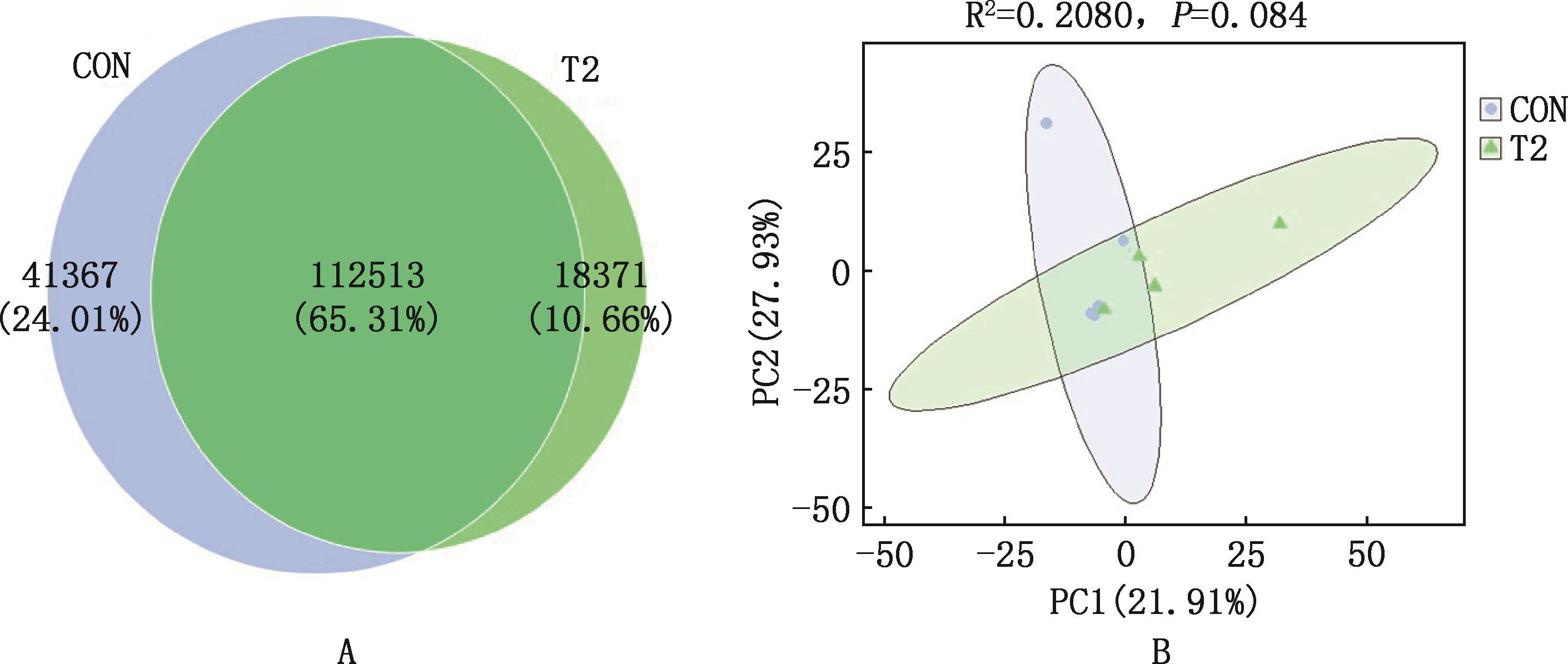
表6
各组黄羽肉鸡粪便微生物Alpha多样性分析"
项目 Items | 对照组 CON | 试验2组 T2 | P值 P-value |
|---|---|---|---|
| Chao1指数 Chao1 index | 1 063±79 | 1 028±83 | 0.811 |
| Ace指数 Ace index | 1 127±87 | 1 089±92 | 0.783 |
| 香侬指数 Shannon index | 5.12±0.18 | 5.36±0.15 | 0.381 |
| 辛普森指数 Simpson index | 0.89±0.02 | 0.91±0.01 | 0.424 |

图3
黄羽肉鸡粪便微生物在门水平(A)和属水平(B)群落组成"


图4
粪便微生物群落在门水平(A)和属水平(B)差异性检验"
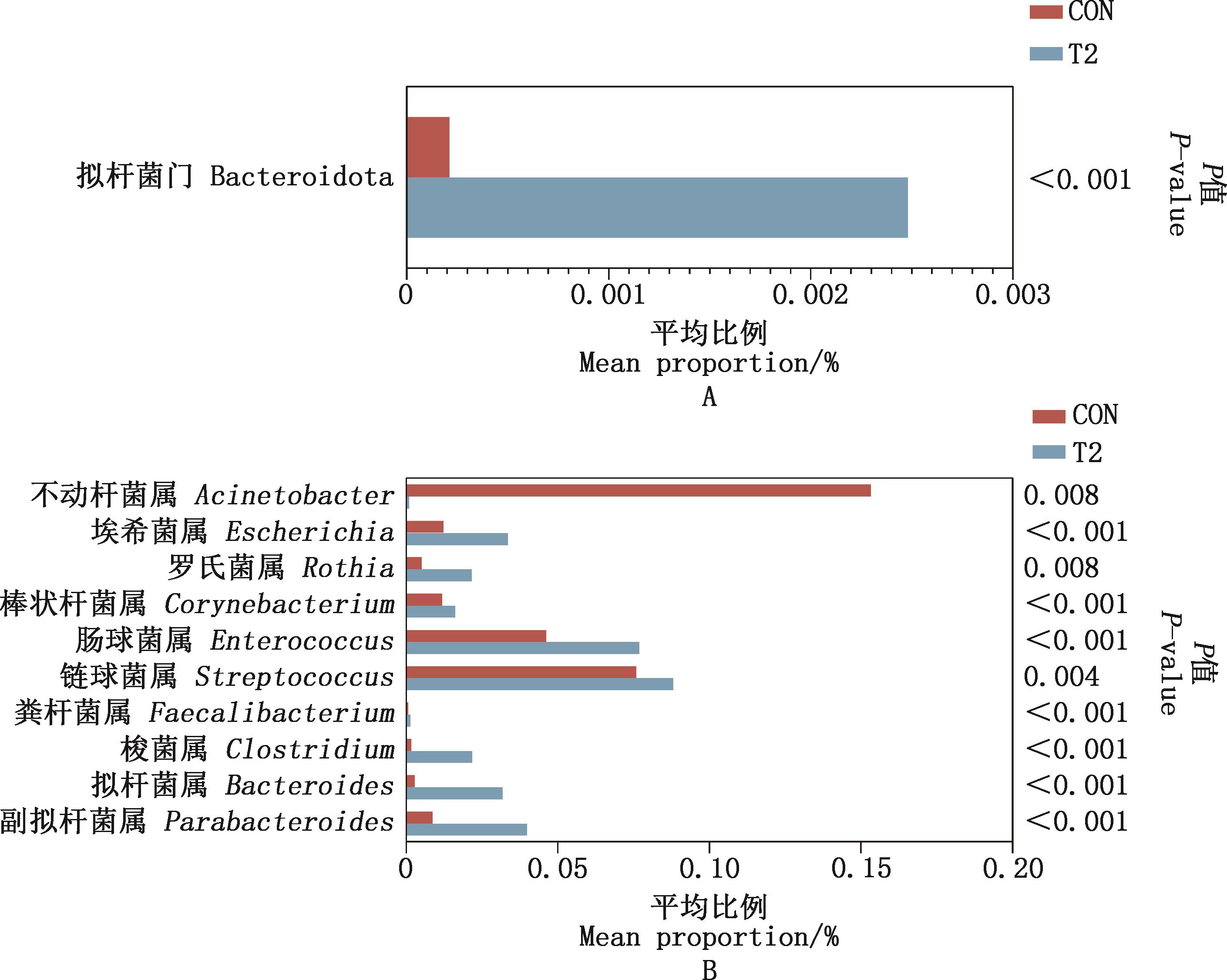
图5
粪便TOP20的耐药基因(A)和差异耐药基因(B)分析"
| [1] | ZHOU R, GUO Q, XIAO Y, et al. Endocrine role of bone in the regulation of energy metabolism[J]. Bone Research,2021,9(1):425-443. |
| [2] | LIANG X, ZHANG Z, WANG H, et al. Early-life prophylactic antibiotic treatment disturbs the stability of the gut microbiota and increases susceptibility to H9N2 AIV in chicks[J]. Microbiome,2023,11(1):163. |
| [3] | ZAISS M M, JONES R M, SCHETT G, et al. The gut-bone axis: How bacterial metabolites bridge the distance[J]. Journal of Clinical Investigation,2019,129(8):3018-3028. |
| [4] | MEHMOOD K, ZHANG H, LI K, et al. Effect of tetramethylpyrazine on tibial dyschondroplasia incidence, tibial angiogenesis, performance and characteristics via HIF-1α/VEGF signaling pathway in chickens[J]. Scientific Reports,2018,8(1):2495. |
| [5] | HIPSLEY E H. Dietary “fibre” and pregnancy toxaemia[J].British Medical Journal, 1953,2(4833):420-422. |
| [6] | 郭爱伟, CHEN L,杨亚晋,等. 饲粮纤维对家禽肠道健康的调控及作用机制[J].动物营养学报,2016,28(11):3377-3385. |
| GUO A W, CHEN L, YANG Y J,et al. Regulation of dietary fiber on gut health of poultry and its potential mechanisms[J].Chinese Journal of Animal Nutrition,2016,28(11):3377-3385.(in Chinese) | |
| [7] | JHA R, BERROCOSO J D. Review: Dietary fiber utilization and its effects on physiological functions and gut health of swine[J]. Animal,2015,9(9):1441-1452. |
| [8] | TEJED O J, KIM W K. Role of dietary fiber in poultry nutrition[J]. Animals,2021,11(2):461. |
| [9] | 何文锋,张 咪,杨亚晋,等. 饲粮中添加膳食纤维对肉鸡生长性能和肠道健康影响的Meta分析[J].动物营养学报,2024,36(3):1927-1941. |
| HE W F, ZHANG M, YANG Y J, et al. Effects of dietary fiber supplementation in diet on growth performance and intestinal health of broiler chickens: A Meta-analysis[J].Chinese Journal of Animal Nutrition, 2024,36(3):1927-1941.(in Chinese) | |
| [10] | MONTIEL R S, ACOSTA I T, DELGADO E V, et al. Inulin as a growth promoter in diets for rabbits[J]. Revista Brasileira de Zootecnia,2013,42(12):885-891. |
| [11] | ORTIZ L T, RODRÍGUEZ M L, ALZUETA C, et al. Effect of inulin on growth performance, intestinal tract sizes, mineral retention and tibial bone mineralisation in broiler chickens[J]. British Poultry Science,2009,50(3):325-332. |
| [12] | ZULFIQAR Z, HUANG S, SHI Y, Dietary fiber derived short-chain fatty acids as a critical driver of the gut-bone axis in animal bone health: A review[J]. Animal Nutrition,2025,5:002. |
| [13] | 何贵文. 饲粮中添加不同不溶性和可溶性膳食纤维比例对肉鸡生产性能、养分代谢及肠道健康的影响[D].昆明: 西南林业大学,2022. |
| HE G W. Effects of different proportions of insoluble and soluble dietary fiber on performance, nutrient metabolism and intestinal health of broilers[D].Kunming:Southwest Forestry University,2022.(in Chinese) | |
| [14] | 赵奕敏,杨凌君,叶 玲,等. 饲粮纤维对畜禽肠道调控研究进展[J].中国饲料,2019,11:11-15. |
| ZHAO Y M, YANG L J, YE L, et al. Research progress on dietary fiber regulating and controlling the intestines of livestock and poultry[J].China Feed,2019,11:11-15.(in Chinese) | |
| [15] | BAKIRHAN H, KARABUDAK E. Effects of inulin on calcium metabolism and bone health[J]. International Journal for Vitamin and Nutrition Research,2023,93(1):85-96. |
| [16] | PENG H, YAN Z, KANG X, et al. The chicken gut metagenome and the modulatory effects of plant-derived benzylisoquinoline alkaloids[J].Microbiome,2018,6(1):211. |
| [17] | LUCAS S, OMATA Y, HOFMANN J, et al. Short-chain fatty acids regulate systemic bone mass and protect from pathological bone loss[J]. Nature Communications,2018,9(1):55. |
| [18] | FYHRIE D, HARASH G, RICHARDSON K C, et al. Basic morphometry, microcomputed tomography and mechanical evaluation of the tibiotarsal bone of a dual-purpose and a broiler chicken line[J]. PLoS One,2020,15(3):e0230070. |
| [19] | 中华人民共和国农业农村部. 家禽生产性能名词术语和度量计算方法: [S].北京:中国农业出版社,2020. |
| MINISTRY OF AGRICULTURE AND RURAL AFFAIRS OF THE PEOPLE’S REPUBLIC OF CHINA. Terms and measurement methods for poultry production performance ( )[S].Beijing:China Agriculture Press,2020. (in Chinese) | |
| [20] | REHMAN H F, ZANEB H, MASOOD S, et al. Effect of moringa oleifera leaf powder supplementation on pectoral muscle quality and morphometric characteristics of tibia bone in broiler chickens[J]. Brazilian Journal of Poultry Science,2018,20(4):817-824. |
| [21] | LEE J, TOMPKINS Y, KIM D H, et al. Increased sizes and improved qualities of tibia bones by myostatin mutation in Japanese quail[J]. Frontiers in Physiology,2023,13:1085935. |
| [22] | 宋琼莉,宋文静,陈小连,等. 饲粮代谢能水平对宁都黄鸡生长性能、屠宰性能和血液生化指标的影响[J].中国畜牧兽医,2022,49(2):539-547. |
| SONG Q L, SONG W J, CHEN X L,et al. Effects of dietary metabolizable energy levels on growth performance, carcass traits and serum biochemical indices of Ningdu Yellow chickens[J]. China Animal Husbandry & Veterinary Medicine,2022,49(2):539-547. (in Chinese) | |
| [23] | JHA R, MISHRA P. Dietary fiber in poultry nutrition and their effects on nutrient utilization, performance, gut health, and on the environment: A review[J]. Journal of Animal Science and Biotechnology,2021,12(1):51. |
| [24] | 丁冉冉. 不可溶性纤维对肉鸡生产性能、肠道健康以及肝脏脂质代谢的影响[D].郑州:河南农业大学,2022. |
| DING R R. Effects of insoluble fiber on growth performance, intestinal health and liver lipid metabolism of broilers [D].Zhengzhou:Henan Agricultural University,2022.(in Chinese) | |
| [25] | EFRANJI S, SEDGHI M, MAHDAVI A H, et al. The interactive effect of insoluble-fibre inclusion and feed form on the performance, tibia bone quality, and gastrointestinal histomorphology of Hy-line W-36 laying pullets[J]. Animal Production Science,2024,64(1):AN23221. |
| [26] | OKRATHOK S, SIRISOPAPONG M, MERMILLOD P, et al. Modified dietary fiber from cassava pulp affects the cecal microbial population, short-chain fatty acid, and ammonia production in broiler chickens[J]. Poultry Science,2023,102(1):102265. |
| [27] | HOU L, SUN B, YANG Y. Effects of added dietary fiber and rearing system on the gut microbial diversity and gut health of chickens[J]. Animals,2020,10(1):107. |
| [28] | 吴诗樵,陈 亮. 饲粮纤维水平和食糜收集期对生长猪回肠食糜消化酶活性、养分流量和短链脂肪酸组分的影响[J].中国畜牧兽医,2025,52(7):3136-3144. |
| WU S Q, CHEN L. Effects of dietary fiber level and digista collection period on digestive enzyme activity, nutrient flow and short-chain fatty acid composition in the ileal digesta of growing pigs[J]. China Animal Husbandry & Veterinary Medicine,2025,52(7):3136-3144.(in Chinese) | |
| [29] | LI Y P, WANG Z Y, YANG H M, et al. Effects of dietary fiber on growth performance, slaughter performance, serum biochemical parameters, and nutrient utilization in geese[J]. Poultry Science,2017,96(5):1250-1256. |
| [30] | 周世霞.日粮粗纤维水平对朗德鹅生长性能、血清生化指标和胃肠道发育的影响[D].武汉:华中农业大学,2006. |
| ZHOU S X.Effects of crude fiber level diets on growth performance, serum biochemical parameters, and gastrointestinal development in Landes geese[D].Wuhan: Huazhong Agricultural University, 2006.(in Chinese) | |
| [31] | ŚWIĄTKIEWICZ S, KORELESKI J, ARCZEWSKA-WŁOSEK A. Effect of inulin and oligofructose on performance and bone characteristics of broiler chickens fed on diets with different concentrations of calcium and phosphorus[J]. British Poultry Science,2011,52(4): 483-491. |
| [32] | MORENO-MENDOZA Y, LÓPEZ-VILLARREAL K D, HERNÁNDEZ-MARTÍNEZ C A, et al. Effect of moringa leaf powder and agave inulin on performance, intestinal morphology, and meat yield of broiler chickens[J]. Poultry Science,2021,100(2):738-745. |
| [33] | 王贝贝,郝二英,张海华,等.饲粮中添加有机锰铁铜锌复合制剂对蛋鸡生产性能、血液生化指标、卵巢功能和胫骨质量的影响[J]. 中国畜牧兽医,2025,52(5):2012-2022. |
| WANG B B, HAO E Y, ZHANG H H, et al.Effects of dietary organic manganese-iron-copper-zinc compound preparations on the production performance,blood biochemical indices, follicle development and tibia quality of laying hens[J]. China Animal Husbandry & Veterinary Medicine,2025,52(5):2012-2022.(in Chinese) | |
| [34] | MA H, XU B, LI W, et al. Effects of alpha-lipoic acid on the behavior, serum indicators, and bone quality of broilers under stocking density stress[J]. Poultry Science,2020,99(10):4653-4661. |
| [35] | BRYK G, CORONEL M Z, PELLEGRINI G, et al. Effect of a combination GOS/FOS® prebiotic mixture and interaction with calcium intake on mineral absorption and bone parameters in growing rats[J]. European Journal of Nutrition,2014,54(6):913-923. |
| [36] | PARK Y C, WEAVER M C. Calcium and bone health: Influence of prebiotics[J]. Functional Food Reviews, 2011,3(2):62-72. |
| [37] | SALAAM Z, AKINYEMI M, OSAMEDE O. Effect of strain and age on bone integrity of commercial broiler chickens[J]. Biotechnology in Animal Husbandry,2016,32(2):195-203. |
| [38] | SANCHEZ-RODRIGUEZ E, BENAVIDES-REYES C, TORRES C, et al. Changes with age (from 0 to 37 d) in tibiae bone mineralization, chemical composition and structural organization in broiler chickens[J]. Poultry Science,2019,98(11):5215-5225. |
| [39] | HUANG S, ZHANG C, XU T, et al. Integrated fecal microbiome and metabolomics reveals a novel potential biomarker for predicting tibial dyschondroplasia in chickens[J]. Frontiers in Physiology,2022,13:887207. |
| [40] | FAUSTIN EVARIS E, SARMIENTO-FRANCO L, SANDOVAL-CASTRO C A. Meat and bone quality of slow-growing male chickens raised with outdoor access in tropical climate[J]. Journal of Food Composition and Analysis, 2021,98:103802. |
| [41] | WHISNER C M, WEAVER C M. Prebiotics and Bone[M]. Cham:Springer International Publishing. 2017. |
| [42] | KADIRI S K, TIWARI P, KHOBRAGADE D S, et al. Inulin and Gastrointestinal disorders[M]. Singapore: Springer Nature,2025. |
| [43] | SCHOLZ-AHRENS K E, SCHREZENMEIR J. Inulin, oligofructose and mineral metabolism—Experimental data and mechanism[J]. British Journal of Nutrition,2007,87(S2):S179-S186. |
| [44] | BAKIRHAN H, KARABUDAK E. Effects of inulin on calcium metabolism and bone health[J]. International Journal for Vitamin and Nutrition Research,2023,93(1):85-96. |
| [45] | HE W W, XIE Z Q, THOGERSEN R, et al. Effects of calcium source, inulin, and lactose on gut-bone associations in an ovarierectomized rat model[J]. Molecular Nutrition & Food Research,2022,66(8):210083. |
| [46] | 张倩倩. 北京油鸡育雏期和育成期饲粮钙和有效磷水平研究[D].泰安:山东农业大学,2022. |
| ZHANG Q Q. Study on the dietary calcium and available phosphorus levels of Beijing You chicken during brooding and growing periods[D].Tai’an:Shandong Agricultural University,2022.(in Chinese) | |
| [47] | PACIFICI R. Role of gut microbiota in the skeletal response to PTH[J]. Journal of Clinical Endocrinology & Metabolism,2021,106(3):636-645. |
| [48] | BLAINE J, CHONCHOL M, LEVI M. Renal control of calcium, phosphate, and magnesium homeostasis[J]. Clinical Journal of the American Society of Nephrology,2015,10(7):1257-1272. |
| [49] | HOLLOWAY L, MOYNIHAN S, ABRAMS S A, et al. Effects of oligofructose-enriched inulin on intestinal absorption of calcium and magnesium and bone turnover markers in postmenopausal women[J]. British Journal of Nutrition,2007,97(2):365-372. |
| [50] | LEE J, TOMPKINS Y, KIM D H, et al. The effects of myostatin mutation on the tibia bone quality in female Japanese quail before and after sexual maturation[J]. Poultry Science,2023,102(7):102734. |
| [51] | YANG K L, MULLINS B J, LEJEUNE A, et al. Mitigation of osteoclast-mediated arthritic bone remodeling by short chain fatty acids[J]. Arthritis & Rheumatology,2024,76(4):647-659. |
| [52] | ZHANG H, QIN S, ZHU Y, et al. Dietary resistant starch from potato regulates bone mass by modulating gut microbiota and concomitant short-chain fatty acids production in meat ducks[J]. Frontiers in Nutrition,2022,9:860086. |
| [53] | ZHANG C, XU T, LIN L, et al. Morinda officinalis polysaccharides ameliorates bone growth by attenuating oxidative stress and regulating the gut microbiota in thiram-induced tibial dyschondroplasia chickens[J]. Metabolites,2022,12(10):958. |
| [54] | DESAI S M, SEEKATZ M A, KOROPATKIN M N, et al. A dietary fiber-deprived gut microbiota degrades the colonic mucus barrier and enhances pathogen susceptibility[J]. Cell,2016,167(5):1339-1353.e21. |
| [55] | HUANG P, ZHANG Y, XIAO K P, et al. The chicken gut metagenome and the modulatory effects of plant-derived benzylisoquinoline alkaloids[J]. Microbiome,2018,6(1):211. |
| [56] | OLIVER A, XUE Z Y, TANG YR, et al. Association of diet and antimicrobial resistance in healthy US adults[J]. Current Developments in Nutrition,2022,6(S1):1023. |
| [57] | SHEN Y, SUN D, CHEN K, et al. High-fat and low-fiber diet elevates the gut resistome: A comparative metagenomic study[J]. NPJ Biofilms and Microbiomes,2025,11(1):156. |
| [58] | TAN R, JIN M, SHAO Y F, et al. High-sugar, high-fat, and high-protein diets promote antibiotic resistance gene spreading in the mouse intestinal microbiota[J]. Gut Microbes,2022,14(1):2022442. |
| [1] | 李玉萌, 吴永保, 吴森, 徐彤, 王宁, 鹿震涛, 任雯雯, 王岐蒙, 曹俊婷, 杨亦文, 邢光楠, 唐静, 侯水生, 闻治国. 不同饲料效率肉鸭生长性能、屠宰性能和血浆生化指标差异分析[J]. 中国畜牧兽医, 2026, 53(2): 692-702. |
| [2] | 汤莉, 张敏, 李军, 刘锦妮, 邓凯伟, 梁成成, 何书海, 吴海港, 陈晖, 李怡凡, 龚启蒙, 武东珂. 绿茶浸提液对青脚麻鸡屠宰性能、肉品质和血清生化指标的影响[J]. 中国畜牧兽医, 2026, 53(2): 798-809. |
| [3] | 王奇林, 曹润来, 刘佩雯, 刘子瑜, 薛竹青, 杜海霞, 张悦, 张敏静, 李亚聪, 王威阳, 丛雁方, 王晓旭, 刘志杰. 貉源支气管败血波氏杆菌分离鉴定及其生物学特性分析[J]. 中国畜牧兽医, 2026, 53(1): 489-498. |
| [4] | 李雅婷, 周伟, 庄蕾, 牟启铭, 金永燕, 赵健楠, 谢明, 周正奎, 夏呈强, 唐静. 维生素D3和25-羟基维生素D3对产蛋后期种鸭胫骨质量和肠道微生物组成的影响[J]. 中国畜牧兽医, 2025, 52(9): 4043-4056. |
| [5] | 范秋丽, 苟钟勇, 王怡彤, 崔燕, 罗琦丽, 叶金玲, 林厦菁, 王一冰, 蒋守群. 发酵杂粕对中速型黄羽肉鸡生长性能、血浆生化指标及肉品质的影响[J]. 中国畜牧兽医, 2025, 52(9): 4069-4081. |
| [6] | 崔燕, 蒋守群, 范秋丽, 林厦菁, 丁发源, 高开国, 苟钟勇. 全小麦型饲粮对黄羽肉鸡生长性能和肉品质的影响[J]. 中国畜牧兽医, 2025, 52(9): 4136-4145. |
| [7] | 秦艺萌, 崔涛, 王佳宁, 张艳磊, 吴淑琴, 孙全文, 马旭平, 赵月平. 谷子代替部分玉米对伊拉肉兔屠宰性能、肉品质、血清免疫和抗氧化指标的影响[J]. 中国畜牧兽医, 2025, 52(8): 3584-3594. |
| [8] | 王雪杨, 林展, 李嘉琛, 席鹏, 张贺伟. 植物提取物与质粒携带的抗生素耐药基因水平转移关系的研究进展[J]. 中国畜牧兽医, 2025, 52(7): 3479-3488. |
| [9] | 吕学泽, 任海媛, 王梁, 谢实勇, 杨卫芳, 刘钧, 武书庚, 吴迪梅, 刘砚涵. 填饲时间对北京鸭生长性能、屠宰性能、营养品质和肠道形态的影响[J]. 中国畜牧兽医, 2025, 52(6): 2582-2591. |
| [10] | 刘嘉逸, 吴华, 沈童, 王凯龙, 王文胜, 陈自鑫. 黑果枸杞提取物对八眉三元猪生长性能、屠宰性能、抗氧化功能及肉品质的影响[J]. 中国畜牧兽医, 2025, 52(6): 2637-2649. |
| [11] | 黄静, 赵娜, 郭万正, 陈芳, 樊启文, 杜恩存, 陶文静, 金枫, 魏金涛. 发酵饲料桑对黄羽肉鸡血清生化指标、肠道组织形态及盲肠微生物菌群结构的影响[J]. 中国畜牧兽医, 2025, 52(5): 2088-2100. |
| [12] | 边智尧, 刘国华, 韩帅娟, 陈志敏, 郑爱娟. 饲粮添加益生菌对肉鸡生长性能、屠宰性能、免疫器官指数和养分表观代谢率的影响[J]. 中国畜牧兽医, 2025, 52(5): 2140-2148. |
| [13] | 田应平, 杜云, 蒋耀洲, 刘沁松, 周晓红, 吴胜, 赵旭东, 张福平. 贵州隐性白羽鸡生长发育、肉用性能及其相关性分析[J]. 中国畜牧兽医, 2025, 52(5): 2208-2218. |
| [14] | 杨洋, 袁超, 陈浩林, 粟朝芝, 韩勇, 赵彦频. 努贵杂交F1代羊与贵州黑山羊屠宰性能及肉品质比较研究[J]. 中国畜牧兽医, 2025, 52(4): 1694-1704. |
| [15] | 蔺冰冰, 赵洪哲, 关娜, 乌日古木拉, 其根, 张杨, 温永俊, 王凤雪. 内蒙古部分地区牛源产气荚膜梭菌的分离鉴定及耐药性分析[J]. 中国畜牧兽医, 2025, 52(4): 1873-1883. |
| 阅读次数 | ||||||
|
全文 |
|
|||||
|
摘要 |
|
|||||
